Product Design, Manufacturing & Innovation Resources
घर » नौ-बॉक्स मैट्रिक्स एक्सटेंशन

नौ-बॉक्स मैट्रिक्स एक्सटेंशन

1980
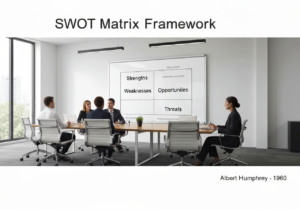
Nine-box matrix extension in a strategic planning workshop for business administration.

(यह छवि केवल उदाहरण के लिए बनाई गई है)

The classic four-box Ansoff Matrix has been extended into a nine-box grid to provide a more granular view of strategic options. This version subdivides the ‘new product’ and ‘new market’ axes into stages, such as ‘modified product’ or ‘expanded market’. This allows for intermediate strategies that sit between the four original quadrants, offering a more nuanced approach to risk and growth.

While the original Ansoff Matrix provides a powerful, high-level overview of growth strategies, its four-quadrant structure can sometimes be too simplistic for the complexities of modern business. The nine-box matrix is an adaptation that addresses this by introducing intermediate steps. Instead of a binary choice between ‘existing’ and ‘new’, the axes are expanded to include a middle option.

For the product axis, the options become ‘Existing Product’, ‘Modified/Extended Product’, and ‘New Product’. For the market axis, they become ‘Existing Market’, ‘Expanded Market’ (e.g., new segments or nearby regions), and ‘New Market’. This creates a 3×3 grid with nine strategic options. For example, a company could pursue a strategy of selling a modified product to an expanded market, which is a less risky step than full-blown diversification but more ambitious than simple market penetration. This extended framework helps managers to visualize a clearer, more gradual path for growth. It acknowledges that innovation and market entry are not all-or-nothing propositions. A company can test the waters with a product modification before committing to a completely new product, or it can expand into a culturally similar market before attempting a more challenging international leap. This nuanced approach allows for a more sophisticated alignment of strategy with the company’s risk appetite and resources.

UNESCO Nomenclature: 5311
– प्रबंधन

Type

सार प्रणाली

व्यवधान

इंक्रीमेंटल

उपयोग

विशिष्ट/विशेषज्ञ

शगुन

  • the original Ansoff matrix (1957)
  • criticism of the simplicity of the four-box model
  • development of more complex strategic planning tools like the ge/mckinsey matrix

आवेदन

  • strategic planning workshops requiring more detailed options
  • companies looking for incremental steps towards diversification
  • risk analysis that differentiates between product modification and true innovation
  • market expansion planning that distinguishes between adjacent geographic areas and entirely new ones
  • product portfolio management with varying degrees of innovation

पेटेंट:

NA

संभावित नवाचार विचार

  • developing interactive software that maps a company’s project portfolio onto the nine-box grid
  • creating a dynamic nine-box matrix that shifts based on real-time market data and competitor moves
  • applying the nine-box framework to personal skill development (e.g., existing skill, modified skill, new skill)
  • using the grid to plan a phased digital transformation strategy for a legacy company
  • a consulting model that uses the nine-box grid to assess the innovation pipeline of a client
  • integrating the nine-box matrix with financial forecasting tools to model the risk/reward of each of the nine options
  • a gamified business simulation based on the nine-box grid for executive training
  • using the framework to map out a content marketing strategy (e.g., repurposed content, new format content, new topic content)
  • applying the grid to non-profit program development to balance core mission with new initiatives
  • a research project analyzing the success rates of companies pursuing strategies in each of the nine boxes
Related to: Ansoff matrix, nine-box grid, strategic planning, growth strategy, product modification, market expansion, business framework, corporate strategy, risk management, strategic options.

ऐतिहासिक संदर्भ

आधुनिक कार्यालय में विपणन पेशेवर उत्पाद जीवन चक्र के चार चरणों का विश्लेषण कर रहे हैं।

उत्पाद जीवन चक्र के चार चरण (ऐतिहासिक संस्करण)

उत्पाद जीवन चक्र (PLC) मॉडल उन चरणों का वर्णन करता है जिनसे एक उत्पाद अपनी लॉन्चिंग से लेकर बाजार से वापसी तक गुजरता है। ये चार प्रमुख चरण हैं: परिचय (कम बिक्री, उच्च लागत), वृद्धि (तेजी से बढ़ती बिक्री और लाभ), परिपक्वता (उच्चतम बिक्री, घटते लाभ मार्जिन), और गिरावट (गिरती बिक्री और लाभ)। यह ढांचा रणनीतिक विपणन और प्रबंधन निर्णयों में मदद करता है। महत्वपूर्ण नोट: अधिक आधुनिक दृष्टिकोणों में, और कम बिक्री या विपणन उन्मुख, उत्पाद जीवन चक्र में इसके विनिर्माण, साथ ही इसके रीसाइक्लिंग चरण शामिल होने चाहिए। एक और भी अधिक पूर्ण दृष्टिकोण, जैसे कि हम innovation.world पर दृढ़ता से वकालत करते हैं, इसमें एक बाजार अध्ययन और एक विचार चरण भी शामिल होगा, और क्षेत्र के आधार पर, पोस्ट मार्केट निगरानी भी।

नौ-बॉक्स मैट्रिक्स एक्सटेंशन

1965
1970
1980
1980
1983
1990
1992
1960
1970
1980
1980
1982
1986
1990
1992

(यदि तिथि अज्ञात है या प्रासंगिक नहीं है, उदाहरण के लिए "द्रव यांत्रिकी", तो इसके उल्लेखनीय उद्भव का एक अनुमानित आंकड़ा प्रदान किया गया है)

नवीनतम परिवर्धन

शीर्ष पोस्ट और लेख

शीर्ष मूल उपकरण

10वां वर्ष सालगिरह

पंजीकृत सदस्यों के लिए पूर्ण आकार की छवियाँ और डाउनलोड 100% निःशुल्क उपलब्ध हैं।