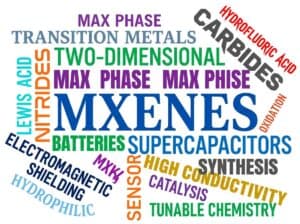
एमएक्सईन संक्रमण धातुओं के द्वि-आयामी कार्बाइड और नाइट्राइड होते हैं, जिन्हें सामान्यतः एमएक्स चरण से ए परत को हटाकर बनाया जाता है। प्रारंभिक विधियों में हाइड्रोफ्लोरिक अम्ल से नक़्क़ाशी का उपयोग किया जाता था, जबकि लुईस अम्ल पिघले हुए लवण से नक़्क़ाशी एक नया, फ्लोराइड-मुक्त विकल्प है। एकल-परत और बहुपरत फ्लेक्स के गुणधर्म भिन्न होते हैं। क्रमबद्ध द्वि-संक्रमण-धातु और द्विवैकेंसी संरचनाएं इस परिवार का विस्तार करती हैं।
High conductivity, hydrophilic surfaces and tunable chemistry make MXenes interesting for अति-कondensators, batteries, electromagnetic shielding, सेंसर और उत्प्रेरण. Oxidation in water and scale-up of etching remain obstacles. Storage in a suitable atmosphere or as inks affects quality. The listings below follow synthesis, characterization and applications.
MXenes परतदार कार्बाइड और नाइट्राइड होते हैं जिनकी सतह को रसायनज्ञ अपनी इच्छानुसार बदल सकते हैं। इनके सबसे करीबी रिश्तेदार वे शीट हैं जो ग्राफीन और छिद्रयुक्त मेजबानों में धातु-कार्बनिक ढाँचेऊर्जा भंडारण के लिए, आगे बढ़ें अति-कondensators और सोडियम-आयन बैटरीजहां एमएक्सईएन इलेक्ट्रोड की फास्ट चार्जिंग के लिए टेस्टिंग की जाती है।
यह एमएक्सिन पर दुनिया भर के प्रकाशनों और पेटेंटों का हमारा नवीनतम चयन है, जो कई वैज्ञानिक ऑनलाइन पत्रिकाओं के बीच, वर्गीकृत और केंद्रित है एमएक्सिन, लुईस एसिड पिघले हुए नमक की नक़्क़ाशी, HF नक़्क़ाशी, मैक्स चरण, डाइवैकेंसी एमएक्सिन, ऑर्डर किए गए डबल-ट्रांज़िशन-मेटल, ML‑MXene, लुईस एसिड पिघला हुआ नमक, डाइवैकेंसी एमएक्सिन, ऑर्डर किए गए डबल ट्रांज़िशन मेटल, सॉलिड-सॉल्यूशन एमएक्सिन, FL‑MXene, मल्टी-लेयर एमएक्सिन, लगभग-मुक्त इलेक्ट्रॉन और टिंडल प्रकीर्णन।
Sensor and method of manufacture thereof
Patent published on the 2026-10-21 in EP under Ref EP4826369 by AALTO UNIV FOUNDATION SR [FI] (Lyu Zhongpeng [fi], Tan Hongwei [fi], Hosseini Skokouh Seyed [fi], JÄÄnvirta Antti [fi], Jiang Pan [fi])
Abstract: [0001] According to an example aspect of the present invention, there is provided a resistive sensor for sensing at least one gaseous substance, the resistive sensor comprising: at least one first electronic device for electrically sensing the at least one gaseous substance with a first sensitivity, said at least one first electronic device comprising a first composition of MXene and optionally lignin, and at least one second electronic device for electrically sensing the at least one gaseous su[...]
Our summary: The invention describes a resistive sensor designed to detect gaseous substances. It includes two electronic devices with different compositions of MXene and optional lignin. Each device offers distinct sensitivity levels for enhanced detection capabilities.
Resistive sensor, MXene, gaseous substance, sensitivity
Patent
Negative electrode active material for lithium ion batteries, method of preparing negative electrode active material, negative electrode, and lithium
Patent published on the 2026-09-23 in EP under Ref EP4811449 by SAMSUNG SDI CO LTD [KR] (She Zimin [cn], Kim Young-min [cn], Xu Xiaodong [cn], Qu Xiaodan [cn], Li Guangxin [cn], Zhou Yu [cn])
Abstract: [0001] A negative electrode active material includes a silicon-carbon composite material. The silicon-carbon composite material comprises a first layer disposed at a center of the silicon-carbon composite material and including a hard carbon-based porous carbon material having silicon coated therein. A second layer coating is formed on the outside of the first layer and including one or more of a two-dimensional nanomaterial including graphene, graphene oxide, MXene, molybdenum disulfide, and gr[...]
Our summary: The negative electrode active material is a silicon-carbon composite with a hard carbon-based porous core. It features a second layer of two-dimensional nanomaterials such as graphene or MXene. This structure enhances the performance of lithium ion batteries.
silicon-carbon composite, negative electrode active material, lithium ion batteries, two-dimensional nanomaterial
Patent
Electromagnetic interference shielding film comprising heterogeneously stacked metal-mxene and method for preparing the same
Patent published on the 2026-08-27 in US under Ref US20260255565 by SEOUL NATIONAL UNIV R& DB FOUNDATION [KR] (Joo Young Chang [kr], Yeon Han Wool [kr], Kang Geo San [kr])
Abstract: The present inventive concept relates to an electromagnetic interference shielding film comprising a heterogeneously stacked metal-MXene (MX), and a method for preparing the same. With a sandwich structure in which an MXene layer is disposed between metal thin film layers, the electromagnetic interference shielding film exhibits excellent electromagnetic wave shielding efficiency even at a reduced thickness compared to conventional films.[...]
Our summary: The invention presents an electromagnetic interference shielding film with a heterogeneously stacked metal-MXene structure. It features a sandwich design with an MXene layer between metal thin films. This configuration provides superior shielding efficiency at a reduced thickness compared to traditional films.
electromagnetic interference, shielding film, metal-MXene, preparation method
Patent
Positive electrode for rechargeable lithium battery and rechargeable lithium battery including same
Patent published on the 2026-08-19 in EP under Ref EP4793998 by SAMSUNG SDI CO LTD [KR] (Park Jinseok [kr], Nam Hyun [kr], Lee Minho [kr], Yeou Jungock [kr], Park Jeongjoo [kr])
Abstract: Disclosed are a positive electrode for a rechargeable lithium battery, and a rechargeable lithium battery including the positive electrode. The positive electrode for a rechargeable lithium battery includes a substrate, and a positive electrode active material layer on the substrate. The positive electrode active material layer includes MXene, a solid electrolyte, and a positive electrode active material. A distribution of the solid electrolyte increases from the lower portion to the upper porti[...]
Our summary: The document describes a positive electrode for a rechargeable lithium battery. It includes a substrate and an active material layer with MXene and a solid electrolyte. The solid electrolyte s distribution increases from the lower to the upper portion of the layer.
positive electrode, rechargeable lithium battery, MXene, solid electrolyte
Patent
Positive electrode for rechargeable lithium battery and rechargeable lithium battery including same
Patent published on the 2026-08-13 in US under Ref US20260237725 by SAMSUNG SDI CO LTD [KR] (Park Jin Seok [kr], Nam Hyun [kr], Lee Minho [kr], Yeou Jung Ock [kr], Park Jeongjoo [kr])
Abstract: Disclosed are a positive electrode for a rechargeable lithium battery, and a rechargeable lithium battery including the positive electrode. The positive electrode for a rechargeable lithium battery includes a substrate, and a positive electrode active material layer on the substrate. The positive electrode active material layer includes MXene, a solid electrolyte, and a positive electrode active material. A distribution of the solid electrolyte increases from the lower portion to the upper porti[...]
Our summary: The content describes a positive electrode designed for rechargeable lithium batteries. It features a substrate with a layered active material that includes MXene and a solid electrolyte. The solid electrolyte s distribution varies from the lower to the upper portion of the active material layer.
positive electrode, lithium battery, MXene, solid electrolyte
Patent
Reconfigurable swcnt ferroelectric field-effect transistor arrays
Patent published on the 2026-07-30 in US under Ref US20260217946 by JACKSON STATE UNIV [US] (Gogotsi Yury [us], Fitzpatrick James Broe [us], Pradham Nihar R [us])
Abstract: [0000] A composite, comprising: a polyvinylidene fluoride (PVDF) matrix, the PVDF of the matrix having a crystalline portion that is primarily β-phase in nature; and a plurality of MXene flakes dispersed within the PVDF matrix, at least some of the MXene flakes optionally being monolayer in nature. A capacitor, comprising: a first electrode; a second electrode; and a dielectric layer disposed between the first electrode and the second electrode, the dielectric layer comprising a polyvinylidene [...]
Our summary: The content discusses a composite material made of a PVDF matrix with β-phase crystals and MXene flakes. It describes a capacitor design featuring a dielectric layer of the same composite. Additionally, it outlines a method for delaminating MXene in propylene carbonate to create a suspension of flakes.
SWCNT, ferroelectric, MXene, PVDF
Patent
Development of MWCNTs/MXene/PVA Hydrogel Electrochemical Sensor for Multiplex Detection of Wound Infection Biomarkers
Published on 2026-02-03 by Qihang Li, Jia Han, Ting Xue, Yuyu Bu @MDPI
Abstract: To address the clinical urgency of simultaneously monitoring multiple biomarkers in chronic wound infections, this study presents the innovative development of an electrochemical sensor based on a MWCNTs/MXene/PVA composite hydrogel. A dual-channel conductive network is constructed via the electrostatic self-assembly of the two-dimensional material MXene and multi-walled carbon nanotubes (MWCNTs). This strategy not only enhances the charge transfer efficiency but also effectively suppresses the [...]
Our summary: This study presents a novel electrochemical sensor using MWCNTs/MXene/PVA hydrogel for detecting multiple wound infection biomarkers. A dual-channel conductive network enhances charge transfer and reduces aggregation. The sensor achieves a low detection limit for pyocyanin in complex biological matrices, enabling high-precision point-of-care testing.
MWCNTs, MXene, PVA, electrochemical sensor
Publication
NIR-II Responsive Platinum-Engineered Vanadium Carbide MXene Endows Poly-L-Lactic Acid Bone Scaffold with Photothermal Antibacterial Property
Published on 2026-01-30 by Lin Sun, Zihao Zhang, Bingxin Sun, Zhiheng Yu, Guoyong Wang @MDPI
Abstract: Vanadium carbide (V2C) MXene shows great potential for addressing challenging implant-associated infections in bone regeneration due to its strong photothermal conversion efficiency. However, its photothermal efficacy is restricted to the near-infrared I (NIR-I) region due to a limited absorption range. To address this, we designed platinum nanoparticle-decorated V2C heterostructures (Pt@V2C) via an in situ growth method, leveraging Pt’s plasmonic and catalytic properties to extend[...]
Our summary: The study presents platinum-decorated vanadium carbide MXene heterostructures that extend photothermal efficacy to the NIR-II region. These structures are integrated into poly-L-lactic acid scaffolds, achieving high photothermal conversion efficiency and significant antibacterial effects. The scaffolds demonstrate biocompatibility and support tissue regeneration, offering a promising solution for implant-associated infections.
MXene, photothermal, antibacterial, bone scaffold
Publication