Innovation.monde

(Image générée à titre d'illustration uniquement)
Innovation.monde
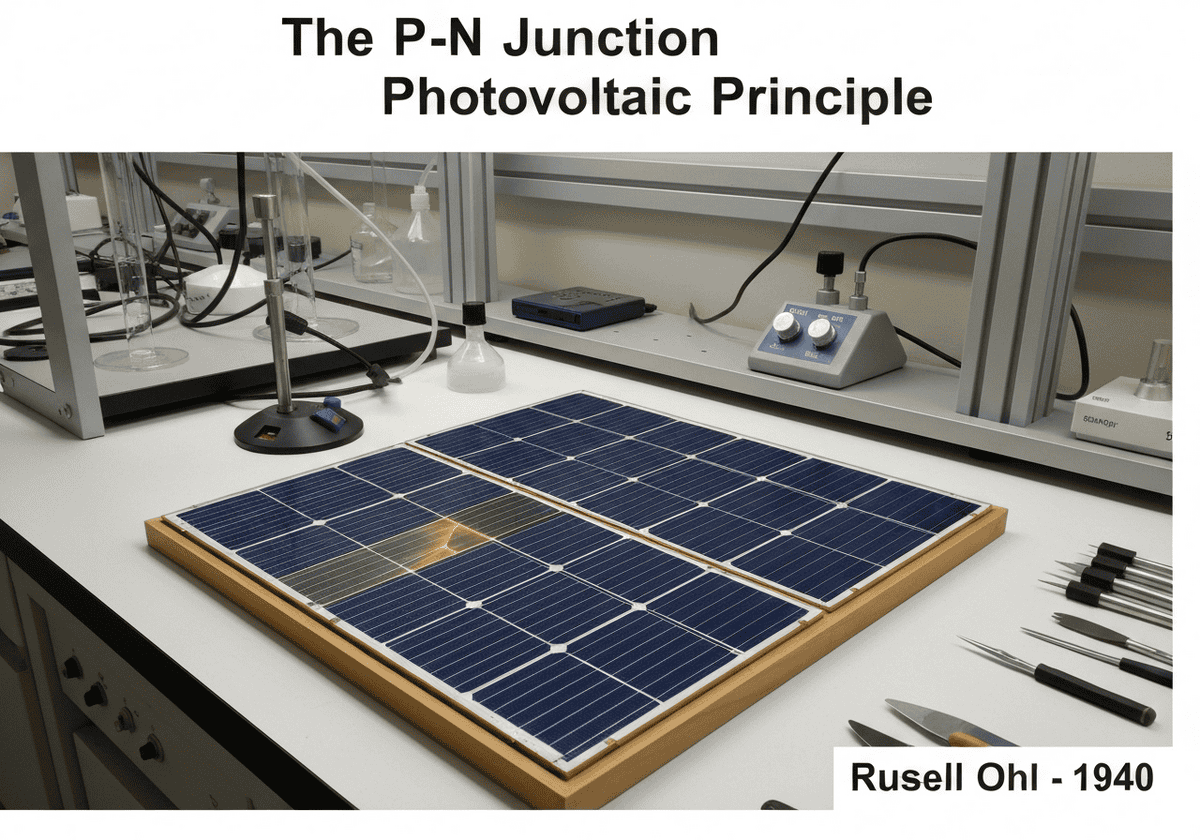
La jonction p-n est l'élément fondamental de la plupart des cellules solaires. Elle est formée en associant un semi-conducteur de type p, riche en trous (porteurs de charge positifs), à un semi-conducteur de type n, riche en électrons (porteurs de charge négatifs). Ce procédé est généralement obtenu en dopant un cristal semi-conducteur unique, comme le silicium, avec différentes impuretés de chaque côté.
At the interface, electrons from the n-side diffuse into the p-side, and holes from the p-side diffuse into the n-side. This diffusion process doesn’t continue indefinitely. As electrons and holes cross the junction, they recombine, leaving behind ionized donor atoms on the n-side and ionized acceptor atoms on the p-side. This creates a region depleted of free charge carriers, known as the depletion region or space charge region. The fixed, ionized atoms in this region establish a strong, static electric field pointing from the n-side to the p-side.
This built-in electric field is crucial for the photovoltaic effect. When a photon with energy greater than the semiconductor’s bandgap energy ([latex]E_g[/latex]) is absorbed, it excites an electron from the valence band to the conduction band, creating an electron-hole pair. If this pair is generated within the depletion region or close enough to diffuse into it, the electric field acts on them. The field sweeps the electron towards the n-side and the hole towards the p-side. This separation of charge prevents immediate recombination and creates an accumulation of positive charge on the p-side and negative charge on the n-side. This charge separation across the device results in a photovoltage, which can drive a current through an external circuit, thus converting light energy into electrical energy.
En raison du trafic généré par les robots de scraping, actuellement supérieur à 40 000 par jour, ce contenu est réservé aux membres de la communauté.
> Connexion < ou > Registre < (100% gratuit) pour y accéder, ainsi qu'à tous les autres contenus et outils à accès restreint.
Le principe photovoltaïque à jonction PN
(si la date est inconnue ou non pertinente, par exemple « mécanique des fluides », une estimation arrondie de son émergence notable est fournie)
Les images en pleine résolution et les téléchargements sont uniquement disponibles, et 100% gratuits, pour les membres inscrits.
> Se connecter <