Product Design, Manufacturing & Innovation Resources
Maison » La liaison carbone-fluor : la source de la stabilité des PFAS

La liaison carbone-fluor : la source de la stabilité des PFAS

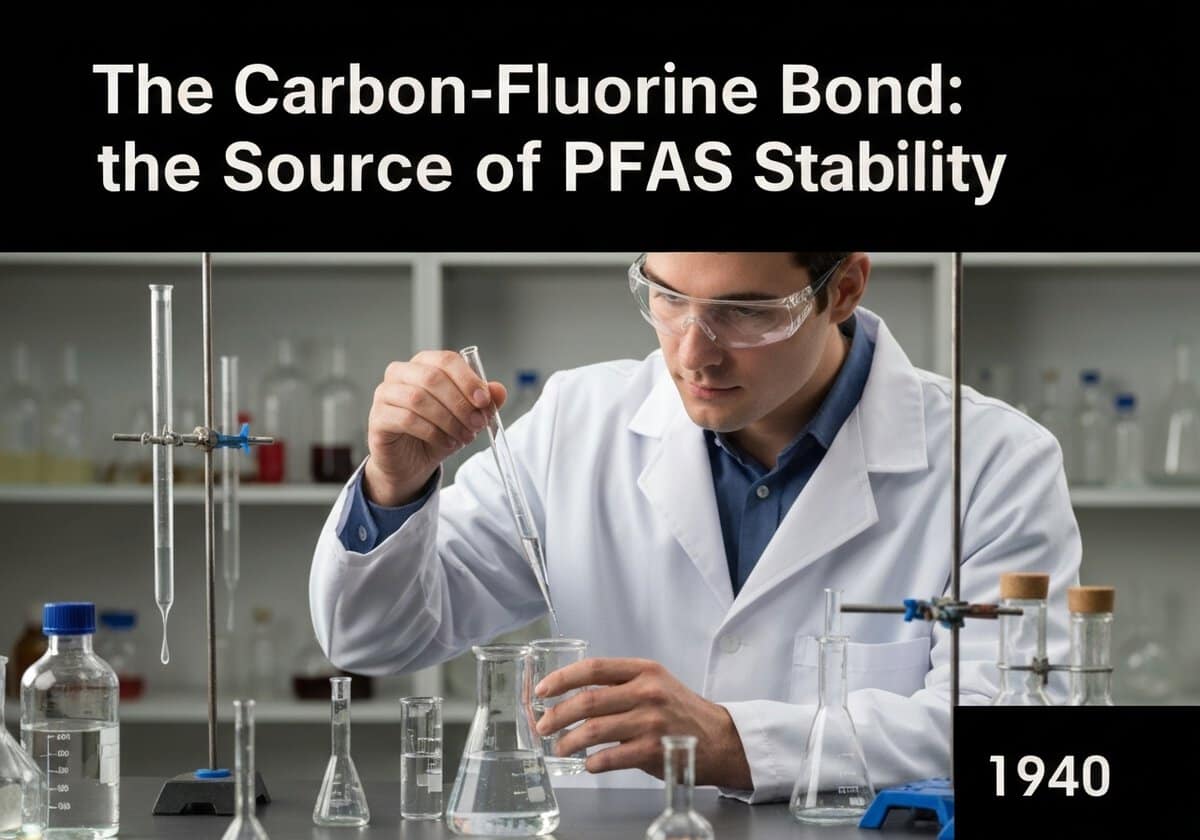
1940
Chimiste menant une expérience sur les PFAS dans un laboratoire de chimie organique.

(Image générée à titre d'illustration uniquement)

Per- and polyfluoroalkyl substances (PFAS) are characterized by a chain of carbon atoms bonded to fluorine atoms. The carbon-fluorine (C-F) bond is one of the strongest single bonds in organic chemistry, with a bond dissociation energy around 485 kJ/mol. This extreme strength makes PFAS highly resistant to chemical, thermal, and biological degradation, leading to their environmental persistence.

The exceptional stability of per- and polyfluoroalkyl substances (PFAS) is fundamentally rooted in the properties of the carbon-fluorine (C-F) bond. Fluorine is the most electronegative element, creating a highly polarized bond with carbon. This results in a short bond length (around 1.35 Å) and a very high bond dissociation energy, making it extremely difficult to break. In perfluoroalkyl substances, where all non-terminal carbons are fully saturated with fluorine atoms, this effect is amplified. The fluorine atoms create a helical sheath around the carbon backbone, sterically protecting it from chemical attack. This ‘fluorine shield’ also repels both water (hydrophobicity) and oils (oleophobicity), a rare combination that makes PFAS effective surfactants. The cumulative inductive effect of multiple fluorine atoms also strengthens adjacent C-C bonds within the chain, further contributing to the molecule’s overall inertness. This chemical robustness is why PFAS are dubbed “forever chemicals”; they do not readily break down under natural environmental conditions, leading to their widespread accumulation.

UNESCO Nomenclature: 2506
- Chimie organique

Taper

Propriétés chimiques

Perturbation

Fondamentaux

Usage

Utilisation généralisée

Précurseurs

  • découverte du fluor par Henri Moisan en 1886
  • development of quantum mechanics to explain chemical bonding (e.g., linus pauling’s work on electronegativity)
  • synthèse précoce de composés organofluorés simples à la fin du XIXe et au début du XXe siècle

Applications

  • revêtements antiadhésifs (téflon)
  • tissus antitaches (scotchgard)
  • mousses extinctrices (AFFF)
  • vêtements hydrofuges
  • emballage alimentaire

Brevets:

NA

Idées d'innovations potentielles

En raison du trafic généré par les robots de scraping, actuellement supérieur à 40 000 par jour, ce contenu est réservé aux membres de la communauté.
> Connexion < ou > Registre < (100% gratuit) pour y accéder, ainsi qu'à tous les autres contenus et outils à accès restreint.

Related to: carbon-fluorine bond, pfas, perfluoroalkyl, stability, bond energy, organic chemistry, forever chemicals, electronegativity, persistence, organofluorine.

Contexte historique

La liaison carbone-fluor : la source de la stabilité des PFAS

1838
1872
1910
1940
1940
1946
1950
1800
1852
1900
1912
1940
1940
1950
1950

(si la date est inconnue ou non pertinente, par exemple « mécanique des fluides », une estimation arrondie de son émergence notable est fournie)

Inventions, innovations et principes techniques connexes

Les images en pleine résolution et les téléchargements sont uniquement disponibles, et 100% gratuits, pour les membres inscrits.