Product Design, Manufacturing & Innovation Resources
Hogar » Green Fluorescent Protein (GFP) as a Wavelength Shifter

Green Fluorescent Protein (GFP) as a Wavelength Shifter

1990
  • Osamu Shimomura
  • Martin Chalfie
  • Roger Y. Tsien
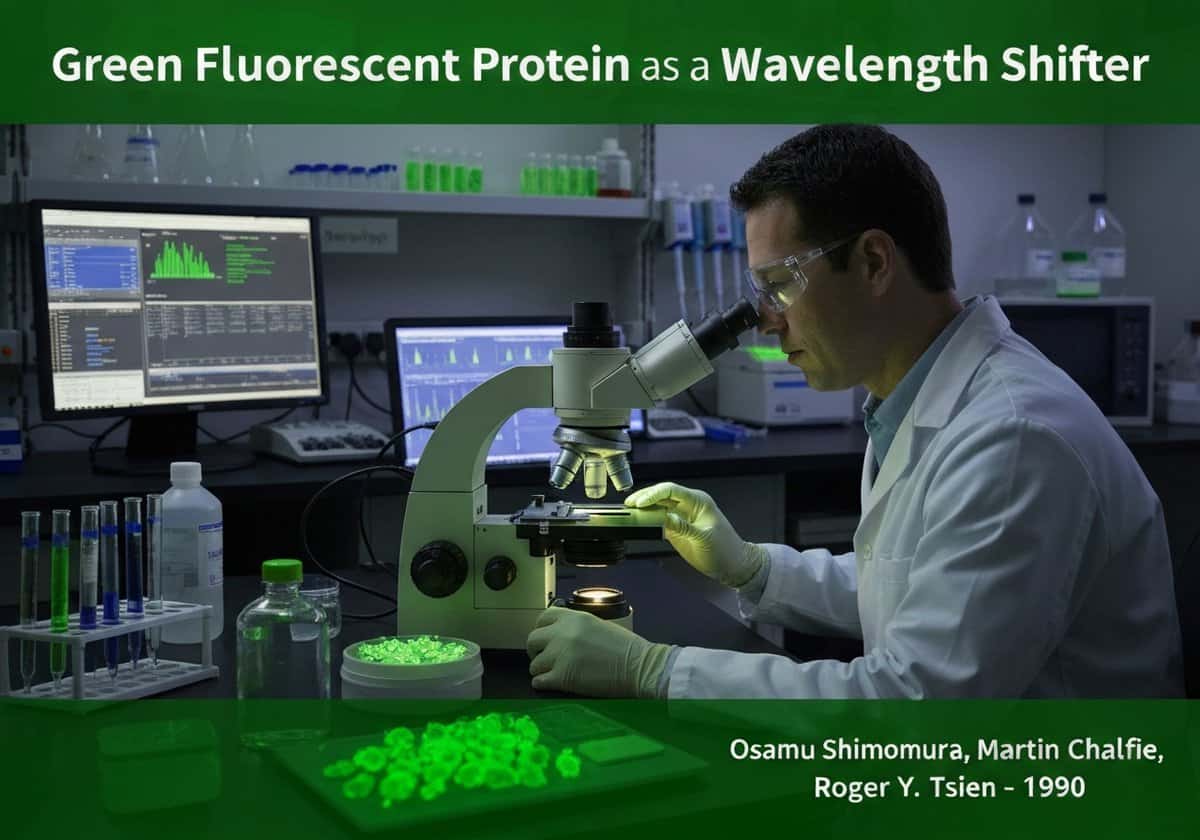
Experimento de laboratorio con la proteína verde fluorescente en la investigación bioquímica.

(Imagen generada únicamente con fines ilustrativos)

In some organisms like the jellyfish Aequorea victoria, the initial bioluminescent reaction produces blue light. This energy is then transferred to a secondary protein, the Green Fluorescent Protein (GFP), via Förster resonance energy transfer (FRET). GFP absorbs the blue light and re-emits it as green light, effectively shifting the color of the luminescence.


The discovery and application of GFP revolutionized cell biology. Osamu Shimomura first isolated GFP from *Aequorea victoria* in the 1960s while studying the bioluminescent photoprotein aequorin. Aequorin emits blue light upon binding with Ca²⁺ ions. Shimomura noticed the jellyfish glowed green, not blue, leading him to discover the energy transfer to GFP. The key feature of GFP is its chromophore, formed autocatalytically from a Ser-Tyr-Gly sequence within the protein’s primary structure. This chromophore is shielded within a beta-barrel structure, protecting it from the environment and enabling its bright fluorescence.

Martin Chalfie demostró más tarde que el gen de GFP podría expresarse en otros organismos (*E. coli* y *C. elegans*), donde funcionaría como un marcador fluorescente sin necesidad de cofactores específicos de la especie.

UNESCO Nomenclature: 2401
- Bioquímica

Tipo

Biological Molecule

Ruptura

incremetal

Uso

Uso generalizado

Precursores

  • discovery of bioluminiscencia in aequorea victoria
  • understanding of protein structure and function
  • desarrollo de recombinant DNA tecnología
  • discovery of Förster resonance energy transfer (FRET)

Aplicaciones

  • reporter gene in biología molecular to visualize gene expression
  • tagging proteins to study their location and movement within cells
  • calcium imaging (with variants like gcamp)
  • cribado de alto rendimiento en el descubrimiento de fármacos
  • creating transgenic glowing pets (e.g., glofish)

Patentes:

  • US5491084A
  • US6146826A

Ideas para posibles innovaciones

  • gfp-based sensors that change color in the presence of specific pollutants
  • whole-body imaging in preclinical research using near-infrared fluorescent proteins
  • fluorescent tattoos that can monitor blood glucose or other metabolites
  • gfp-tagged viruses to track the spread of infection in real-time
  • artistic and architectural materials incorporating fluorescent proteins
  • educational kits for students to learn about gene expression using glowing bacteria
  • cellular-level “barcodes” using different fluorescent proteins to track individual cells in a population
  • optogenetic tools where gfp is fused to light-sensitive proteins to control cellular activity
  • fluorescent silk produced by transgenic silkworms for novel textiles
  • biosensors for detecting explosives or chemical warfare agents
Related to: GFP, green fluorescent protein, aequorea victoria, fluorescence, FRET, reporter gene, protein tagging, chromophore, Osamu Shimomura, Roger Tsien.

Contexto histórico

Green Fluorescent Protein (GFP) as a Wavelength Shifter

1987
1990
1990
1990
1997
2000
1983
1988
1990
1990
1997
2000
2008

(Si la fecha es desconocida o no es relevante, por ejemplo "mecánica de fluidos", se proporciona una estimación redondeada de su aparición notable)

décimo año aniversario

Las imágenes en tamaño completo y las descargas solo están disponibles, de forma totalmente gratuita, para los miembros registrados.

> Acceso <