Product Design, Manufacturing & Innovation Resources
Hogar » El principio fotovoltaico de la unión PN

El principio fotovoltaico de la unión PN

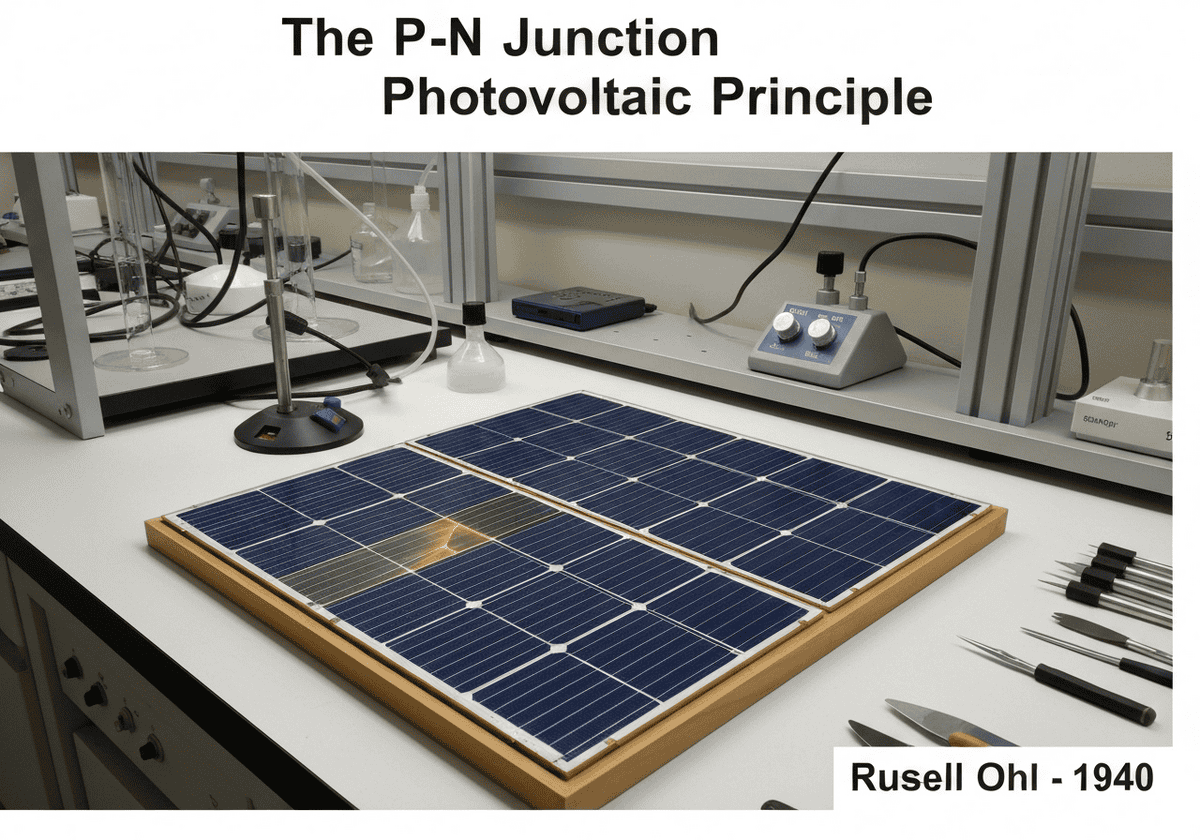
1940
  • Russell Ohl
La unión P-N en una célula solar demuestra la física de los semiconductores.

(Imagen generada únicamente con fines ilustrativos)

Innovación.mundo

La unión pn es el componente fundamental de la mayoría de las células solares. Se forma uniendo un semiconductor de tipo p, con un exceso de huecos (portadores de carga positivos), con un semiconductor de tipo n, con un exceso de electrones (portadores de carga negativos). Esto se consigue típicamente dopando un único cristal semiconductor, como el silicio, con diferentes impurezas en cada lado.

At the interface, electrons from the n-side diffuse into the p-side, and holes from the p-side diffuse into the n-side. This diffusion process doesn’t continue indefinitely. As electrons and holes cross the junction, they recombine, leaving behind ionized donor atoms on the n-side and ionized acceptor atoms on the p-side. This creates a region depleted of free charge carriers, known as the depletion region or space charge region. The fixed, ionized atoms in this region establish a strong, static electric field pointing from the n-side to the p-side.

This built-in electric field is crucial for the photovoltaic effect. When a photon with energy greater than the semiconductor’s bandgap energy ([latex]E_g[/latex]) is absorbed, it excites an electron from the valence band to the conduction band, creating an electron-hole pair. If this pair is generated within the depletion region or close enough to diffuse into it, the electric field acts on them. The field sweeps the electron towards the n-side and the hole towards the p-side. This separation of charge prevents immediate recombination and creates an accumulation of positive charge on the p-side and negative charge on the n-side. This charge separation across the device results in a photovoltage, which can drive a current through an external circuit, thus converting light energy into electrical energy.

UNESCO Nomenclature: 2210
– Física

Tipo

Dispositivo físico

Ruptura

Revolucionario

Uso

Uso generalizado

Precursores

  • Descubrimiento del efecto fotoeléctrico por Heinrich Hertz (1887)
  • einstein’s explanation of the photoelectric effect (1905)
  • desarrollo de la física de semiconductores y técnicas de dopaje
  • Descubrimiento de la rectificación en un contacto metal-semiconductor (1874)

Aplicaciones

  • paneles solares fotovoltaicos
  • fotodiodos
  • diodos emisores de luz (leds)
  • transistores semiconductores

Patentes:

  • US2402662A

Ideas para posibles innovaciones

Debido al bloqueo del tráfico generado por bots, que actualmente supera los 40.000 al día, este contenido está reservado para los miembros de la comunidad.
> Iniciar sesión < o > Registrarse < (100% gratis) para acceder a esto, al igual que a todo el demás contenido y herramientas restringidos.

Related to: p-n junction, photovoltaic effect, semiconductor, depletion region, electron-hole pair, charge separation, built-in field, solar cell.

Contexto histórico

El principio fotovoltaico de la unión PN

1932
1933
1937
1940
1947
1950
1950
1931
1932
1936-01-01
1938
1940
1950
1950
1950

(Si la fecha es desconocida o no es relevante, por ejemplo "mecánica de fluidos", se proporciona una estimación redondeada de su aparición notable)

Invención, innovación y principios técnicos relacionados.

Las imágenes a tamaño completo y las descargas sólo están disponibles, 100% gratis, para los miembros registrados.

> Acceso <