Product Design, Manufacturing & Innovation Resources
بيت » مجموعات الأقمار الصناعية الصغيرة

مجموعات الأقمار الصناعية الصغيرة

2010
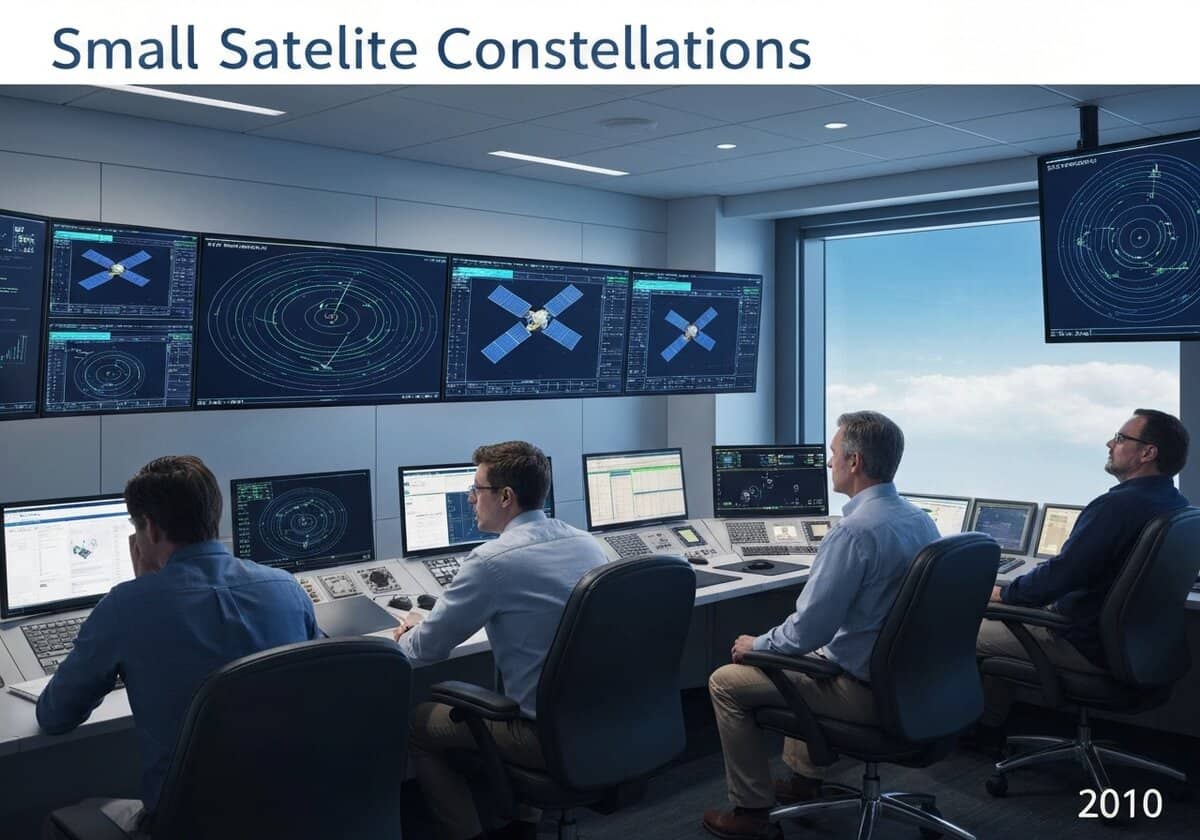
غرفة تحكم تضم مهندسين متخصصين في مجال الطيران والفضاء يراقبون عمليات كوكبة الأقمار الصناعية الصغيرة.

(صورة تم إنشاؤها للتوضيح فقط)

A group of numerous small satellites orbiting in a coordinated formation to achieve a common objective that a single, larger satellite cannot. These constellations provide global or near-global coverage with high revisit rates. Key applications include global broadband internet (Starlink), daily Earth observation (Planet Labs), and maritime/aviation tracking (Spire Global), enabled by the low cost of individual satellites.

The concept of a satellite constellation is not new; the GPS system is a prime example. However, the ‘NewSpace’ revolution has been defined by mega-constellations composed of hundreds or thousands of small satellites in Low Earth Orbit (LEO). This architecture is fundamentally different from traditional geostationary (GEO) satellites. While a single GEO satellite can cover a large region, LEO satellites have a much smaller field of view and move rapidly across the sky. Therefore, a large number must be used in concert to provide continuous coverage.

This approach offers several advantages. The low altitude reduces signal latency, which is critical for applications like broadband internet. The high number of satellites provides high temporal resolution, or ‘revisit rate’, allowing for near-constant monitoring of the Earth’s surface. Furthermore, the system is resilient; the failure of a single satellite has minimal impact on the overall service. The primary challenge is deployment and maintenance. Launching thousands of satellites is a massive logistical and financial undertaking. On-orbit management requires sophisticated automation for station-keeping, collision avoidance, and de-orbiting at the end of life to mitigate the growing problem of space debris. For communications constellations, inter-satellite links (often using lasers) are necessary to route data around the globe without relying on ground stations.

UNESCO Nomenclature: 3302
هندسة الطيران والفضاء

يكتب

بنية النظام

الاضطراب

المالية الفرعية

الاستخدام

الاستخدام الواسع النطاق

السلائف

  • the Iridium satellite constellation concept from the 1990s
  • the global positioning system (GPS) as an early, highly successful military constellation
  • advances in mass manufacturing techniques applied to spacecraft
  • development of low-cost small satellite buses like the CubeSat
  • availability of affordable launch options through rideshare models

التطبيقات

  • global satellite internet services (e.g., starlink, oneweb)
  • تصوير يومي عالي الدقة للأرض بأكملها (على سبيل المثال، كوكبة الحمامة التابعة لشركة بلانيت لابز)
  • تتبع السفن والطائرات في الوقت الفعلي (على سبيل المثال، أقمار ليمور الصناعية التابعة لشركة سباير جلوبال)
  • internet of things (iot) connectivity (e.g., swarm technologies)
  • radio occultation for weather forecasting (e.g., geooptics)

براءات الاختراع:

NA

أفكار ابتكارات محتملة

بسبب عمليات جمع البيانات من خلال برامج الروبوت، والتي تتجاوز حاليًا 40 ألفًا يوميًا، فإن هذا المحتوى مخصص لأعضاء المجتمع فقط.
> تسجيل الدخول < أو > سجل < (مجاني 100٪) للوصول إلى هذا، وكذلك جميع المحتويات والأدوات الأخرى المقيدة.

ذات صلة بـ: كوكبة الأقمار الصناعية، المدار الأرضي المنخفض، الكوكبة الضخمة، ستارلينك، ون ويب، بلانيت لابز، مراقبة الأرض، التغطية العالمية، الحطام الفضائي، الروابط بين الأقمار الصناعية.

السياق التاريخي

مجموعات الأقمار الصناعية الصغيرة

2000
2000
2003
2010
2013-09-24
2000
2000
2002
2010
2013

(إذا كان التاريخ غير معروف أو غير ذي صلة، على سبيل المثال "ميكانيكا الموائع"، يتم توفير تقدير تقريبي لظهوره الملحوظ)

الصور بالحجم الكامل والتنزيلات متاحة فقط 100% مجاناً للأعضاء المسجلين.