Product Design, Manufacturing & Innovation Resources
بيت » كيوب سات

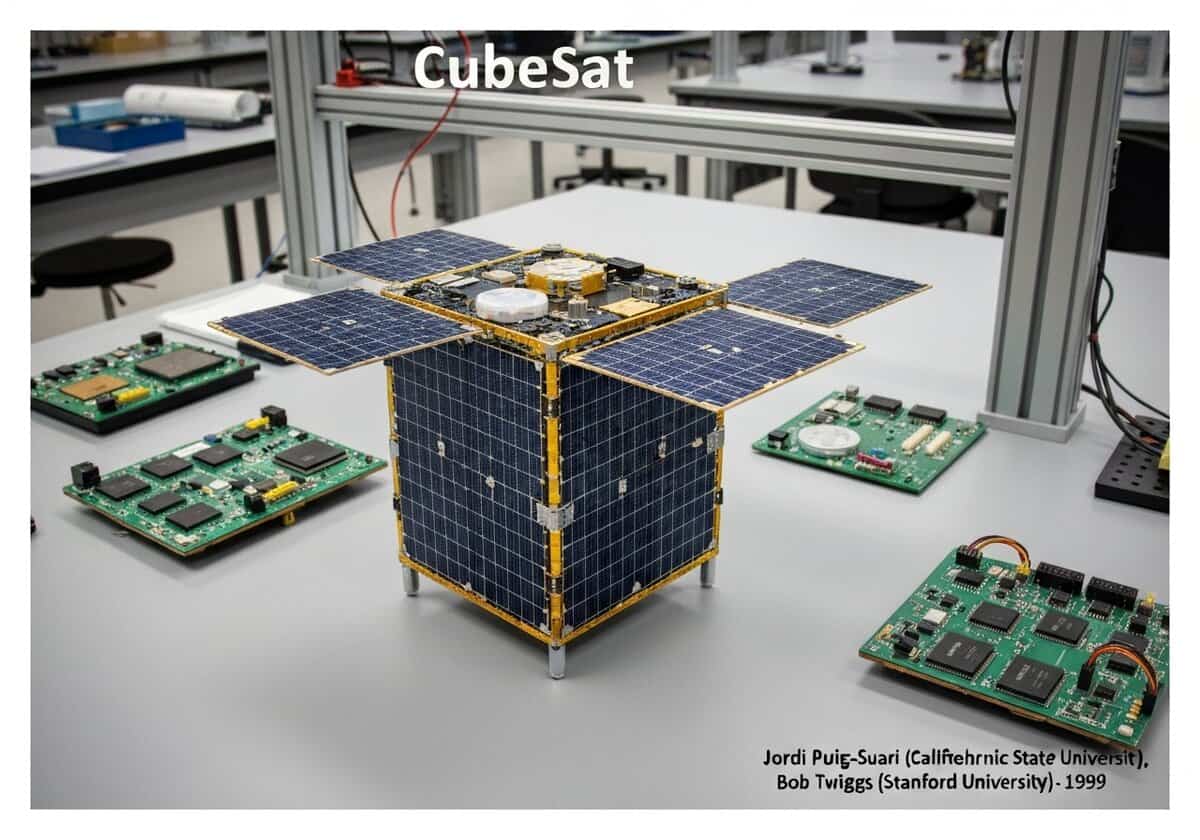
كيوب سات

1999
  • Jordi Puig-Suari (California Polytechnic State University)
  • Bob Twiggs (Stanford University)
تصميم الأقمار الصناعية النانوية المكعبة في مختبر هندسة الطيران والفضاء.

(صورة تم إنشاؤها للتوضيح فقط)

A specification for a class of nanosatellites using a standard unit size of 10x10x10 cm, known as 1U, with a mass up to 2 kg. CubeSats can be scaled to 1.5U, 2U, 3U, 6U, or 12U+ sizes. This standardization dramatically lowered the barrier to entry for space missions by enabling shared launch dispensers and a market for off-the-shelf components.


The CubeSat standard was conceived in 1999 as an educational tool to give graduate students hands-on experience in designing, building, testing, and operating a satellite. The core innovation was not just the small size, but the standardization of the form factor and its interface with the launch vehicle. This was achieved through the Poly-Picosatellite Orbital Deployer (P-POD), a box-like mechanism that holds the CubeSats securely during launch and ejects them into orbit using a spring-loaded system.

By standardizing the external dimensions and providing a simple, reliable deployment method, the CubeSat specification decoupled the satellite’s design from the specifics of the launch vehicle. This allowed launch providers to treat CubeSats as a uniform type of secondary payload, simplifying integration and safety reviews. This predictability fueled the creation of a vibrant ecosystem of commercial-off-the-shelf (COTS) components. Companies began mass-producing CubeSat-compatible subsystems like power systems, on-board computers, radios, and attitude control systems. This COTS market drastically reduced the cost and development time for new missions, transforming the CubeSat from a purely educational tool into a viable platform for commercial ventures, government science, and even interplanetary exploration.

UNESCO Nomenclature: 3302
هندسة الطيران والفضاء

يكتب

معيار التصميم

الاضطراب

ثوري

الاستخدام

الاستخدام الواسع النطاق

السلائف

  • مشاريع الأقمار الصناعية الصغيرة السابقة في مختبر تطوير أنظمة الفضاء بجامعة ستانفورد
  • the need for a standardized, low-cost platform for graduate student education
  • advances in commercial-off-the-shelf (cots) electronics
  • development of standardized launch vehicle adapters for secondary payloads like the asap ring

التطبيقات

  • university-led space science missions
  • commercial earth observation constellations (e.g., planet labs)
  • in-orbit technology demonstration for new hardware and software
  • interplanetary missions (e.g., marcopolo-a and marcopolo-b)
  • amateur radio communication satellites

براءات الاختراع:

NA

أفكار ابتكارات محتملة

بسبب عمليات جمع البيانات من خلال برامج الروبوت، والتي تتجاوز حاليًا 40 ألفًا يوميًا، فإن هذا المحتوى مخصص لأعضاء المجتمع فقط.
> تسجيل الدخول < أو > سجل < (مجاني 100٪) للوصول إلى هذا، وكذلك جميع المحتويات والأدوات الأخرى المقيدة.

ذات صلة بـ: كيوب سات، نانو ساتلايت، معيار الأقمار الصناعية، 1U، p-pod، بوب تويغز، جوردي بويغ سواري، الفضاء الجديد، cots، التصميم الموحد.

السياق التاريخي

كيوب سات

1993-07-22
1996
1998
1999
2000
2000
2000
1993
1994
1997
1998
1999-05-01
2000
2000
2000

(إذا كان التاريخ غير معروف أو غير ذي صلة، على سبيل المثال "ميكانيكا الموائع"، يتم توفير تقدير تقريبي لظهوره الملحوظ)

الصور بالحجم الكامل والتنزيلات متاحة فقط 100% مجاناً للأعضاء المسجلين.