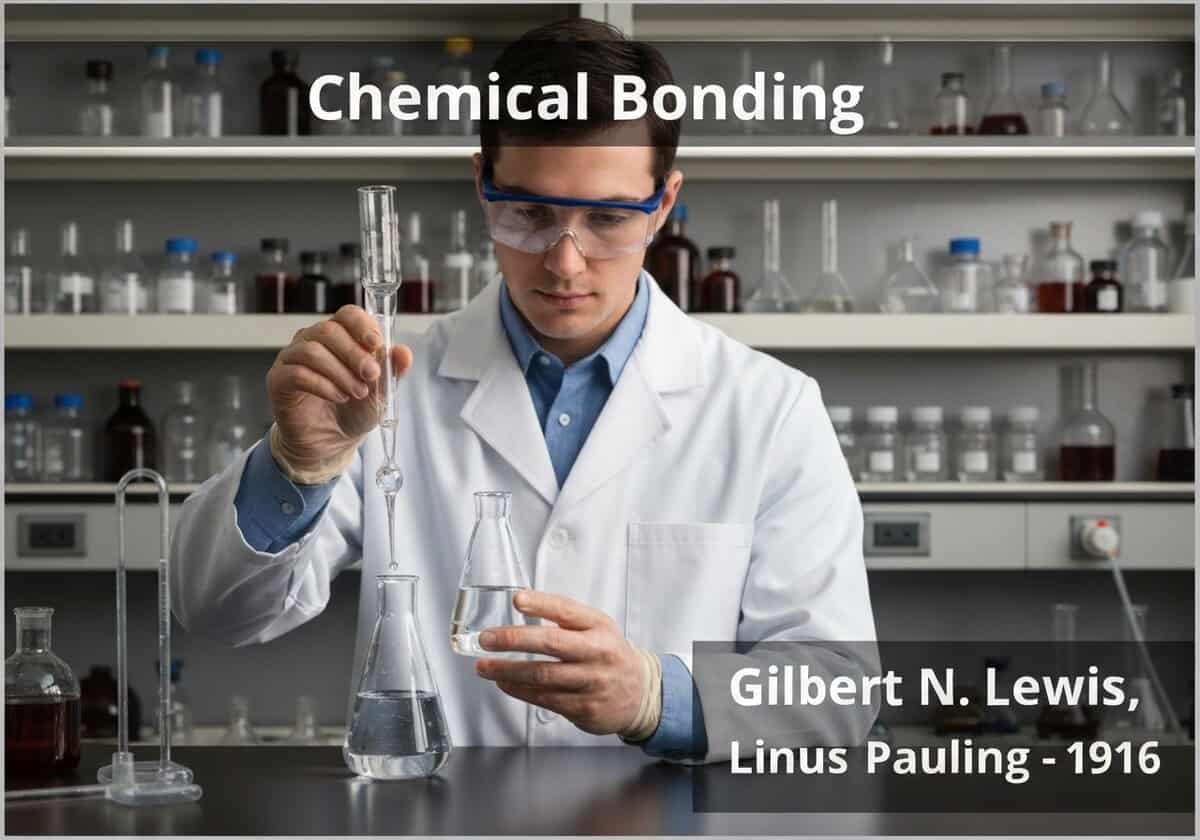
الرابطة الكيميائية
1916
- Gilbert N. Lewis
- Linus Pauling
الرابطة الكيميائية هي تجاذب دائم بين الذرات أو الأيونات أو الجزيئات، يُمكّن من تكوين مركبات كيميائية. تنشأ الروابط من قوة التجاذب الكهروستاتيكي بين الأيونات ذات الشحنات المتقابلة (الروابط الأيونية) أو من خلال مشاركة الإلكترونات (الروابط التساهمية). تُحدد قوة ونوع الروابط بنية المادة وخصائصها.
The concept of chemical bonding explains how individual atoms combine to form the vast array of substances we observe. Gilbert N. Lewis’s 1916 proposal of the covalent bond, where atoms share pairs of electrons to achieve a stable electron configuration (the ‘octet rule’), was a monumental step. This simple yet powerful idea, visualized with Lewis structures, provided the first clear picture of bonding in non-ionic compounds. Ionic bonds, in contrast, are formed by the complete transfer of one or more electrons from an atom with low electronegativity (typically a metal) to one with high electronegativity (a nonmetal), creating charged ions that are held together by electrostatic attraction.
Our understanding was deepened significantly by the application of quantum mechanics. Linus Pauling’s valence bond theory, introduced in the 1930s, described covalent bonds as the result of the overlap of atomic orbitals. This theory introduced the concepts of hybridization (e.g., sp, sp2, sp3) and resonance to explain observed molecular geometries and bond properties. An alternative and often more powerful approach is molecular orbital (MO) theory, which considers electrons to be delocalized across the entire molecule in molecular orbitals formed from the combination of atomic orbitals. MO theory is essential for explaining the properties of conjugated systems, magnetism, and excited states. Beyond these primary types, there are also metallic bonds, characterized by a ‘sea’ of delocalized electrons, and weaker intermolecular forces like hydrogen bonds and van der Waals forces, which are critical for the properties of liquids, solids, and biological macromolecules like DNA.
UNESCO Nomenclature: 2209
- الكيمياء الفيزيائية
الاستخدام
الاستخدام الواسع النطاق
السلائف
- النظرية الذرية (جون دالتون)
- اكتشاف الإلكترون (جيه جيه تومسون)
- تطوير النموذج النووي للذرة (إرنست رذرفورد)
- early concepts of ‘affinity’ and ‘valence’
التطبيقات
- علم وهندسة المواد (على سبيل المثال، إنشاء السبائك والبوليمرات)
- تصميم الأدوية وعلم الأدوية
- تخليق مركبات كيميائية جديدة
- فهم العمليات البيولوجية (على سبيل المثال، طي البروتين)
- تطوير المواد اللاصقة والمركبات
- التنبؤ بالهندسة الجزيئية (نظرية vsepr)
أفكار ابتكارات محتملة
بسبب عمليات جمع البيانات من خلال برامج الروبوت، والتي تتجاوز حاليًا 40 ألفًا يوميًا، فإن هذا المحتوى مخصص لأعضاء المجتمع فقط.
> تسجيل الدخول < أو > سجل < (مجاني 100٪) للوصول إلى هذا، وكذلك جميع المحتويات والأدوات الأخرى المقيدة.
Related to: chemical bond, covalent bond, ionic bond, metallic bond, Gilbert N. Lewis, Linus Pauling, electronegativity, valence electrons, molecular orbital theory, intermolecular forces.