Product Design, Manufacturing & Innovation Resources
Hogar » Enlace químico

Enlace químico

1916
  • Gilbert N. Lewis
  • Linus Pauling
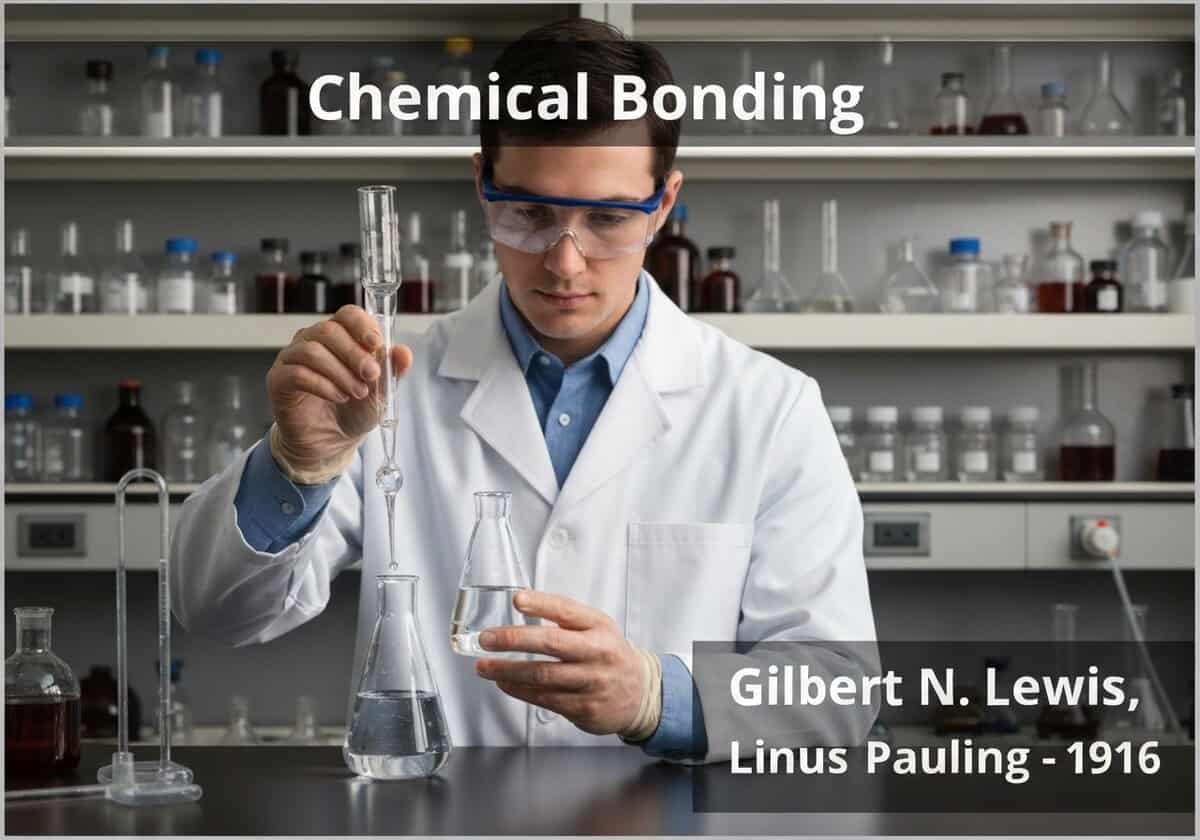
Escena de laboratorio que ilustra el enlace químico en la química física.

(Imagen generada únicamente con fines ilustrativos)

Un enlace químico es una atracción duradera entre átomos, iones o moléculas que permite la formación de compuestos químicos. Los enlaces resultan de la fuerza electrostática de atracción entre iones con carga opuesta (enlaces iónicos) o de la compartición de electrones (enlaces covalentes). La fuerza y ​​el tipo de enlaces determinan la estructura y las propiedades de una sustancia.
The concept of chemical bonding explains how individual atoms combine to form the vast array of substances we observe. Gilbert N. Lewis’s 1916 proposal of the covalent bond, where atoms share pairs of electrons to achieve a stable electron configuration (the ‘octet rule’), was a monumental step. This simple yet powerful idea, visualized with Lewis structures, provided the first clear picture of bonding in non-ionic compounds. Ionic bonds, in contrast, are formed by the complete transfer of one or more electrons from an atom with low electronegativity (typically a metal) to one with high electronegativity (a nonmetal), creating charged ions that are held together by electrostatic attraction.

Our understanding was deepened significantly by the application of quantum mechanics. Linus Pauling’s valence bond theory, introduced in the 1930s, described covalent bonds as the result of the overlap of atomic orbitals. This theory introduced the concepts of hybridization (e.g., sp, sp2, sp3) and resonance to explain observed molecular geometries and bond properties. An alternative and often more powerful approach is molecular orbital (MO) theory, which considers electrons to be delocalized across the entire molecule in molecular orbitals formed from the combination of atomic orbitals. MO theory is essential for explaining the properties of conjugated systems, magnetism, and excited states. Beyond these primary types, there are also metallic bonds, characterized by a ‘sea’ of delocalized electrons, and weaker intermolecular forces like hydrogen bonds and van der Waals forces, which are critical for the properties of liquids, solids, and biological macromolecules like DNA.

UNESCO Nomenclature: 2209
- Química física

Tipo

Sistema abstracto

Ruptura

Fundacional

Uso

Uso generalizado

Precursores

  • teoría atómica (John Dalton)
  • descubrimiento del electrón (JJ Thomson)
  • Desarrollo del modelo nuclear del átomo (Ernest Rutherford)
  • early concepts of ‘affinity’ and ‘valence’

Aplicaciones

  • Ciencia e ingeniería de materiales (por ejemplo, creación de aleaciones y polímeros)
  • diseño de fármacos y farmacología
  • síntesis de nuevos compuestos químicos
  • Comprender los procesos biológicos (por ejemplo, el plegamiento de proteínas)
  • desarrollo de adhesivos y composites
  • Predicción de la geometría molecular (teoría vsepr)

Patentes:

NA

Ideas para posibles innovaciones

Debido al bloqueo del tráfico generado por bots, que actualmente supera los 40.000 al día, este contenido está reservado para los miembros de la comunidad.
> Iniciar sesión < o > Registrarse < (100% gratis) para acceder a esto, al igual que a todo el demás contenido y herramientas restringidos.

Related to: chemical bond, covalent bond, ionic bond, metallic bond, Gilbert N. Lewis, Linus Pauling, electronegativity, valence electrons, molecular orbital theory, intermolecular forces.

Contexto histórico

Enlace químico

1912
1915
1915-11
1916
1918
1919-05-29
1920
1911-04-08
1913
1915
1916
1917
1918
1920
1920

(Si la fecha es desconocida o no es relevante, por ejemplo "mecánica de fluidos", se proporciona una estimación redondeada de su aparición notable)

Invención, innovación y principios técnicos relacionados.

Las imágenes a tamaño completo y las descargas sólo están disponibles, 100% gratis, para los miembros registrados.

> Acceso <