Quantum tunneling is a direct consequence of the Heisenberg uncertainty principle and the probabilistic nature of a particle’s location described by its wavefunction. When a particle’s wavefunction encounters a potential barrier, it does not abruptly drop to zero. Instead, it decays exponentially inside the barrier. If the barrier is thin enough, the wavefunction can have a small but non-zero amplitude on the other side. Since the probability of finding the particle is related to the square of the wavefunction’s amplitude, there is a finite probability of the particle being detected on the far side of the barrier.
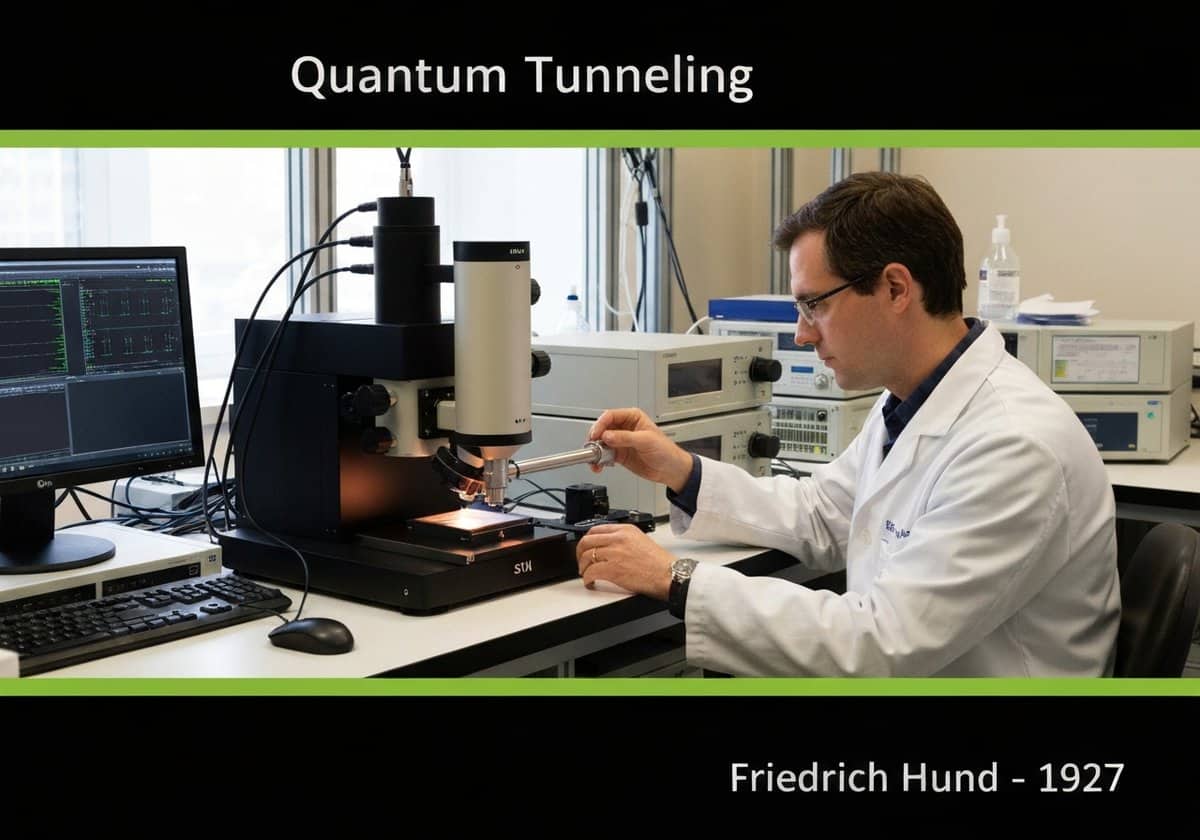
The probability of tunneling decreases exponentially with the thickness of the barrier and the square root of the barrier’s height and the particle’s mass. This is why tunneling is significant for microscopic particles like electrons but negligible for macroscopic objects. For example, in nuclear fusion within the Sun, protons do not have enough thermal energy to overcome their mutual electrostatic repulsion (the Coulomb barrier). Fusion is only possible because the protons can tunnel through this barrier, allowing the strong nuclear force to bind them together. Similarly, the scanning tunneling microscope (STM) works by measuring the tunneling current of electrons between a sharp metallic tip and a sample surface, allowing for imaging with atomic resolution.