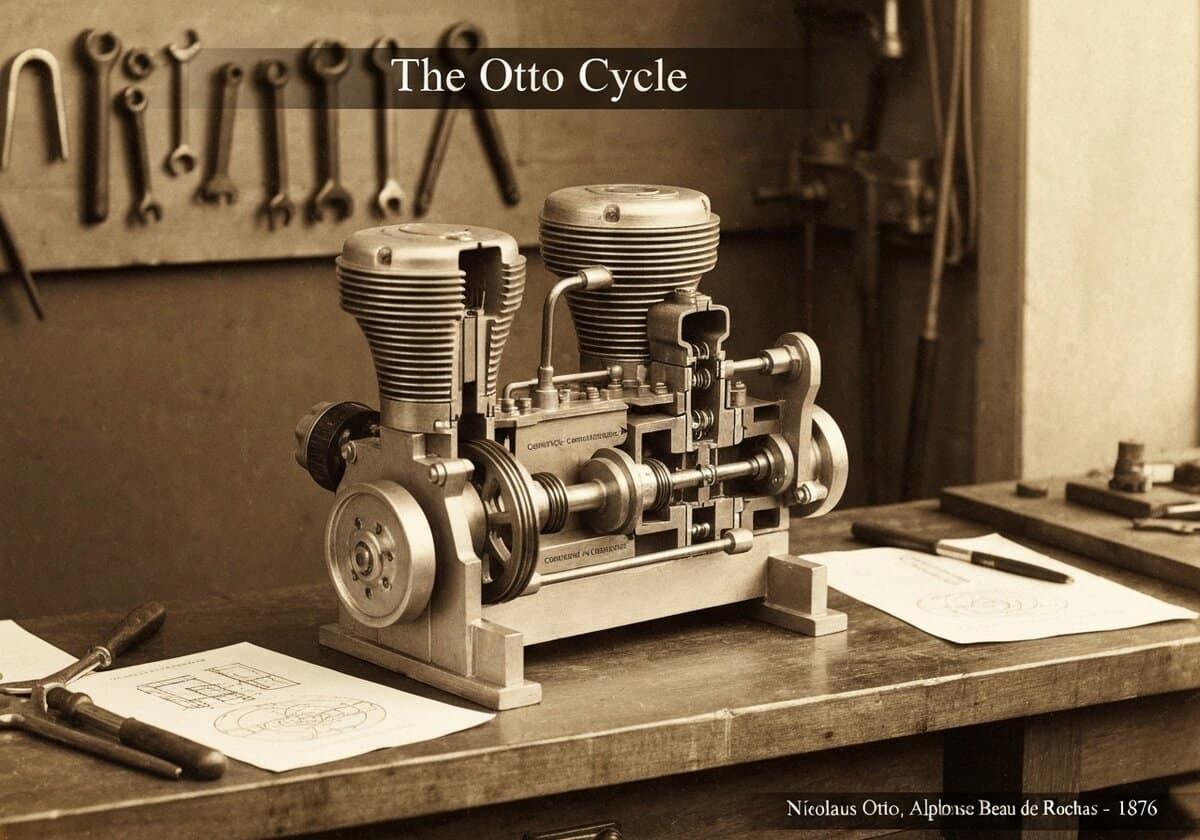
奥托循环
1876
- Nicolaus Otto
- Alphonse Beau de Rochas
The ideal Otto cycle is a 热力学 model for spark-ignition engines. It consists of four internally reversible processes: isentropic compression (1-2), constant volume (isochoric) heat addition (2-3), isentropic expansion (3-4), and constant volume (isochoric) heat rejection (4-1). This cycle forms the theoretical basis for analyzing the performance of gasoline engines, assuming an ideal gas as the working fluid.
奥托循环在压力-体积(PV)图上可视化,形成一个闭合回路。分析从状态 1 开始,即压缩冲程的开始,此时活塞位于下止点(BDC)。
过程 1-2:等熵压缩。 活塞从下止点 (BDC) 运动到上止点 (TDC),压缩空气-燃油混合物。在这个理想的绝热过程中,系统没有热量交换,因此熵保持不变。外界对气体做功,使其内能增加,这表现为压力和温度的升高。
工艺 2-3:恒容加热。 At TDC, the spark plug ignites the mixture. The combustion is assumed to be instantaneous, occurring while the volume does not change (an isochoric process). This adds heat ([latex]Q_{in}[/latex]) to the working fluid, causing a sharp increase in temperature and pressure to state 3, the point of maximum cycle pressure and temperature.
过程 3–4:等熵膨胀(动力冲程)。 燃烧产生的高压气体膨胀,推动活塞从上止点 (TDC) 回到下止点 (BDC)。这种膨胀过程也被理想化为绝热且可逆(等熵)。膨胀的气体对活塞做功,这就是循环的有效输出功。随着气体膨胀,其压力和温度会降低。
工艺 4-1:定容散热。 At BDC, the exhaust valve is assumed to open, and the pressure instantly drops back to the initial pressure of state 1. This is modeled as an isochoric process where heat ([latex]Q_{out}[/latex]) is rejected from the working fluid to the surroundings, completing the cycle and returning the fluid to its initial state.
UNESCO Nomenclature: 2212
- 热力学
前体
- 卡诺循环理论
- 热力学定律
- 活塞和气缸机构的发明
- 火花点火系统的发展
- Alphonse Beau De Rochas’s prior theoretical description (1862)
应用程序
- 汽油内燃机
- 转子发动机(汪克尔发动机)
- 火花点火发动机的性能分析
- 汽车工程教育
- 改进循环(如米勒循环和阿特金森循环)的基础
潜在创新理念
由于机器人流量被拦截(目前每天超过 4 万),此内容仅限社区成员查看。
> 登录 > 或者 > 注册 < (100% 免费)即可访问此内容,以及所有其他受限内容和工具。
Related to: Otto cycle, thermodynamics, isentropic, isochoric, internal combustion engine, four-stroke, p-v diagram, spark-ignition, ideal gas, heat engine.