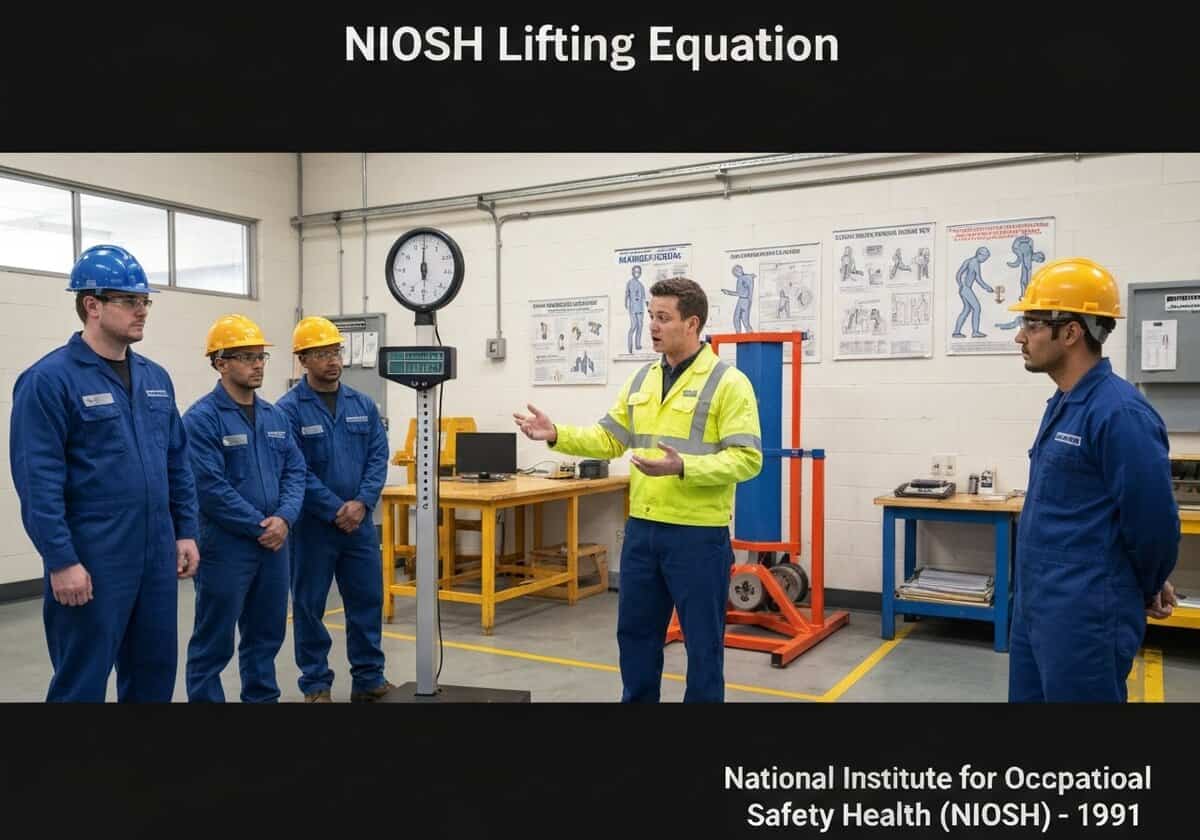
The revised NIOSH lifting equation from 1991 provides a more comprehensive risk assessment than its 1981 predecessor. The core of the method is the calculation of the Recommended Weight Limit (RWL) using the formula: [latex]RWL = LC \times HM \times VM \times DM \times AM \times FM \times CM[/latex]. In this formula, LC is the Load Constant (51 lbs or 23 kg), which is the maximum recommended weight under ideal conditions. The other terms are multipliers, each with a value between 0 and 1, which reduce the allowable weight based on deviations from these ideal conditions. These multipliers are: HM (Horizontal Multiplier), VM (Vertical Multiplier), DM (Distance Multiplier), AM (Asymmetric Multiplier), FM (Frequency Multiplier), and CM (Coupling Multiplier). For example, the further an object is held from the body (increasing the horizontal distance), the smaller the HM value becomes, thus lowering the RWL. The equation also allows for the calculation of a Lifting Index (LI), where [latex]LI = \frac{Load Weight}{RWL}[/latex]. An LI greater than 1.0 indicates that the task is high-risk for some fraction of the workforce, and redesign should be prioritized. An LI of 3.0 or more is considered highly hazardous. The equation is a cornerstone of physical ergonomics, providing a quantitative, evidence-based method for evaluating and mitigating one of the most common causes of workplace injury.