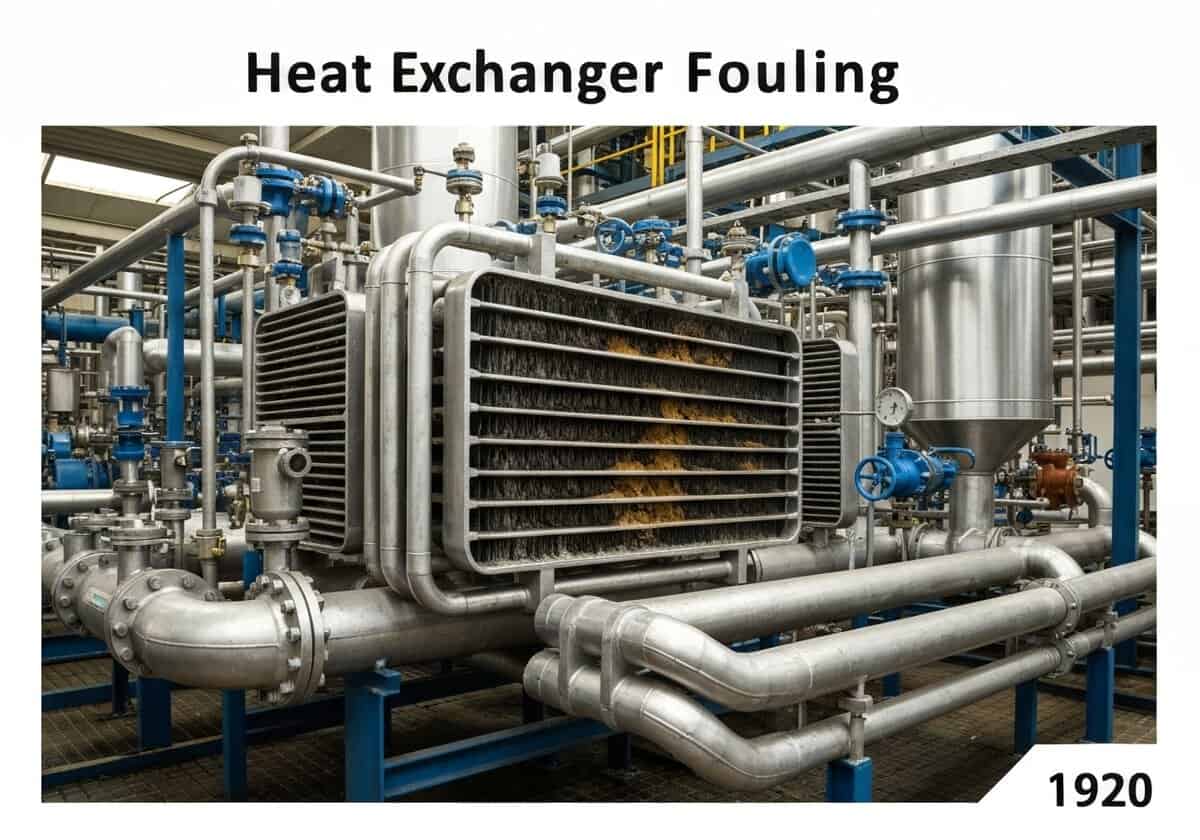
Fouling is a critical, time-dependent problem in nearly all heat exchanger applications. It increases thermal resistance, impedes fluid flow (increasing pressure drop and pumping costs), and can initiate corrosion. There are several types of fouling. Precipitation fouling occurs when dissolved solids in a fluid precipitate onto surfaces, common in cooling water systems (scaling). Particulate fouling is the accumulation of suspended particles like dust or rust. Corrosion fouling results from the heat transfer surface itself reacting to form an insulating layer of corrosion products. Chemical reaction fouling involves reactions within the process fluid that form deposits, such as in polymerization processes. Finally, biofouling is the growth of microorganisms, algae, or slime on surfaces, prevalent in raw water systems. To account for this inevitable degradation, engineers include a ‘fouling factor’ or ‘fouling resistance’ ([latex]R_f[/latex]) during the design phase. This essentially means the heat exchanger is oversized to ensure it still meets the required heat duty after a certain period of operation with the expected level of fouling. The overall heat transfer coefficient for a clean exchanger ([latex]U_{clean}[/latex]) is related to the dirty or service coefficient ([latex]U_{dirty}[/latex]) by [latex]\frac{1}{U_{dirty}} = \frac{1}{U_{clean}} + R_f[/latex]. Managing and mitigating fouling through chemical treatment, filtration, and periodic cleaning is a major aspect of industrial maintenance.