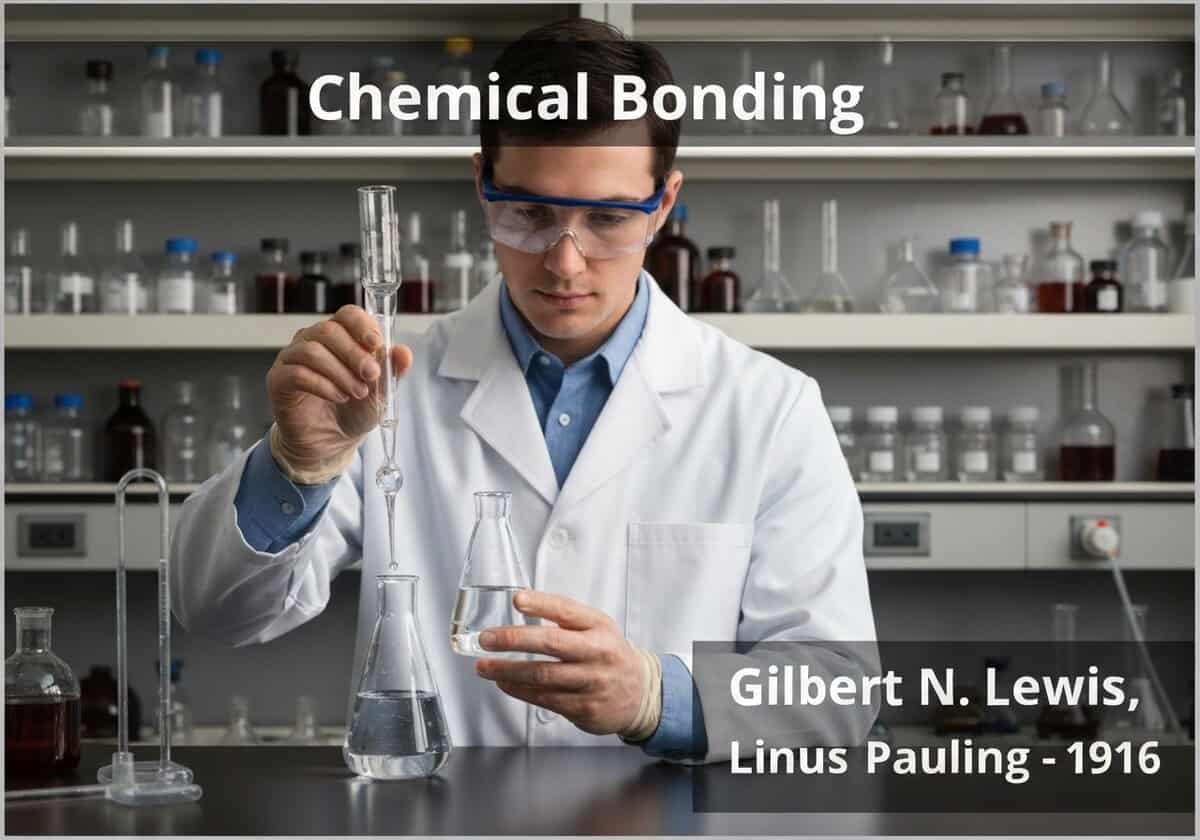
化学键合
1916
- Gilbert N. Lewis
- Linus Pauling
化学键是原子、离子或分子之间持久的吸引力,能够形成化合物。键是由带相反电荷的离子之间的静电吸引力(离子键)或通过共享电子(共价键)产生的。键的强度和类型决定了物质的结构和性质。
The concept of chemical bonding explains how individual atoms combine to form the vast array of substances we observe. Gilbert N. Lewis’s 1916 proposal of the covalent bond, where atoms share pairs of electrons to achieve a stable electron configuration (the ‘octet rule’), was a monumental step. This simple yet powerful idea, visualized with Lewis structures, provided the first clear picture of bonding in non-ionic compounds. Ionic bonds, in contrast, are formed by the complete transfer of one or more electrons from an atom with low electronegativity (typically a metal) to one with high electronegativity (a nonmetal), creating charged ions that are held together by electrostatic attraction.
Our understanding was deepened significantly by the application of quantum mechanics. Linus Pauling’s valence bond theory, introduced in the 1930s, described covalent bonds as the result of the overlap of atomic orbitals. This theory introduced the concepts of hybridization (e.g., sp, sp2, sp3) and resonance to explain observed molecular geometries and bond properties. An alternative and often more powerful approach is molecular orbital (MO) theory, which considers electrons to be delocalized across the entire molecule in molecular orbitals formed from the combination of atomic orbitals. MO theory is essential for explaining the properties of conjugated systems, magnetism, and excited states. Beyond these primary types, there are also metallic bonds, characterized by a ‘sea’ of delocalized electrons, and weaker intermolecular forces like hydrogen bonds and van der Waals forces, which are critical for the properties of liquids, solids, and biological macromolecules like DNA.
UNESCO Nomenclature: 2209
- 物理化学
前体
- 原子理论(约翰·道尔顿)
- 电子的发现(JJ Thomson)
- 原子核模型的发展(欧内斯特·卢瑟福)
- early concepts of ‘affinity’ and ‘valence’
应用程序
- 材料科学与工程(例如,制造合金、聚合物)
- 药物设计和药理学
- 新化合物的合成
- 了解生物过程(例如蛋白质折叠)
- 粘合剂和复合材料的开发
- 预测分子几何结构(vsepr理论)
潜在创新理念
由于机器人流量被拦截(目前每天超过 4 万),此内容仅限社区成员查看。
> 登录 > 或者 > 注册 < (100% 免费)即可访问此内容,以及所有其他受限内容和工具。
Related to: chemical bond, covalent bond, ionic bond, metallic bond, Gilbert N. Lewis, Linus Pauling, electronegativity, valence electrons, molecular orbital theory, intermolecular forces.