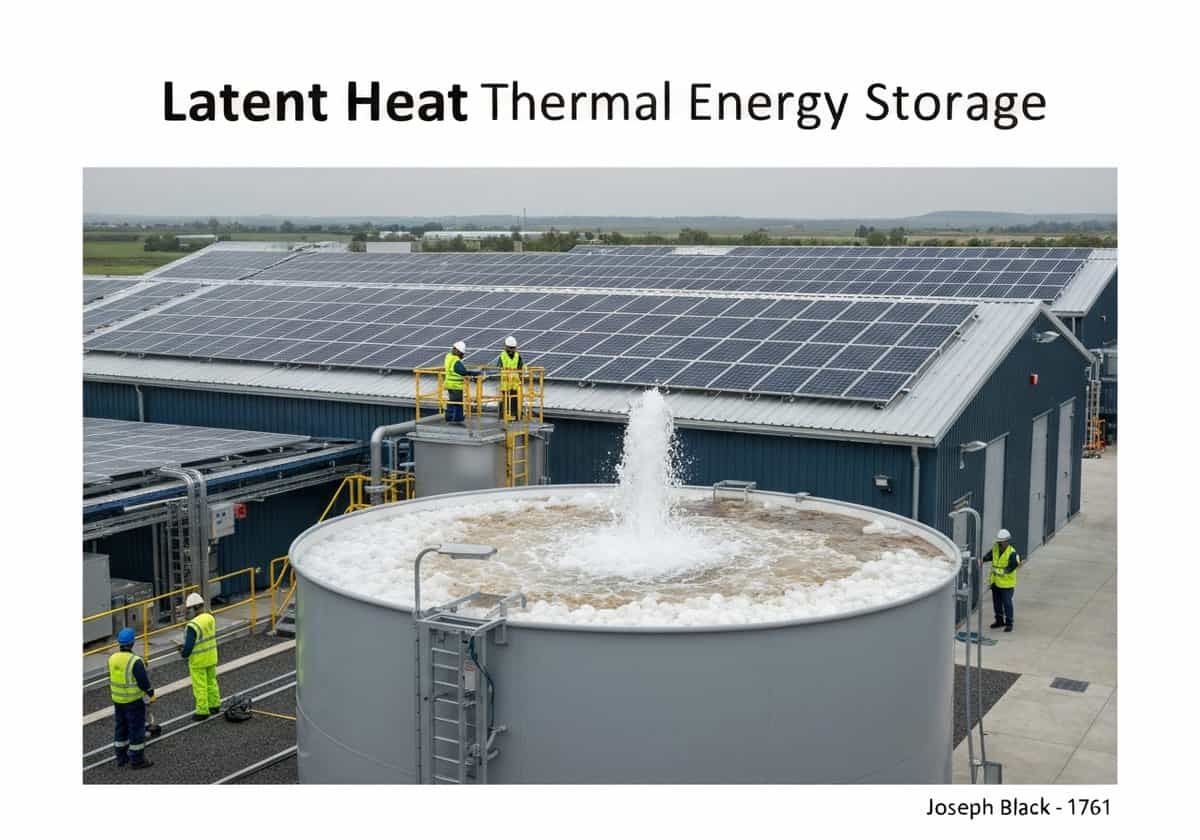
LHTES leverages the principle that a substance absorbs or releases a large amount of energy, known as latent heat (e.g., heat of fusion or vaporization), when it changes its physical state. This process occurs at a constant temperature. The total heat stored ([latex]Q[/latex]) in a PCM includes both sensible heat and latent heat: [latex]Q = int_{T_i}^{T_m} m C_p dT + m Delta H_m + int_{T_m}^{T_f} m C_p dT[/latex], where [latex]m[/latex] is the mass, [latex]C_p[/latex] is the specific heat capacity, [latex]Delta H_m[/latex] is the latent heat of fusion, and [latex]T_m[/latex] is the melting temperature. The key advantage is the high energy density within a small temperature range around the phase transition point. Materials used as PCMs include paraffin waxes, salt hydrates, and fatty acids. The choice of PCM depends on the target operating temperature. For example, molten salts are used in concentrated solar power (CSP) plants for high-temperature storage, while paraffin-based PCMs are used in building materials for passive heating and cooling. Challenges in LHTES include the low thermal conductivity of many PCMs, which can limit charging and discharging rates, and issues with volume change and long-term stability.
Related to: latent heat, thermal energy storage, phase change material, PCM, heat of fusion, thermodynamics, solar thermal, molten salt, energy density, constant temperature.