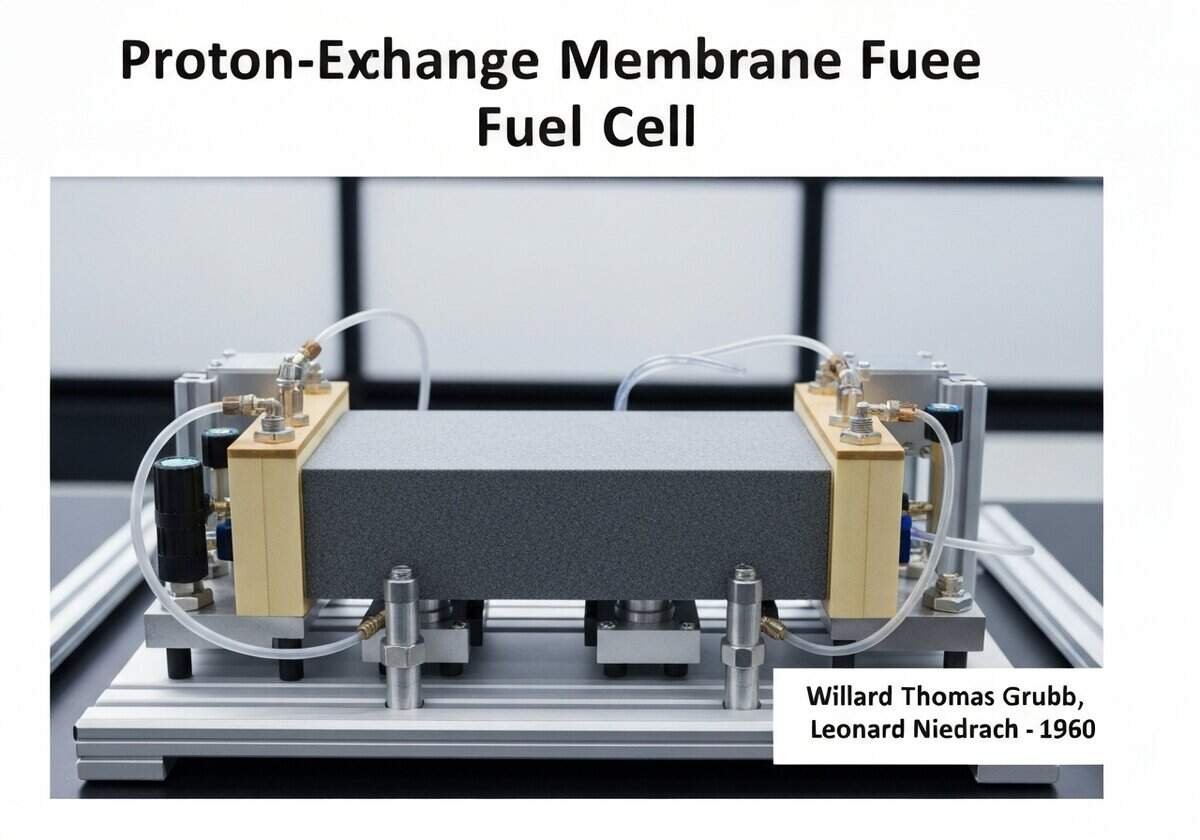
The heart of the PEMFC is the membrane electrode assembly (MEA), which consists of the proton-exchange membrane sandwiched between two catalyst-coated electrodes. At the anode, hydrogen gas is split into protons and electrons: [latex]H_2 \rightarrow 2H^+ + 2e^-[/latex]. The solid polymer membrane, which is an electrical insulator, allows only the protons to pass through to the cathode. The electrons are forced to travel through an external circuit, generating the electrical current. At the cathode, oxygen from the air, the protons from the membrane, and the electrons from the external circuit combine to form water: [latex]O_2 + 4H^+ + 4e^- \rightarrow 2H_2O[/latex].
A critical aspect of PEMFC operation is water management. The membrane must remain hydrated to maintain its proton conductivity, but excess water at the cathode (product water) can block the flow of oxygen to the catalyst sites, a phenomenon known as ‘flooding’. The low operating temperature makes PEMFCs susceptible to catalyst poisoning, particularly from carbon monoxide (CO) present in reformed hydrogen, which binds strongly to the platinum catalyst sites. This necessitates the use of very pure hydrogen fuel, increasing operational costs.