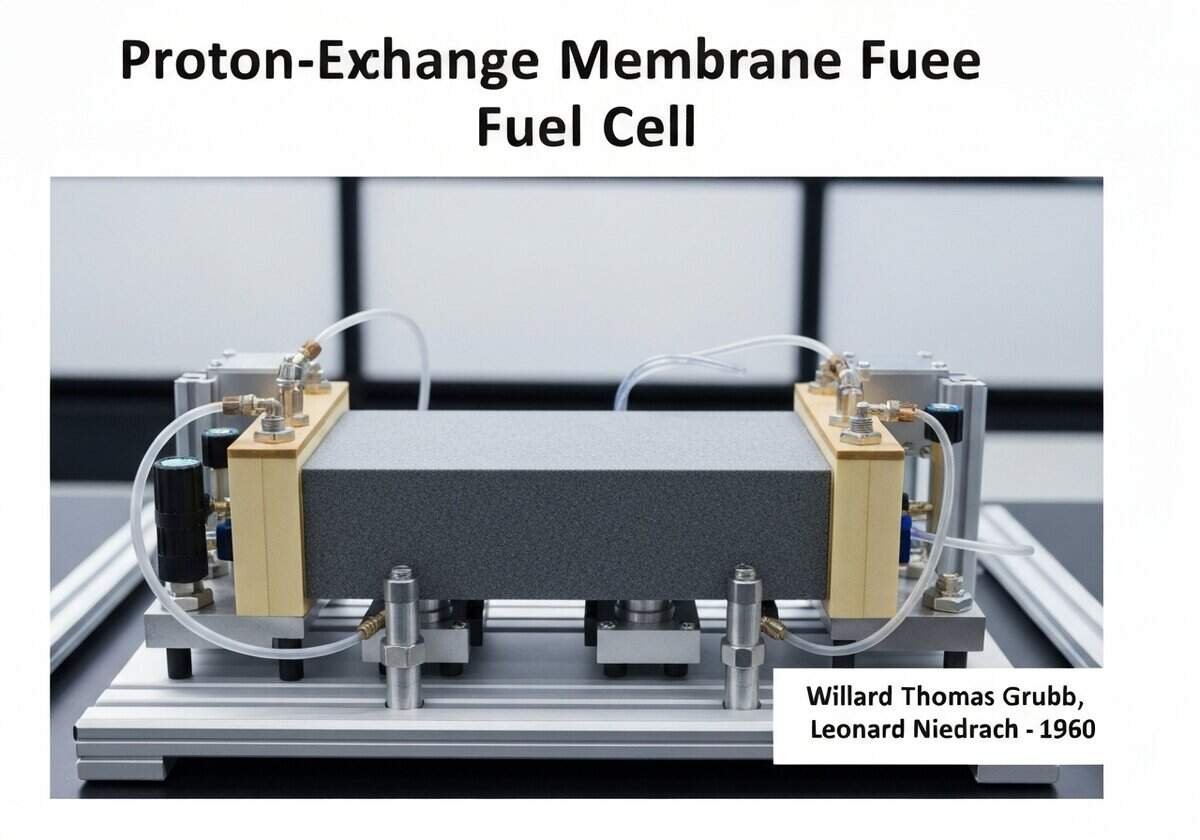
양성자 교환막 연료 전지 PEMFC(양성자 교환막 연료전지)는 나피온(Nafion)과 같은 고체 고분자 막을 전해질로 사용합니다. 이 막은 양극에서 음극으로 양성자(H⁺)를 선택적으로 전도합니다. PEMFC는 저온(일반적으로 50~100°C)에서 작동하므로 빠른 시동과 소형 설계가 가능합니다. 백금 기반 촉매의 손상을 방지하기 위해 고순도 수소를 연료로 사용해야 합니다.
(설명을 위한 생성된 이미지입니다)
양성자 교환막 연료 전지 PEMFC(양성자 교환막 연료전지)는 나피온(Nafion)과 같은 고체 고분자 막을 전해질로 사용합니다. 이 막은 양극에서 음극으로 양성자(H⁺)를 선택적으로 전도합니다. PEMFC는 저온(일반적으로 50~100°C)에서 작동하므로 빠른 시동과 소형 설계가 가능합니다. 백금 기반 촉매의 손상을 방지하기 위해 고순도 수소를 연료로 사용해야 합니다.
The heart of the PEMFC is the membrane electrode assembly (MEA), which consists of the proton-exchange membrane sandwiched between two catalyst-coated electrodes. At the anode, hydrogen gas is split into protons and electrons: [latex]H_2 \rightarrow 2H^+ + 2e^-[/latex]. The solid polymer membrane, which is an electrical insulator, allows only the protons to pass through to the cathode. The electrons are forced to travel through an external circuit, generating the electrical current. At the cathode, oxygen from the air, the protons from the membrane, and the electrons from the external circuit combine to form water: [latex]O_2 + 4H^+ + 4e^- \rightarrow 2H_2O[/latex].
A critical aspect of PEMFC operation is water management. The membrane must remain hydrated to maintain its proton conductivity, but excess water at the cathode (product water) can block the flow of oxygen to the catalyst sites, a phenomenon known as ‘flooding’. The low operating temperature makes PEMFCs susceptible to catalyst poisoning, particularly from carbon monoxide (CO) present in reformed hydrogen, which binds strongly to the platinum catalyst sites. This necessitates the use of very pure hydrogen fuel, increasing operational costs.
현재 하루 4만 건이 넘는 봇 트래픽을 차단하기 위해 이 콘텐츠는 커뮤니티 회원만 이용할 수 있습니다.
> 로그인 < 또는 >등록 < 이 콘텐츠를 비롯한 모든 제한된 콘텐츠와 도구는 (100% 무료로) 이용할 수 있습니다.
양성자 교환막 연료 전지(PEMFC)
(날짜를 알 수 없거나 관련이 없는 경우, 예를 들어 "유체역학"의 경우, 주목할 만한 등장 시기를 대략적으로 추정하여 제공합니다.)

고화질 이미지 및 다운로드는 등록된 회원에게만 100% 무료로 제공됩니다.
> 로그인 <