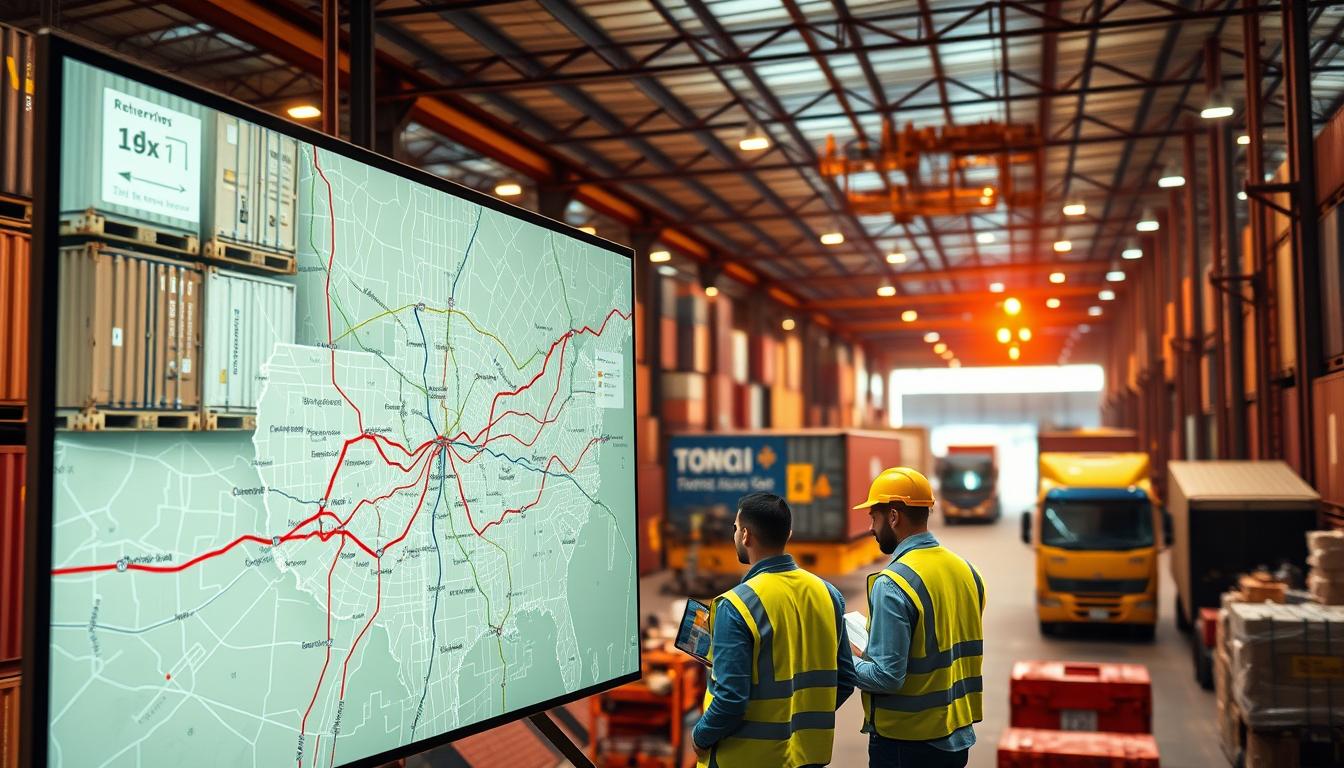
Imagine um movimentado centro de distribuição onde máquinas e trabalhadores se deslocam de forma otimizada entre os locais de trabalho e armazenamento. As rotas precisam ser bem planejadas para cumprir prazos rigorosos e manter custos e outros fatores baixos. Esse desafio está no cerne do chamado Problema do Caixeiro Viajante (PCV). Ele não se restringe apenas à logística. Este artigo explora como o Problema do Caixeiro Viajante pode ser aplicado na vida real e na indústria. Analisa como o planejamento de rotas pode ser aprimorado em todos os setores.
Embora esse problema seja um clássico na matemática pura e nos estudos algorítmicos, sendo também estudado na logística com uma abordagem mais prática, ele é quase desconhecido em outras indústrias e domínios de manufatura.
Esta postagem foca-se especialmente num algoritmo da nossa postagem “Os 10 principais algoritmos e metodologias que deve conhecer em engenharia”.
Principais conclusões
- O problema do caixeiro viajante (PCV) consiste em encontrar a rota mais otimizada entre vários pontos.
- Esse problema começou a despertar interesse nas décadas de 1930 e 1940.
- Isso ajuda as organizações a aumentar a eficiência e reduzir custos em suas operações, otimizar recursos e melhorar a prestação de serviços.
- O problema é amplamente aplicável a diferentes setores e indústrias, não apenas à logística e aos transportes.
- Assim que houver mais de 12 a 20 pontos, o problema se torna muito complexo para se calcular uma solução perfeita.
- Diversos algoritmos foram inventados para encontrar boas aproximações, portanto, não existe um algoritmo perfeito.
O que é o Problema do Caixeiro Viajante?
O problema do caixeiro-viajante: O objetivo é encontrar a maneira mais eficiente para um vendedor visitar várias cidades e retornar ao ponto de partida. Ele deve visitar cada cidade apenas uma vez, buscando reduzir a distância total ao mínimo possível.
Para entender a definição do Problema do Caixeiro Viajante (PCV), saiba que o número de rotas aumenta à medida que mais cidades são adicionadas. Por exemplo, quatro cidades significam que existem 24 caminhos possíveis. Adicionar mais cidades aumenta o desafio, resultando em um número excessivo de rotas potenciais a serem consideradas.
Muitas empresas, como as dos setores de logística, telecomunicações e manufatura, enfrentam esse problema frequentemente. Uma boa solução para o problema do caixeiro-viajante poderia economizar dinheiro e aumentar a eficiência. Isso demonstra como a pesquisa teórica relacionada à matemática ajuda a resolver problemas da vida real.
Por que isso é um problema tão difícil?
Se houver n cidades, haverá (n-1)!/2 passeios únicos (o /2 ocorre se o passeio for um ciclo e as direções não importarem).
Além disso, pequenas alterações nos dados de entrada (por exemplo, distâncias ou novas cidades) alteram completamente a rota ideal, tornando o problema altamente sensível e complexo de resolver. | Cidades visitadas | Possíveis rotas/combinações |
| 3 | 6 | |
| 4 | 24 | |
| 5 | 120 | |
| 6 | 720 | |
| 7 | 5040 | |
| … | … | |
| 20 | 6 × 10¹⁶ (quase 2 milênios se cada cálculo de rota exigisse um microssegundo) | |
| 25 | mais do que a idade do nosso universo, se cada cálculo de rota exigisse um microssegundo. |
Histórico do Problema do Caixeiro Viajante

O Problema do Caixeiro Viajante surgiu no início do século XX, graças a alguns matemáticos brilhantes. William Rowan Hamilton e Karl Menger foram nomes importantes que nos ajudaram a entender como navegar por caminhos complexos. Eles se concentraram em tornar mais fácil encontrar a melhor rota.
By the 1930s, people began to define the TSP more clearly. Scholars from Vienna and Harvard worked together on this. They started to see how it could solve real problems, like making school bus routes better. This made more people interested in solving the TSP.
O Problema das Rotas Terrestres (TSP) tornou-se extremamente útil para empresas, especialmente aquelas do setor de transporte e logística. Nas décadas de 1950 e 1960, a RAND Corporation assumiu a responsabilidade. Eles desenvolveram maneiras inteligentes de lidar com o TSP, que se tornaram essenciais para otimizar a logística.
Why is it an NP-Hard Problem?

The Traveling Salesman Problem is a tough puzzle in computer science. It’s marked famous as an NP-hard problem because it’s really hard to solve as it grows exponentially faster than any computer can handle if there are a lot of cities.
What is an “NP-hard” problem: in computer science and computational complexity theory, “NP” stands for Non-deterministic Polynomial time. An NP-hard problem is at least as hard as the hardest problems in NP, meaning every problem in NP can be polynomial-time reduced to it. Unlike NP-complete problems that can be verified in polynomial time, there is no known algorithm that solves NP-hard problems in polynomial time.
Because of this, experts use special shortcuts and smart guesses. These tricks help them find pretty good paths without needing impossible amounts of computing power to get a decent solution that works well enough in real life. See chapter below some of these approaches to help them deal with the huge number of possible paths.
Industrial Applications
The Traveling Salesman Problem helps different industries making things like routes and processes better. Many areas like logistics, transportation, and manufacturing use TSP to make their work easier. TSP approximate solutions and their variants are used in:
TransporteThe most similar usages to the original salesman problem:
| Routing
 Firms can set up their network nodes in the best way to cut down on signal loss and boosts performance in network design. |
Manufacturing & Machines
| In-house Logistics
It helps plan paths smartly for equipment and lines. This means machines and assembly lines are laid out better, saving time, making things fast and helping ergonomia.
|
Science & Research
|  |
Methods of Approximating the Best Answer Quickly

While this is out of the scope of this post to list and provide all details of almost 100 years of science research on this topic, here below some methods currently used.
These methods do not always find the best solution, but they get pretty close without taking a lot of time.
- Nearest Neighbor (NN) Heuristic
- Process: start at a random city; repeatedly visit the nearest unvisited city until all are visited.
- Pros: fast, simple, but not always close to optimal.
- Christofides’ Algorithm
- Process: builds a tour using minimum spanning trees and perfect matching (guarantees a solution within 1.5 times the optimal for metric TSP).
- Pros: best-known performance guarantee for metric TSP.
- Greedy Algorithm
- Process: at each step, pick the shortest available edge that does not form a cycle (except the final edge).
- Pros: fast, but usually not optimal.
- 2-opt and k-opt Local Search
- Process: iteratively replace k edges in the tour with different edges to reduce total length (2-opt, 3-opt are common).
- Pros: significantly improves initial heuristics, widely used for post-processing.
- Genetic Algorithms (GA)
- Process: use population-based search with crossover and mutation to evolve better solutions over generations.
- Pros: flexible, can escape local minima.
- Simulated Annealing (SA)
- Process: probabilistically accepts worse solutions occasionally to avoid local optima, gradually reducing “temperature”.
- Pros: effective for complex search spaces.
Other notable methods: ant colony optimization, Tabu Search, Lin-Kernighan heuristic.
Conclusion on the TSP
The Traveling Salesman Problem (TSP) is crucial for many industries, while still unknown for some. It shows how important it is for improving efficiency and saving costs. Many organizations already use TSP solutions to make their routes and work plans better.
Finding new ways to solve this old problem shows its lasting value. The TSP solving is still a challenge with potential new options thanks to advancements in technology such as algorithms improved by artificial intelligence and machine learning will open new ways to solve this tough challenges. This progress will literally open new routes, make operations strategies better and help organizations streamline their processes more efficiently.
Related Readings
- Combinatorial Optimization Algorithms: exact and heuristic methods like Genetic Algorithms, Simulated Annealing
- Graph Theory and Network Analysis: Hamiltoniano cycles, shortest path algorithms
- Operations Research: linear programming, integer programming
- Computational Complexity Theory: NP-hardness characterization
- Meta Heuristics and Swarm Intelligence: ant colony pptimization, particle swarm optimization in solving TSP
Perguntas frequentes
O que é o Problema do Caixeiro Viajante (PCV)?
O Problema do Caixeiro Viajante (PCV) é um quebra-cabeça importante. Trata-se de encontrar o caminho mais curto que visite cada local apenas uma vez e retorne ao ponto de partida. Isso é fundamental para empresas que precisam planejar rotas com eficiência. O principal desafio é o enorme número de rotas possíveis, que aumenta a cada novo local. Além disso, problemas do mundo real, como trânsito e prazos, tornam o planejamento ainda mais difícil.
Por que o TSP é considerado um problema NP-difícil?
O Problema do Caixeiro Viajante (PCV) é complexo porque o número de rotas potenciais aumenta exponencialmente a cada cidade adicional. Isso torna muito difícil encontrar a melhor rota rapidamente, especialmente com a adição de mais de 20 localidades.
Quais são algumas aplicações comuns do TSP?
O TSP é utilizado em diversas áreas, como na otimização de rotas de entrega e na gestão de cadeias de suprimentos. Também é útil na área da saúde para o agendamento de consultas, na robótica para guiar movimentos e na fabricação de eletrônicos para o posicionamento, teste de pequenos componentes e rotas de cobre.
Como a teoria dos grafos e os algoritmos heurísticos se relacionam com o TSP?
A teoria dos grafos é a matemática por trás do Problema do Caixeiro Viajante (PCV). Ela usa pontos (vértices) para representar cidades e linhas (arestas) para os caminhos entre elas. Isso ajuda a desenvolver métodos para resolver problemas do PCV de forma eficaz. Algoritmos heurísticos são atalhos inteligentes para resolver o PCV. Eles ajudam a encontrar rotas suficientemente boas rapidamente, mesmo que não sejam perfeitas. Métodos como o do Vizinho Mais Próximo e o algoritmo Guloso são exemplos comuns. Técnicas como recozimento simulado e algoritmos genéticos também são particularmente úteis para problemas de grande porte.
Como o TSP impacta a eficiência da cadeia de suprimentos?
O TSP aumenta a eficiência da cadeia de suprimentos ao otimizar as rotas de transporte. Isso leva à redução de custos, melhor aproveitamento dos recursos e maior coordenação entre todos os envolvidos. Na área da saúde, o TSP otimiza a prestação de serviços de atendimento domiciliar e de emergência. Ele garante a entrega rápida de suprimentos médicos, aprimorando o atendimento e a satisfação do paciente.
Glossário de termos utilizados
Deoxyribonucleic Acid (DNA): Uma molécula composta por duas cadeias que formam uma dupla hélice, constituída por nucleotídeos que codificam informações genéticas através de sequências de quatro bases: adenina, timina, citosina e guanina. Ela serve como material hereditário na maioria dos organismos vivos.
Printed Circuit Board (PCB): Uma placa plana feita de material isolante que suporta e conecta componentes eletrônicos através de caminhos condutores, geralmente gravados em folhas de cobre. Ela serve como base para a montagem de circuitos e facilita as conexões elétricas entre os componentes.
Unmanned Aerial Vehicle (UAV): Uma aeronave remotamente pilotada ou autônoma, projetada para diversas aplicações, incluindo vigilância, reconhecimento e entrega, sem um piloto humano a bordo. Opera por meio de estações de controle em solo ou sistemas de automação embarcados, frequentemente equipados com sensores e câmeras para coleta de dados.
Very-large-scale Integration (VLSI): Uma tecnologia para criar circuitos integrados combinando milhares a milhões de transistores em um único chip, permitindo a miniaturização de sistemas eletrônicos complexos e aprimorando o desempenho, a eficiência energética e a funcionalidade em dispositivos como computadores e smartphones.