Product Design, Manufacturing & Innovation Resources
» 2형 초전도체

2형 초전도체

1957
  • Alexei Abrikosov
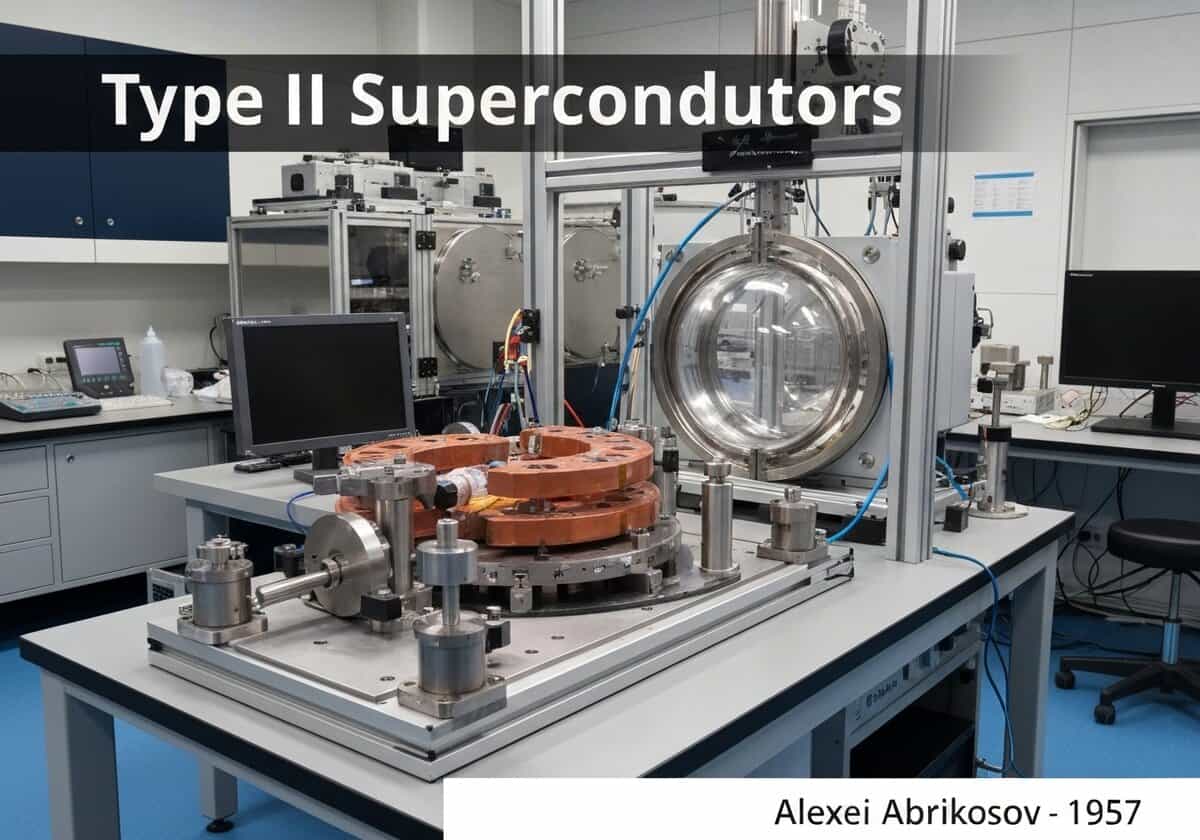
실험실에서 타입 II 초전도체 시연을 위한 초전도 자석 설치.

(설명을 위한 생성된 이미지입니다)

1957년 알렉세이 아브리코소프가 이론적으로 예측한 바에 따르면 긴즈버그-란다우 이론에 따르면, 2형 초전도체는 두 개의 임계 자기장, [latex]H_{c1}[/latex]과 [latex]H_{c2}[/latex]로 특징지어집니다. 이 두 자기장 사이에서 2형 초전도체는 혼합 상태 또는 '와류' 상태에 들어가며, 아브리코소프 와류라고 불리는 양자화된 자속관을 통해 자기장이 부분적으로 침투할 수 있습니다. 이로 인해 2형 초전도체는 1형 초전도체보다 훨씬 높은 자기장에서도 초전도 상태를 유지할 수 있습니다.

The existence of Type II superconductors is crucial for most high-field applications of superconductivity. A Type I superconductor completely expels magnetic fields up to a critical field [latex]H_c[/latex], above which it abruptly transitions to the normal state. This [latex]H_c[/latex] is generally too low for building powerful magnets. Abrikosov showed that for materials where the Ginzburg-Landau parameter [latex]\kappa > 1/\sqrt{2}[/latex], it is energetically favorable for the material to allow magnetic flux to penetrate in a quantized manner rather than becoming fully normal. This penetration occurs above a lower critical field [latex]H_{c1}[/latex]. The flux enters in the form of cylindrical filaments called vortices or fluxons. Within the core of each vortex, the material is in the normal state, but the surrounding bulk remains superconducting. Each vortex carries a single quantum of magnetic flux, [latex]\Phi_0 = h/2e[/latex]. As the external field increases, more vortices enter the material, forming a regular triangular lattice known as an Abrikosov vortex lattice. The material remains superconducting, with zero resistance, until an upper critical field [latex]H_{c2}[/latex] is reached, at which point the vortex cores overlap and the entire material becomes normal. Since [latex]H_{c2}[/latex] can be hundreds of times larger than [latex]H_{c1}[/latex], Type II materials are essential for generating strong magnetic fields. All high-temperature superconductors and many alloys like Niobium-titanium (NbTi) and Niobium-tin (Nb3Sn) are Type II.

UNESCO Nomenclature: 2211
고체물리학

유형

재료 분류

분열

상당한

용법

널리 사용됨

전구체

  • 긴즈버그-란다우 이론(1950)
  • 초전도 현상의 발견
  • 마이스너 효과
  • 자기 선속 양자화 개념

응용 프로그램

  • superconducting magnets for mri and nmr machines
  • 입자 가속기(예: LHC)
  • 자기부상열차
  • 고자기장 연구용 자석
  • superconducting magnetic energy storage (smes)

특허:

NA

잠재적 혁신 아이디어

현재 하루 4만 건이 넘는 봇 트래픽을 차단하기 위해 이 콘텐츠는 커뮤니티 회원만 이용할 수 있습니다.
> 로그인 < 또는 >등록 < 이 콘텐츠를 비롯한 모든 제한된 콘텐츠와 도구는 (100% 무료로) 이용할 수 있습니다.

관련 항목: 제2형 초전도체, 아브리코소프 소용돌이, 혼합 상태, 임계 자기장, 자속 양자화, 긴즈버그-란다우 이론, 자속 고정, 고자기장 자석, NbTi, YBCO.

역사적 맥락

2형 초전도체

1950
1950
1957
1957
1959-11
1960
1960
1950
1950
1950
1957
1958
1960
1960
1960

(날짜를 알 수 없거나 관련이 없는 경우, 예를 들어 "유체역학"의 경우, 주목할 만한 등장 시기를 대략적으로 추정하여 제공합니다.)

관련 발명, 혁신 및 기술 원칙

고화질 이미지 및 다운로드는 등록된 회원에게만 100% 무료로 제공됩니다.

> 로그인 <