Product Design, Manufacturing & Innovation Resources
» 第二種超伝導体

第二種超伝導体

1957
  • Alexei Abrikosov
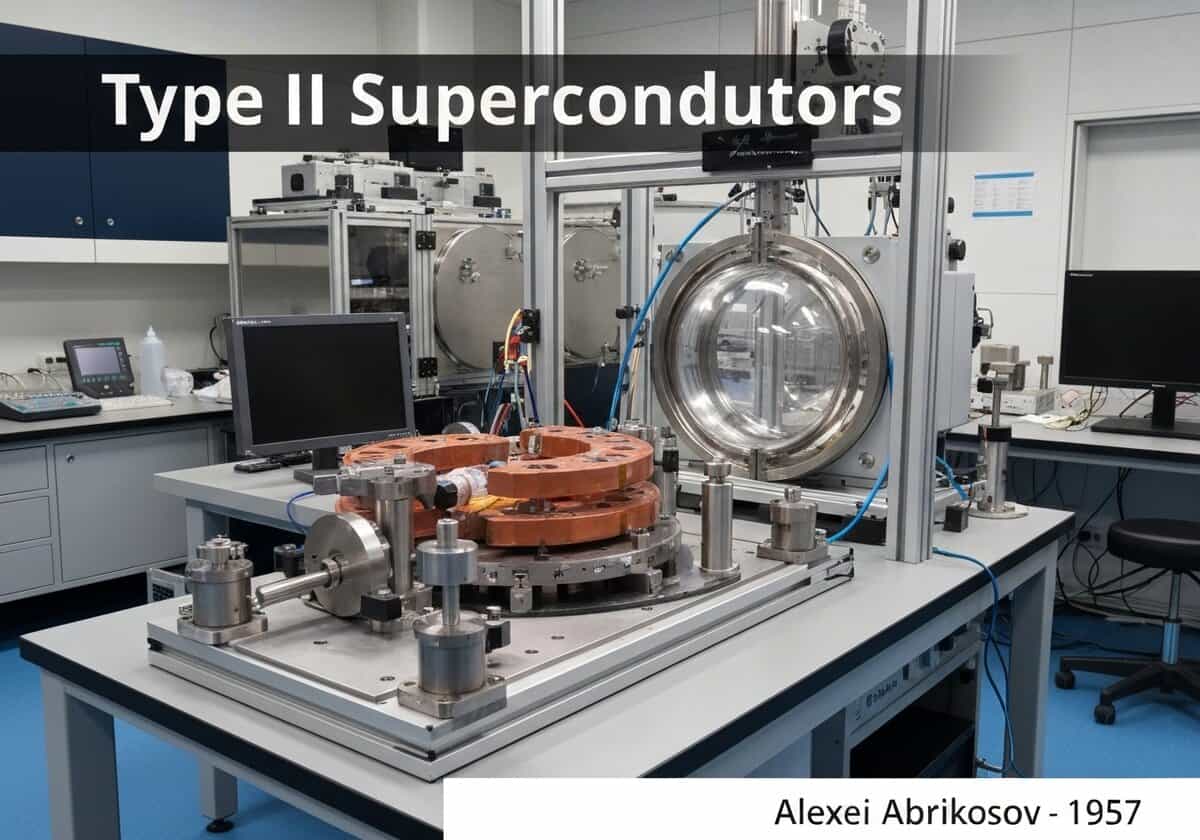
実験室でII型超電導体を実証する超電導マグネットのセットアップ。.

(画像はイメージです)

1957年にアレクセイ・アブリコソフによって理論的に予測された ギンズブルグ=ランドー 理論上、II型超伝導体は、[latex]H_{c1}[/latex]と[latex]H_{c2}[/latex]という2つの臨界磁場によって特徴づけられます。これらの磁場の間では、混合状態または「渦」状態に入り、アブリコソフ渦と呼ばれる量子化された磁束管を通して磁場が部分的に浸透します。これにより、II型超伝導体はI型超伝導体よりもはるかに高い磁場でも超伝導状態を維持できます。

The existence of Type II superconductors is crucial for most high-field applications of superconductivity. A Type I superconductor completely expels magnetic fields up to a critical field [latex]H_c[/latex], above which it abruptly transitions to the normal state. This [latex]H_c[/latex] is generally too low for building powerful magnets. Abrikosov showed that for materials where the Ginzburg-Landau parameter [latex]\kappa > 1/\sqrt{2}[/latex], it is energetically favorable for the material to allow magnetic flux to penetrate in a quantized manner rather than becoming fully normal. This penetration occurs above a lower critical field [latex]H_{c1}[/latex]. The flux enters in the form of cylindrical filaments called vortices or fluxons. Within the core of each vortex, the material is in the normal state, but the surrounding bulk remains superconducting. Each vortex carries a single quantum of magnetic flux, [latex]\Phi_0 = h/2e[/latex]. As the external field increases, more vortices enter the material, forming a regular triangular lattice known as an Abrikosov vortex lattice. The material remains superconducting, with zero resistance, until an upper critical field [latex]H_{c2}[/latex] is reached, at which point the vortex cores overlap and the entire material becomes normal. Since [latex]H_{c2}[/latex] can be hundreds of times larger than [latex]H_{c1}[/latex], Type II materials are essential for generating strong magnetic fields. All high-temperature superconductors and many alloys like Niobium-titanium (NbTi) and Niobium-tin (Nb3Sn) are Type II.

UNESCO Nomenclature: 2211
固体物理学

タイプ

材料分類

混乱

実質的な

使用法

広く普及している

前駆物質

  • ギンズブルグ=ランダウ理論(1950年)
  • 超伝導の発見
  • マイスナー効果
  • 磁束量子化の概念

アプリケーション

  • superconducting magnets for mri and nmr machines
  • 粒子加速器(例:LHC)
  • 磁気浮上式鉄道
  • 高磁場研究用磁石
  • superconducting magnetic energy storage (smes)

特許:

NA

潜在的なイノベーションのアイデア

ボットによるトラフィック(現在1日あたり4万件以上)を排除するため、このコンテンツはコミュニティメンバー限定となっています。
> ログイン < または > 登録 < (100%無料)でこれにアクセスできます。他のすべての制限付きコンテンツとツールも同様です。

関連: II型超伝導体、アブリコソフ渦、混合状態、臨界磁場、磁束量子化、ギンツブルグ・ランダウ理論、磁束ピン止め、高磁場磁石、NbTi、YBCO。

歴史的背景

第二種超伝導体

1950
1950
1957
1957
1959-11
1960
1960
1950
1950
1950
1957
1958
1960
1960
1960

(日付が不明または関連性がない場合、例えば「流体力学」などでは、その注目すべき出現時期の概算値が提示されます。)

関連する発明、革新、および技術原理

フルサイズの画像とダウンロードは、登録会員のみが100%無料で利用できます。