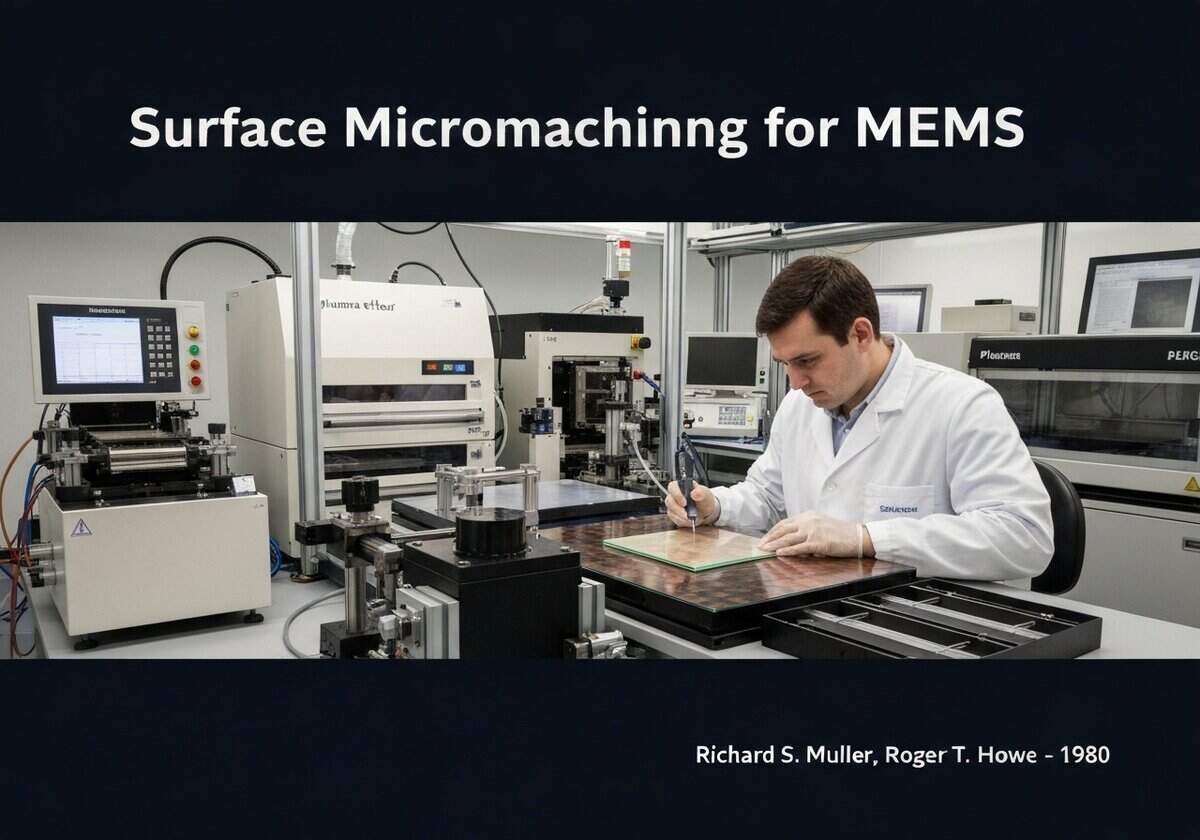
표면 미세가공 제작 MEMS 기판 위에 박막을 증착하고 패터닝하여 소자를 제작하는 기술입니다. 이 기술은 희생층(예: 이산화규소)을 증착하고, 패터닝한 후, 구조층(예: 폴리실리콘)을 증착하고, 마지막으로 희생층을 제거하여 기계적 구조를 드러내는 일련의 과정을 포함합니다. 이 공정을 통해 웨이퍼 표면에 직접 복잡하고 자립형인 미세 구조를 만들 수 있습니다.
표면 미세가공은 MEMS 제작의 핵심 기술로, 일반적으로 실리콘 웨이퍼와 같은 기판 위에 복잡한 기계 시스템을 제작할 수 있게 해줍니다. 이 공정은 적층 방식으로, 구조물을 층층이 쌓아 올리는 방식으로, 벌크 미세가공의 절삭 방식과는 대조적입니다. 일반적인 공정 흐름은 기판 위에 질화규소와 같은 절연층을 증착하는 것으로 시작됩니다. 그 다음, 저압 화학 기상 증착(LPCVD)을 이용하여 인산규산염 유리(PSG)라고 하는 이산화규소의 일종인 희생층을 증착합니다. 이 층은 광식각 및 에칭을 통해 패턴을 형성하여 최종 구조물이 기판에 고정될 영역과 움직이는 부품 아래의 간격을 정의합니다.
Next, the structural layer, most commonly polycrystalline silicon (polysilicon), is deposited over the patterned sacrificial layer. This polysilicon layer is then itself patterned to define the geometry of the desired mechanical components, such as beams, gears, or membranes. This sequence of depositing and patterning sacrificial and structural layers can be repeated multiple times to create highly complex, multi-level structures. The final, critical step is the ‘release’ process. The wafer is immersed in a chemical etchant, typically hydrofluoric acid (HF), which selectively removes the sacrificial PSG layers without attacking the polysilicon structural layers or the silicon nitride isolation layer. This leaves the polysilicon structures free to move, suspended above the substrate by their designated anchors.
A major advantage of this technique is its inherent compatibility with standard CMOS integrated circuit manufacturing processes. This allows for the monolithic integration of MEMS devices with their control and signal processing electronics on the same chip, leading to smaller, cheaper, and higher-performance systems. However, surface micromachining is not without its challenges. The primary failure mode during release is ‘stiction,’ where the released structures, once wet, are pulled down to the substrate by capillary forces during drying and become permanently stuck due to intermolecular forces like van der Waals attraction. Various anti-stiction strategies, such as supercritical CO2 drying or special surface coatings, have been developed to mitigate this critical issue.
관련 용어: 표면 미세가공, MEMS, 제작, 박막, 폴리실리콘, 희생층, 에칭, 미세가공, 리소그래피, 스티션.