Product Design, Manufacturing & Innovation Resources
» 나선형 모델(SW 프로세스)

나선형 모델(SW 프로세스)

1986-01-01
  • Barry Boehm
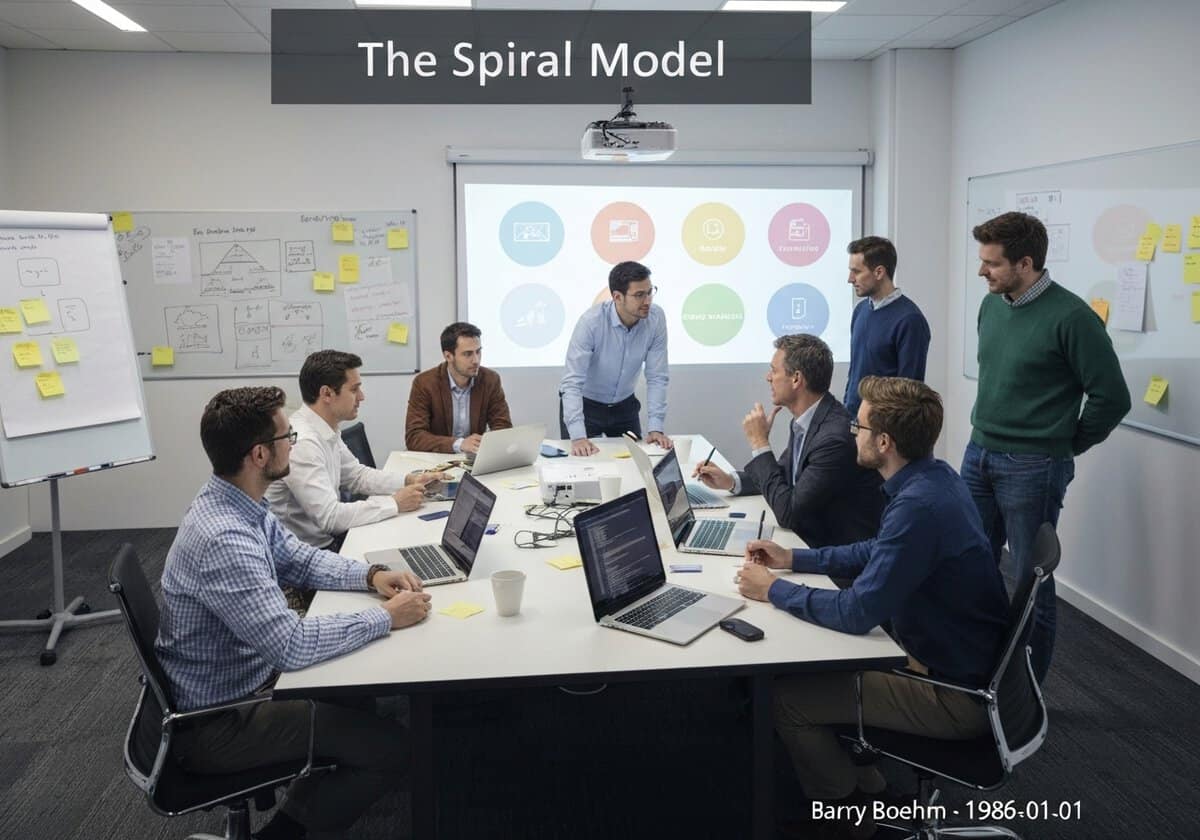
Software engineering team discussing the Spiral Model in a modern office setting.

(설명을 위한 생성된 이미지입니다)

The Spiral Model is a risk-driven 소프트웨어 development process model that combines elements of both prototyping and the waterfall model. It is a type of iterative development where the project passes through four phases in each iteration (spiral): determine objectives, identify and resolve risks, develop and test, and plan the next iteration. It emphasizes continuous risk analysis.

Introduced by Barry Boehm in 1986, the Spiral Model was designed to address the shortcomings of the traditional Waterfall model, particularly for large, complex projects. Each loop of the spiral represents a phase of the software process. Unlike other models, it doesn’t start with a full set of requirements. Instead, the initial spiral might focus on developing a proof-of-concept to test feasibility. Each subsequent loop builds upon the last, moving from a conceptual level to a fully engineered product. The four key activities in each cycle are: 1) Determine objectives, alternatives, and constraints for the iteration. 2) Evaluate alternatives; identify and resolve risks. This is the most critical part, involving activities like prototyping, simulation, and benchmarking to mitigate high-risk elements. 3) Develop and verify the next-level product. This involves the actual coding, integration, and testing, similar to a mini-waterfall process for that iteration’s deliverable. 4) Plan the next iteration. The project is reviewed, and plans are drawn up for the next spiral. This model allows for the incremental release of the product and refinement of requirements throughout the development lifecycle, making it highly flexible and suitable for projects where risk management is paramount.

UNESCO Nomenclature: 1208
– Software

유형

추상 시스템

분열

점진적

용법

틈새/전문 분야

전구체

  • waterfall model
  • prototyping models
  • risk management principles
  • incremental development models

응용 프로그램

  • large, expensive, and complicated government projects
  • high-risk software development
  • projects where requirements are unclear or complex
  • research and development projects

특허:

NA

잠재적 혁신 아이디어

현재 하루 4만 건이 넘는 봇 트래픽을 차단하기 위해 이 콘텐츠는 커뮤니티 회원만 이용할 수 있습니다.
> 로그인 < 또는 >등록 < 이 콘텐츠를 비롯한 모든 제한된 콘텐츠와 도구는 (100% 무료로) 이용할 수 있습니다.

Related to: spiral model, barry boehm, risk-driven, software development, iterative, prototyping, waterfall model, risk analysis, software engineering, project management.

역사적 맥락

나선형 모델(SW 프로세스)

1980
1980
1980
1986-01-01
1990
1990
1993
1980
1980
1980
1982-07-01
1988-06-01
1990
1993
1997-04-23

(날짜를 알 수 없거나 관련이 없는 경우, 예를 들어 "유체역학"의 경우, 주목할 만한 등장 시기를 대략적으로 추정하여 제공합니다.)

관련 발명, 혁신 및 기술 원칙

고화질 이미지 및 다운로드는 등록된 회원에게만 100% 무료로 제공됩니다.

> 로그인 <