Product Design, Manufacturing & Innovation Resources
Lar » O Modelo Espiral (processo SW)

O Modelo Espiral (processo SW)

1986-01-01
  • Barry Boehm
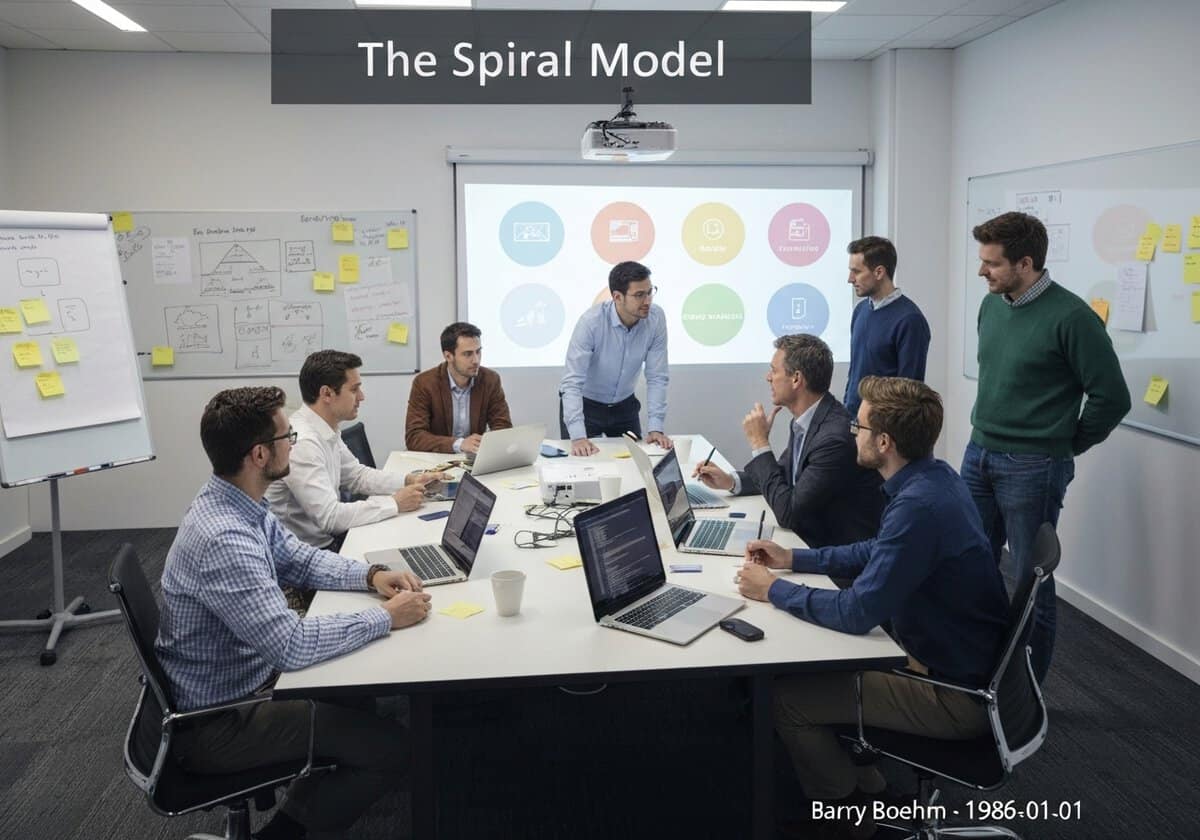
Equipe de engenharia de software discutindo o Modelo Espiral em um ambiente de escritório moderno.

(Imagem gerada apenas para fins ilustrativos)

The Spiral Model is a risk-driven software development process model that combines elements of both prototyping and the waterfall model. It is a type of iterative development where the project passes through four phases in each iteration (spiral): determine objectives, identify and resolve risks, develop and test, and plan the next iteration. It emphasizes continuous risk analysis.

Introduced by Barry Boehm in 1986, the Spiral Model was designed to address the shortcomings of the traditional Waterfall model, particularly for large, complex projects. Each loop of the spiral represents a phase of the software process. Unlike other models, it doesn’t start with a full set of requirements. Instead, the initial spiral might focus on developing a proof-of-concept to test feasibility. Each subsequent loop builds upon the last, moving from a conceptual level to a fully engineered product. The four key activities in each cycle are: 1) Determine objectives, alternatives, and constraints for the iteration. 2) Evaluate alternatives; identify and resolve risks. This is the most critical part, involving activities like prototyping, simulation, and benchmarking to mitigate high-risk elements. 3) Develop and verify the next-level product. This involves the actual coding, integration, and testing, similar to a mini-waterfall process for that iteration’s deliverable. 4) Plan the next iteration. The project is reviewed, and plans are drawn up for the next spiral. This model allows for the incremental release of the product and refinement of requirements throughout the development lifecycle, making it highly flexible and suitable for projects where risk management is paramount.

UNESCO Nomenclature: 1208
– Software

Tipo

Sistema abstrato

Interrupção

Incremental

Uso

Nicho/Especializado

Precursores

  • waterfall model
  • prototyping models
  • risk management principles
  • incremental development models

Aplicações

  • large, expensive, and complicated government projects
  • high-risk software development
  • projects where requirements are unclear or complex
  • research and development projects

Patentes:

NA

Ideias de Inovação Potencial

Devido ao tráfego de bots de coleta de dados, atualmente superior a 40 mil por dia, este conteúdo é reservado aos membros da comunidade.
> Login < ou > Registrar < (100% gratuito) para acessar isso, assim como todo o restante do conteúdo e das ferramentas restritas.

Related to: spiral model, barry boehm, risk-driven, software development, iterative, prototyping, waterfall model, risk analysis, software engineering, project management.

Contexto histórico

O Modelo Espiral (processo SW)

1980
1980
1980
1986-01-01
1990
1990
1993
1980
1980
1980
1982-07-01
1988-06-01
1990
1993
1997-04-23

(Caso a data seja desconhecida ou irrelevante, por exemplo, "mecânica dos fluidos", é fornecida uma estimativa aproximada de seu surgimento notável)

Princípios relacionados à invenção, inovação e tecnologia

Imagens em tamanho real e downloads estão disponíveis apenas, 100% gratuitos, para membros registrados.