Product Design, Manufacturing & Innovation Resources
» 레일리 기준(광학 분해능)

레일리 기준(광학 분해능)

1900
  • John William Strutt, 3rd Baron Rayleigh
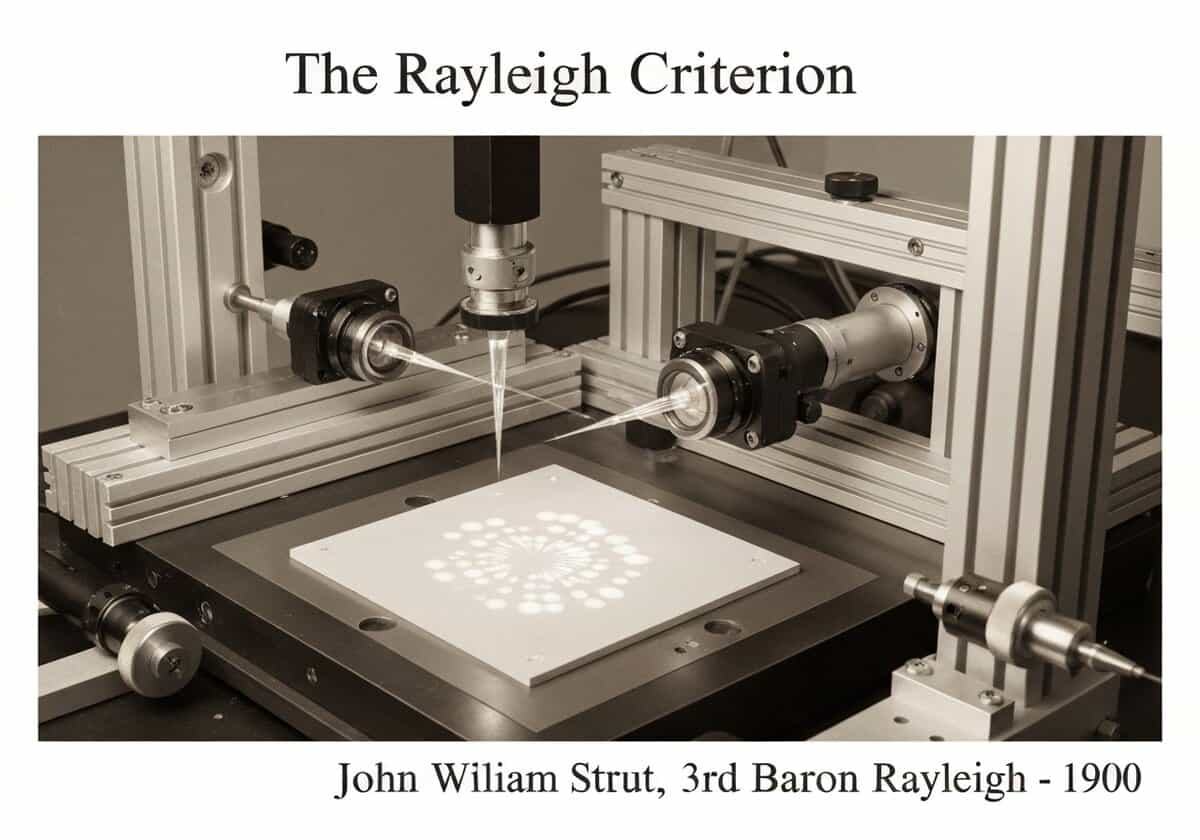
광학의 레이리 기준을 설명하는 프로젝션 포토리소그래피 시스템.

(설명을 위한 생성된 이미지입니다)

투영식 포토리소그래피 시스템이 인쇄할 수 있는 최소 형상 크기는 회절에 의해 제한되며, 레일리 기준(Rayleigh criterion)으로 근사화됩니다. 임계 치수(CD)는 [latex]CD = k_1 cdot frac{lambda}{NA}[/latex]로 주어지며, 여기서 [latex]lambda[/latex]는 빛의 파장, NA는 렌즈의 개구수, [latex]k_1[/latex]는 공정 관련 계수입니다. 형상이 작을수록 더 짧은 파장이나 더 높은 개구수가 필요합니다.

The Rayleigh criterion is a fundamental principle in optics that defines the limit of resolution for any imaging system, including the projection systems used in photolithography. It states that two point sources are just resolvable when the center of the diffraction pattern of one is directly over the first minimum of the diffraction pattern of the other. In the context of lithography, this translates to the smallest line or space that can be reliably printed. The formula [latex]CD = k_1 \cdot \frac{\lambda}{NA}[/latex] encapsulates the three primary levers for improving resolution. Firstly, reducing the wavelength ([latex]\lambda[/latex]) of the light source has been a major driver of progress, moving from g-line (436 nm) and i-line (365 nm) mercury lamps to Deep UV (DUV) excimer lasers like KrF (248 nm) and ArF (193 nm), and ultimately to Extreme UV (EUV) at 13.5 nm. Secondly, increasing the numerical aperture (NA) of the projection lens allows it to capture more diffracted light orders, leading to a sharper image. NA is defined as [latex]NA = n \sin \theta[/latex], where n is the refractive index of the medium between the lens and the wafer. Thirdly, the process factor [latex]k_1[/latex] represents the ‘cleverness’ of the process, encompassing improvements like resolution enhancement techniques (RET), photoresist chemistry, and process control. While theoretically [latex]k_1[/latex] has a minimum of 0.25, practical manufacturing values have been pushed down from ~0.8 towards ~0.3 through immense engineering effort. This equation has been the guiding principle for the semiconductor industry’s roadmap for decades, driving the relentless scaling predicted by Moore’s Law.

UNESCO Nomenclature: 2209
전자기학

유형

추상 시스템

분열

기초적인

용법

널리 사용됨

전구체

  • 호이겐스-프레넬 파동 전파 원리
  • 프라운호퍼 회절 이론
  • 고품질 광학 렌즈 개발

응용 프로그램

  • 고해상도 현미경 설계
  • 반도체 리소그래피 공정 개발
  • 천체망원경 설계
  • 광디스크(CD, DVD, 블루레이)의 데이터 저장 밀도 한계

특허:

NA

잠재적 혁신 아이디어

현재 하루 4만 건이 넘는 봇 트래픽을 차단하기 위해 이 콘텐츠는 커뮤니티 회원만 이용할 수 있습니다.
> 로그인 < 또는 >등록 < 이 콘텐츠를 비롯한 모든 제한된 콘텐츠와 도구는 (100% 무료로) 이용할 수 있습니다.

관련 개념: 레일리 기준, 해상도, 개구수, 파장, k1 인자, 회절 한계, 포토리소그래피, 심자외선(DUV), 극자외선(EUV), 광학.

역사적 맥락

레일리 기준(광학 분해능)

1900
1900
1900
1900
1902
1902
1907
1900
1900
1900
1900
1900-12-14
1902
1904
1907

(날짜를 알 수 없거나 관련이 없는 경우, 예를 들어 "유체역학"의 경우, 주목할 만한 등장 시기를 대략적으로 추정하여 제공합니다.)

관련 발명, 혁신 및 기술 원칙

고화질 이미지 및 다운로드는 등록된 회원에게만 100% 무료로 제공됩니다.

> 로그인 <