Product Design, Manufacturing & Innovation Resources
» NIOSH 리프팅 방정식

NIOSH 리프팅 방정식

1991
  • National Institute for Occupational Safety and Health (NIOSH)
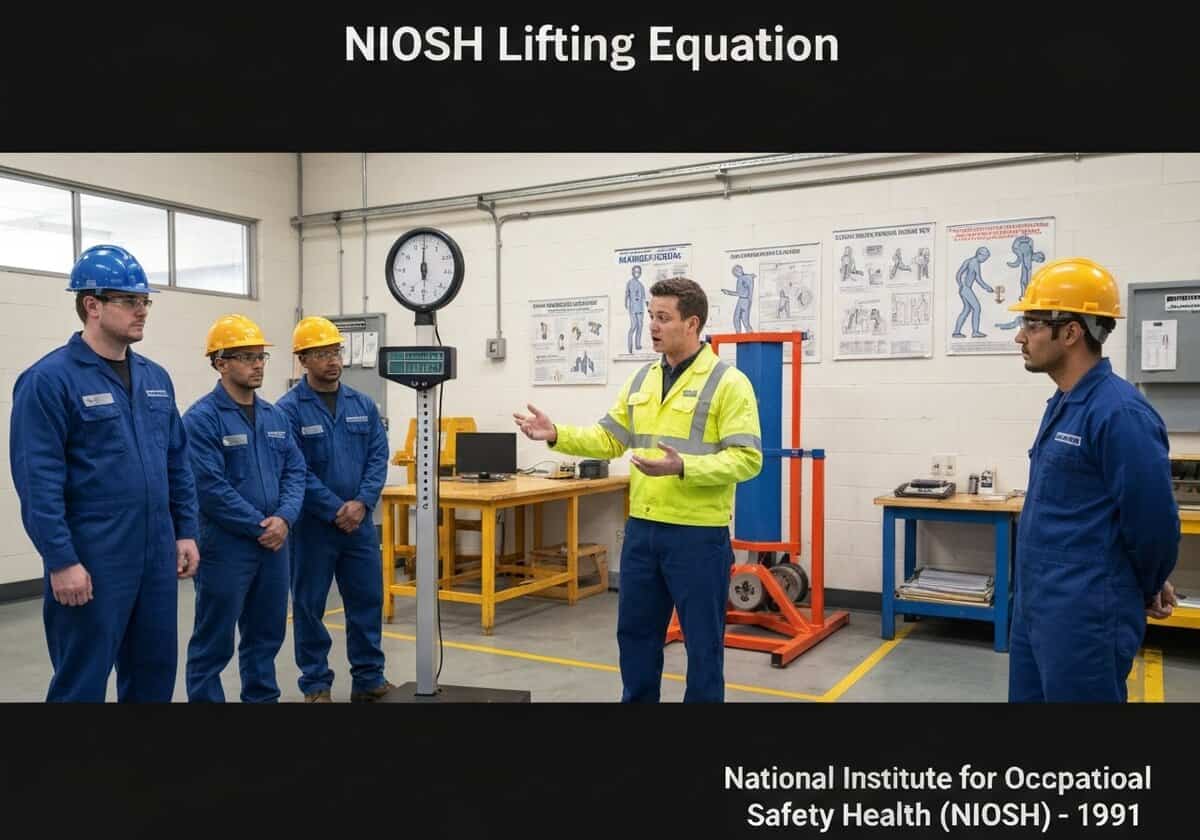
산업 보건 전문가가 산업 현장에서 NIOSH 리프팅 방정식을 시연하고 있습니다.

(설명을 위한 생성된 이미지입니다)

그만큼 NIOSH lifting equation is a tool used by occupational health and safety professionals to assess the risk of musculoskeletal injury associated with manual lifting tasks. It calculates a Recommended Weight Limit (RWL) for a specific task, representing the maximum weight a healthy worker could lift without increased risk of low back injury, considering factors like task geometry and frequency.


The revised NIOSH lifting equation from 1991 provides a more comprehensive risk assessment than its 1981 predecessor. The core of the method is the calculation of the Recommended Weight Limit (RWL) using the formula: [latex]RWL = LC \times HM \times VM \times DM \times AM \times FM \times CM[/latex]. In this formula, LC is the Load Constant (51 lbs or 23 kg), which is the maximum recommended weight under ideal conditions. The other terms are multipliers, each with a value between 0 and 1, which reduce the allowable weight based on deviations from these ideal conditions. These multipliers are: HM (Horizontal Multiplier), VM (Vertical Multiplier), DM (Distance Multiplier), AM (Asymmetric Multiplier), FM (Frequency Multiplier), and CM (Coupling Multiplier). For example, the further an object is held from the body (increasing the horizontal distance), the smaller the HM value becomes, thus lowering the RWL. The equation also allows for the calculation of a Lifting Index (LI), where [latex]LI = \frac{Load Weight}{RWL}[/latex]. An LI greater than 1.0 indicates that the task is high-risk for some fraction of the workforce, and redesign should be prioritized. An LI of 3.0 or more is considered highly hazardous. The equation is a cornerstone of physical ergonomics, providing a quantitative, evidence-based method for evaluating and mitigating one of the most common causes of workplace injury.

UNESCO Nomenclature: 3307
산업공학

유형

추상 시스템

분열

점진적

용법

널리 사용됨

전구체

  • biomechanical models of the lumbar spine
  • epidemiological studies linking manual lifting to low back pain
  • psychophysical studies on maximum acceptable weights
  • the original 1981 niosh lifting guide
  • static strength prediction models

응용 프로그램

  • job hazard analysis in manufacturing and logistics
  • redesign of workstations to reduce lifting risks
  • development of workplace safety standards and regulations
  • training programs for manual material handling
  • rehabilitation and return-to-work planning for injured employees

특허:

NA

잠재적 혁신 아이디어

현재 하루 4만 건이 넘는 봇 트래픽을 차단하기 위해 이 콘텐츠는 커뮤니티 회원만 이용할 수 있습니다.
> 로그인 < 또는 >등록 < 이 콘텐츠를 비롯한 모든 제한된 콘텐츠와 도구는 (100% 무료로) 이용할 수 있습니다.

Related to: NIOSH, lifting equation, RWL, recommended weight limit, musculoskeletal injury, occupational safety, biomechanics, manual handling, risk assessment, ergonomics.

역사적 맥락

NIOSH 리프팅 방정식

1990
1990
1990
1991
1992
1993
1994
1990
1990
1990
1990
1992
1992
1993-07-22
1996

(날짜를 알 수 없거나 관련이 없는 경우, 예를 들어 "유체역학"의 경우, 주목할 만한 등장 시기를 대략적으로 추정하여 제공합니다.)

관련 발명, 혁신 및 기술 원칙

고화질 이미지 및 다운로드는 등록된 회원에게만 100% 무료로 제공됩니다.

> 로그인 <