Product Design, Manufacturing & Innovation Resources
» 현대 원자 이론

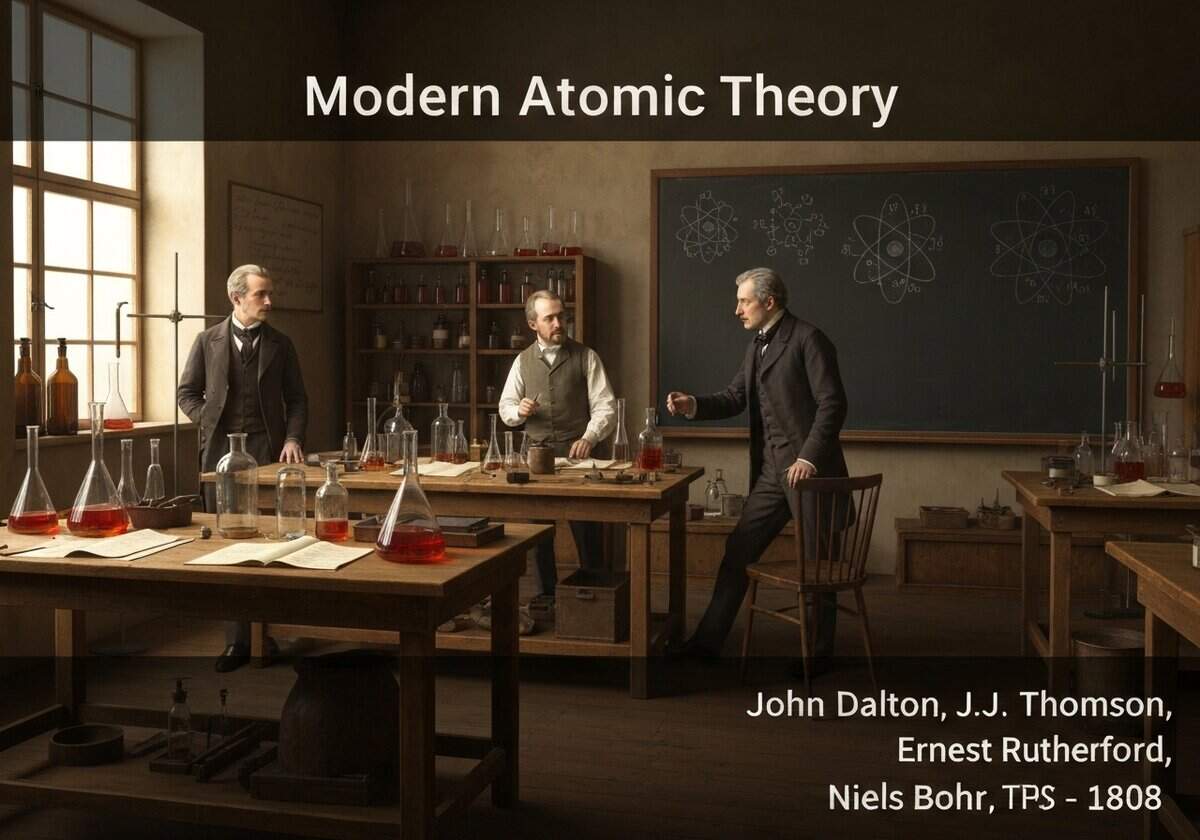
현대 원자 이론

1808
  • John Dalton
  • J.J. Thomson
  • Ernest Rutherford
  • Niels Bohr
원자 구조와 화학 반응을 연구하는 19세기 과학자들로 구성된 실험실.

(설명을 위한 생성된 이미지입니다)

원자론은 모든 물질이 원자라고 불리는 개별 단위로 구성되어 있다고 주장합니다. 원소는 원자핵에 특정 개수의 양성자를 가진 원자들로 이루어져 있습니다. 과거에는 더 이상 쪼갤 수 없는 것으로 여겨졌던 원자는 이제 양성자, 중성자, 전자와 같은 아원자 입자로 구성되어 있음이 알려져 있습니다. 화학 반응은 이러한 원자들의 재배열을 포함하며, 이 과정에서 원자의 구조는 보존됩니다.

The modern understanding of the atom is the result of a series of revolutionary discoveries that refined initial concepts. John Dalton’s early 19th-century theory provided the first scientific framework, postulating that elements were made of identical, indivisible atoms and that compounds were combinations of these atoms in fixed ratios. This explained the laws of mass conservation and definite proportions. However, the discovery of the electron by J.J. Thomson in 1897 proved that atoms were divisible. He proposed the ‘plum pudding’ model, with electrons embedded in a sphere of positive charge.

This model was overturned by Ernest Rutherford’s gold foil experiment in 1909. By firing alpha particles at a thin gold foil, he observed that while most passed through, a few were deflected at large angles. This implied a small, dense, positively charged nucleus, leading to his planetary model of the atom with electrons orbiting the nucleus. Niels Bohr refined this in 1913 by incorporating quantum ideas, proposing that electrons exist in specific, quantized energy levels or orbits. This model successfully explained the emission spectra of hydrogen. The final major evolution was the development of quantum mechanics in the 1920s by Schrödinger, Heisenberg, and others. In the current quantum mechanical model, electrons do not have fixed orbits but exist in probability distributions called orbitals, described by wavefunctions. This sophisticated model is the foundation for understanding chemical bonding, reactivity, and the properties of all matter.

UNESCO Nomenclature: 2201
원자 및 분자 물리학

유형

추상 시스템

분열

혁명가

용법

널리 사용됨

전구체

  • 고대 그리스의 '아토모스' 개념 (데모크리토스, 레우키포스)
  • law of conservation of mass (Lavoisier)
  • 일정 성분비의 법칙 (요셉 프루스트)
  • 배수 비례의 법칙 (존 달튼)

응용 프로그램

  • 주기율표의 발전
  • 화학 결합과 분자 구조에 대한 이해
  • 핵에너지와 핵무기
  • 나노기술
  • 반도체 기술 및 전자공학
  • spectroscopy for material analysis

특허:

NA

잠재적 혁신 아이디어

현재 하루 4만 건이 넘는 봇 트래픽을 차단하기 위해 이 콘텐츠는 커뮤니티 회원만 이용할 수 있습니다.
> 로그인 < 또는 >등록 < 이 콘텐츠를 비롯한 모든 제한된 콘텐츠와 도구는 (100% 무료로) 이용할 수 있습니다.

관련 용어: 원자, 원자 이론, 존 달튼, 원자핵, 양성자, 중성자, 전자, 양자 역학, 아원자 입자, 화학 원소.

역사적 맥락

현대 원자 이론

1800
1801
1802
1808
1811
1816-11-16
1820
1800
1800
1802
1802
1810
1816
1816-11-16
1820

(날짜를 알 수 없거나 관련이 없는 경우, 예를 들어 "유체역학"의 경우, 주목할 만한 등장 시기를 대략적으로 추정하여 제공합니다.)
관련 발명, 혁신 및 기술 원칙

고화질 이미지 및 다운로드는 등록된 회원에게만 100% 무료로 제공됩니다.

> 로그인 <