Teoria Atômica Moderna
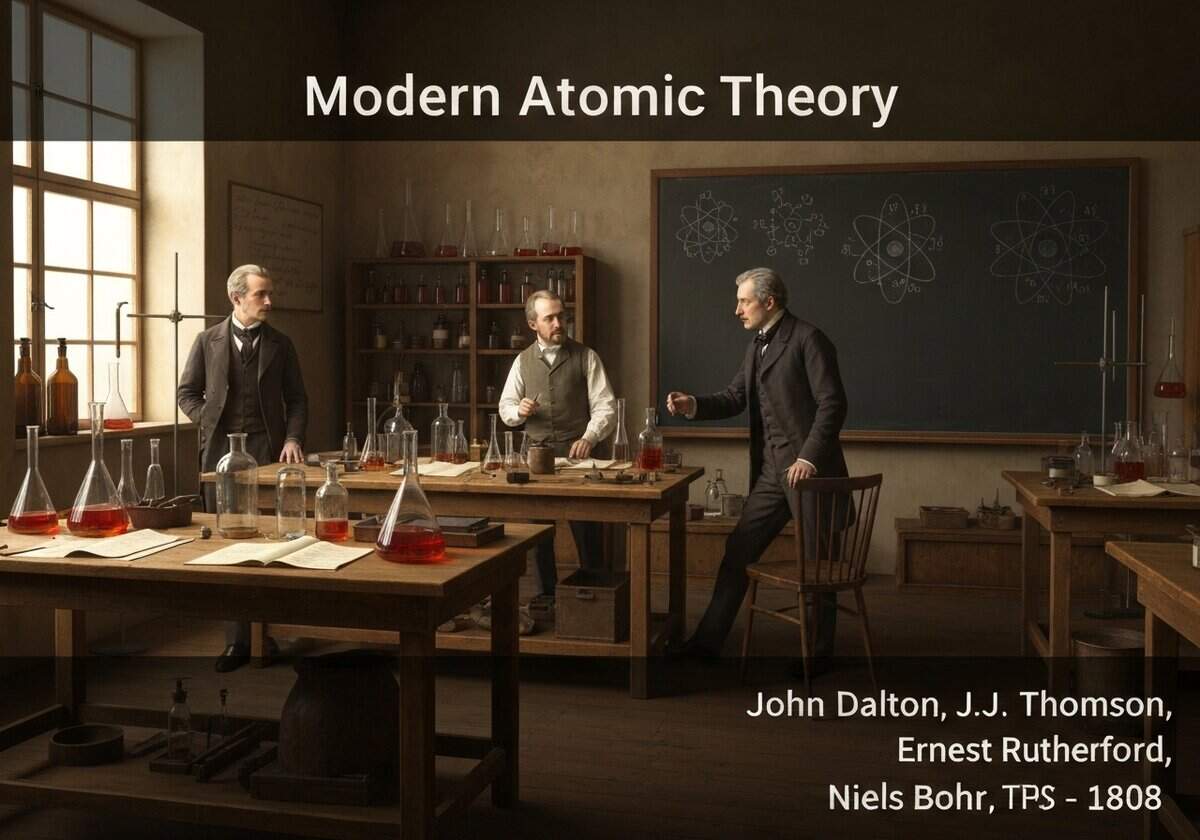
1808
- John Dalton
- J.J. Thomson
- Ernest Rutherford
- Niels Bohr
A teoria atômica postula que toda a matéria é composta de unidades discretas chamadas átomos. Um elemento consiste em átomos com um número específico de prótons em seu núcleo. Embora antes considerados indivisíveis, os átomos são hoje conhecidos por serem compostos de partículas subatômicas: prótons, nêutrons e elétrons. As reações químicas envolvem o rearranjo desses átomos, que são conservados durante o processo.
The modern understanding of the atom is the result of a series of revolutionary discoveries that refined initial concepts. John Dalton’s early 19th-century theory provided the first scientific framework, postulating that elements were made of identical, indivisible atoms and that compounds were combinations of these atoms in fixed ratios. This explained the laws of mass conservation and definite proportions. However, the discovery of the electron by J.J. Thomson in 1897 proved that atoms were divisible. He proposed the ‘plum pudding’ model, with electrons embedded in a sphere of positive charge.
This model was overturned by Ernest Rutherford’s gold foil experiment in 1909. By firing alpha particles at a thin gold foil, he observed that while most passed through, a few were deflected at large angles. This implied a small, dense, positively charged nucleus, leading to his planetary model of the atom with electrons orbiting the nucleus. Niels Bohr refined this in 1913 by incorporating quantum ideas, proposing that electrons exist in specific, quantized energy levels or orbits. This model successfully explained the emission spectra of hydrogen. The final major evolution was the development of quantum mechanics in the 1920s by Schrödinger, Heisenberg, and others. In the current quantum mechanical model, electrons do not have fixed orbits but exist in probability distributions called orbitals, described by wavefunctions. This sophisticated model is the foundation for understanding chemical bonding, reactivity, and the properties of all matter.
UNESCO Nomenclature: 2201
Física atômica e molecular
Interrupção
Revolucionário
Precursores
- conceito grego antigo de ‘atomos’ (Demócrito, Leucipo)
- law of conservation of mass (Lavoisier)
- Lei das proporções definidas (Joseph Proust)
- Lei das proporções múltiplas (John Dalton)
Aplicações
- desenvolvimento da tabela periódica
- Compreendendo as ligações químicas e a estrutura molecular.
- energia nuclear e armas
- nanotecnologia
- tecnologia de semicondutores e eletrônica
- spectroscopy for material analysis
Ideias de Inovação Potencial
Devido ao tráfego de bots de coleta de dados, atualmente superior a 40 mil por dia, este conteúdo é reservado aos membros da comunidade.
> Login < ou > Registrar < (100% gratuito) para acessar isso, assim como todo o restante do conteúdo e das ferramentas restritas.
Relacionado a: átomo, teoria atômica, John Dalton, núcleo, próton, nêutron, elétron, mecânica quântica, partículas subatômicas, elemento químico.