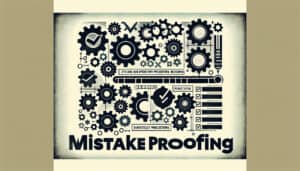
Involves identifying potential error points in a process and then implementing simple, often low-cost devices or methods (e.g., guide pins, warning signals, checklists, specific shapes for parts) that prevent incorrect actions or alert the operator.
長所
Reduces defects and improves quality by eliminating errors at the source; Increases safety; Can simplify tasks and reduce reliance on operator vigilance; Often low-cost to implement.
短所
May not be applicable to all types of errors or processes; Can sometimes slow down a process if not designed carefully; Requires careful analysis to identify all potential error modes; May require creative thinking to devise effective solutions.
カテゴリー:
人間工学, リーンシックスシグマ, 製造業, 品質, リスク管理
最適な用途:
Preventing defects and errors in manufacturing, assembly, or service processes by designing them to be foolproof or to highlight mistakes immediately.
Poka-Yoke methodologies can be effectively utilized across various industries such as automotive, electronics, healthcare, and food processing, among others, where reliable assembly and safe operation are paramount. In these settings, design engineers and quality assurance teams frequently work together to identify processes that are prone to errors and can benefit from mistake-proofing solutions. For instance, in the automotive sector, guide pins are commonly employed in assembly lines to ensure that components can only fit together in the correct orientation, thereby preventing assembly errors. In healthcare, specialized packaging that only allows a single way to access medical devices or medications can prevent mix-ups that could be life-threatening. Checklists are frequently implemented in complex assembly processes or service contexts such as aircraft maintenance, where steps can be easily overlooked; having a checklist or digital signal alerts can ensure that all necessary actions are completed before an aircraft is declared ready for flight. The project phases in which Poka-Yoke methodologies can be effectively applied often include early design or prototyping stages, when potential errors are assessed and preventative designs are conceptualized. Engagement of frontline operators during the design phase can also lead to better identification of error-prone areas, as they have intimate knowledge of where mistakes commonly occur. The low-cost nature of many Poka-Yoke systems makes them attractive for small and medium-sized enterprises (SMEs), which may face budget constraints, while also assuring that implemented measures yield a swift return on investment through reduced rework, increased customer satisfaction, and enhanced safety.
この方法論の主なステップ
Identify potential error points in the process.
Analyze the severity and frequency of errors at each point.
Develop simple devices or methods that prevent errors.
Implement physical guides or alerts to notify operators of mistakes.
Test the effectiveness of the mistake-proofing implementations.
Refine solutions based on feedback and observed outcomes.
Integrate mistake-proofing features into ongoing processes.
プロのヒント
Implement real-time monitoring systems that alert operators immediately when a deviation occurs, enhancing response time and reducing the potential for defects.
Utilize process mapping techniques to visually identify and analyze potential error points, allowing for targeted Poka-Yoke solutions tailored to specific operations.
Incorporate feedback loops where team members can contribute suggestions for mistake-proofing strategies, fostering a culture of continuous improvement and innovation.