Product Design, Manufacturing & Innovation Resources
» 燃料電池の熱力学的効率

燃料電池の熱力学的効率

1950
  • Josiah Willard Gibbs
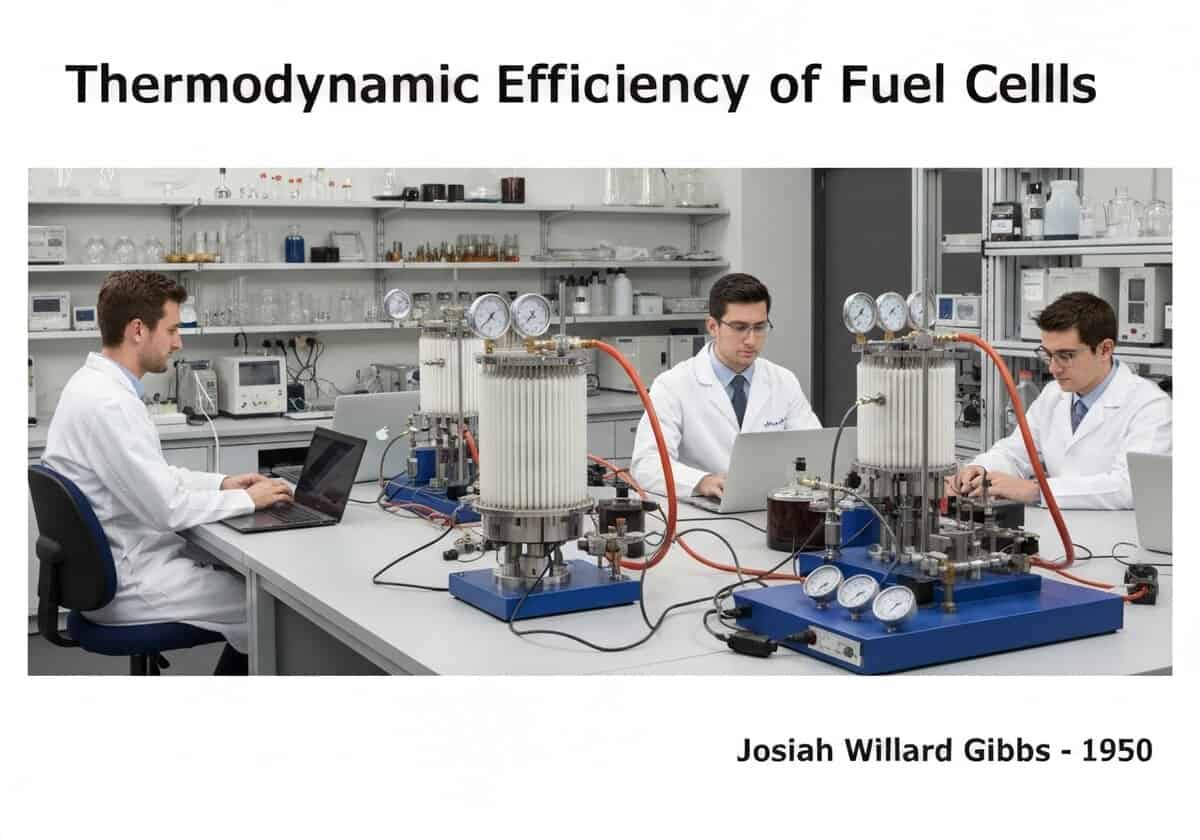
燃料電池の熱力学的効率に関する研究室での研究。.

(画像はイメージです)

理論上の最大効率 燃料電池 は、電気化学反応のギブズ自由エネルギー変化 ([latex]Delta G[/latex]) とエンタルピー変化 ([latex]Delta H[/latex]) の比によって決まります。これは、[latex]eta_{thermo} = frac{Delta G}{Delta H}[/latex] と表されます。重要なのは、燃料電池は熱機関ではないため、カルノー効率の限界に制約されず、理論上の変換効率を大幅に高めることができる点です。

The Gibbs free energy, [latex]\Delta G[/latex], represents the maximum amount of non-expansion work that can be extracted from a thermodynamically closed system at constant temperature and pressure. In a fuel cell, this work is the electrical work performed. The change in enthalpy, [latex]\Delta H[/latex], represents the total heat content of the reaction, which is the energy released during combustion. The difference between these two values, [latex]T\Delta S[/latex] (where T is temperature and [latex]\Delta S[/latex] is the change in entropy), represents the unavoidable waste heat generated by the reaction even under ideal, reversible conditions.

In contrast, a heat engine’s maximum efficiency is dictated by the Carnot limit, [latex]\eta_C = 1 – \frac{T_{cold}}{T_{hot}}[/latex], which depends on the temperature difference between its hot and cold reservoirs. For a typical hydrogen fuel cell operating at standard conditions, the thermodynamic efficiency is around 83%, whereas practical internal combustion engines struggle to exceed 40%. While the theoretical fuel cell efficiency is high, real-world devices suffer from several irreversible losses, or ‘polarizations’, that reduce their practical efficiency. These include activation losses (energy needed to initiate the reaction), ohmic losses (resistance to ion and electron flow), and mass transport losses (failure to supply reactants to reaction sites quickly enough).

UNESCO Nomenclature: 2212
熱力学

タイプ

抽象システム

混乱

実質的な

使用法

広く普及している

前駆物質

  • formulation of the first law of thermodynamics (c. 1850)
  • formulation of the second law of thermodynamics and the concept of entropy by Rudolf Clausius (1850s)
  • ジョサイア・ウィラード・ギブスによるギブスの自由エネルギー概念の発展(1870年代)

アプリケーション

  • 高効率熱電併給(CHP)システムの設計
  • 燃料電池の運転パラメータ(温度、圧力)の最適化
  • 電極および電解質におけるエネルギー損失を低減するための材料科学研究
  • 次世代燃料電池の性能に関する理論的モデリング
  • 燃料電池の実現可能性と燃焼技術の経済分析

特許:

NA

潜在的なイノベーションのアイデア

ボットによるトラフィック(現在1日あたり4万件以上)を排除するため、このコンテンツはコミュニティメンバー限定となっています。
> ログイン < または > 登録 < (100%無料)でこれにアクセスできます。他のすべての制限付きコンテンツとツールも同様です。

関連キーワード:ギブズ自由エネルギー、エンタルピー、エントロピー、燃料電池効率、熱力学、カルノーサイクル、分極、電圧損失、電気化学、エネルギー変換。

歴史的背景

燃料電池の熱力学的効率

1950
1950
1950
1950
1957
1958
1960
1950
1950
1950
1950
1957
1957
1959-11
1960

(日付が不明または関連性がない場合、例えば「流体力学」などでは、その注目すべき出現時期の概算値が提示されます。)

関連する発明、革新、および技術原理

フルサイズの画像とダウンロードは、登録会員のみが100%無料で利用できます。