中性子線脆化
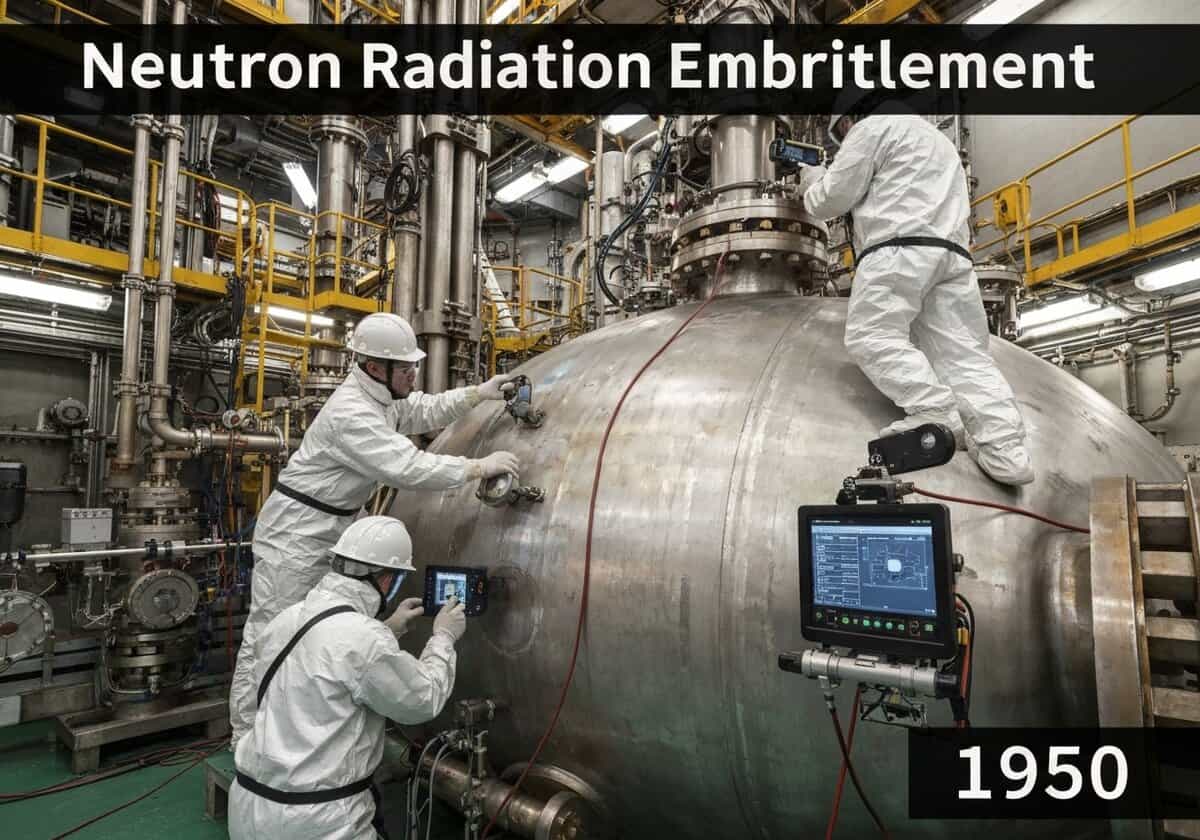
Neutron embrittlement is the loss of 延性 and toughness in materials subjected to neutron irradiation. In nuclear reactors, 高エネルギー neutrons displace atoms from their lattice sites, creating defects like vacancies and interstitials. These defects accumulate and form clusters that impede dislocation motion, thereby increasing the material’s hardness and strength but severely reducing its ability to deform plastically before fracturing.
A critical consequence of neutron embrittlement is the upward shift in the ductile-to-brittle transition temperature (DBTT). The DBTT is the temperature below which a material behaves in a brittle manner and above which it is ductile. For reactor pressure vessels, typically made of ferritic steel, this shift means the vessel could become brittle at its normal operating temperatures, posing a significant safety risk, particularly during shutdown or startup thermal cycles. The amount of DBTT shift is a function of neutron fluence (total neutrons per unit area), neutron energy spectrum, irradiation temperature, and material composition (e.g., copper and nickel content can accelerate embrittlement).
The novelty of this discovery was profound, as it introduced a new degradation mechanism that was not based on chemical corrosion or mechanical fatigue but on subatomic particle interactions. Understanding and quantifying this effect became a cornerstone of nuclear engineering and safety. To manage it, nuclear plants run surveillance programs where samples of the RPV material are placed inside the reactor, periodically removed, and tested to track the progression of embrittlement, ensuring the vessel remains within safe operating limits throughout its life.
UNESCO Nomenclature: 3308
材料科学
前駆物質
- discovery of the neutron by james chadwick
- development of the first nuclear reactor (chicago pile-1)
- eugene wigner’s prediction of radiation damage in solids (wigner effect)
- advances in electron microscopy to visualize crystal lattice defects
- development of fracture mechanics by a. a. griffith
アプリケーション
- lifetime assessment and extension programs for nuclear reactor pressure vessels (rpvs)
- development of radiation-resistant alloys for next-generation fission and fusion reactors
- material surveillance programs in nuclear facilities to monitor degradation
- predictive modeling of material performance in high-radiation environments
- design of shielding and structural components for spacecraft and satellites
潜在的なイノベーションのアイデア
ボットによるトラフィック(現在1日あたり4万件以上)を排除するため、このコンテンツはコミュニティメンバー限定となっています。
> ログイン < または > 登録 < (100%無料)でこれにアクセスできます。他のすべての制限付きコンテンツとツールも同様です。
Related to: neutron embrittlement, radiation damage, nuclear reactor, dbtt, reactor pressure vessel, fracture toughness, lattice defects, irradiation, materials science, nuclear engineering.