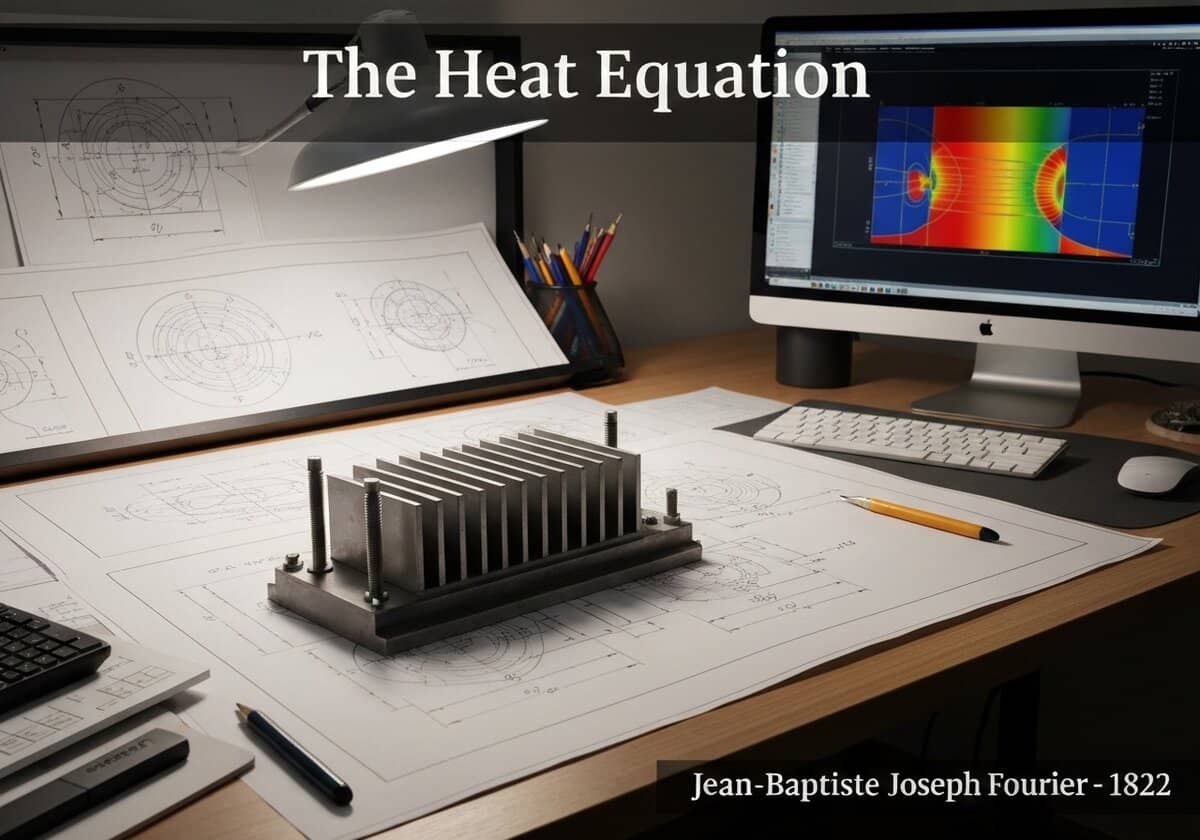
基本的な2次線形放物線 偏微分 熱分布やその他の拡散過程を記述する方程式。その標準形は [latex]frac{partial u}{partial t} = alpha nabla^2 u[/latex] であり、[latex]u(vec{x},t)[/latex] は温度、[latex]t[/latex] は時間、[latex]alpha[/latex] は熱拡散率である。解は、初期温度分布がどのように変化し、時間の経過とともに不規則性が平滑化されて定常状態に近づくかをモデル化する。


(画像はイメージです)
基本的な2次線形放物線 偏微分 熱分布やその他の拡散過程を記述する方程式。その標準形は [latex]frac{partial u}{partial t} = alpha nabla^2 u[/latex] であり、[latex]u(vec{x},t)[/latex] は温度、[latex]t[/latex] は時間、[latex]alpha[/latex] は熱拡散率である。解は、初期温度分布がどのように変化し、時間の経過とともに不規則性が平滑化されて定常状態に近づくかをモデル化する。

The heat equation is the prototypical example of a parabolic PDE. The term [latex]\nabla^2[/latex] is the Laplace operator, which in one spatial dimension [latex]x[/latex] simplifies the equation to [latex]u_t = \alpha u_{xx}[/latex]. The constant [latex]\alpha[/latex] represents the thermal diffusivity of the material, a measure of how quickly heat spreads. A key property of the heat equation is its ‘infinite speed of propagation’; a change in temperature at any point is felt instantaneously, though infinitesimally, everywhere else in the domain. This is a mathematical idealization of the rapid nature of diffusion.
もう一つの特徴は、その平滑化効果です。初期温度分布[latex]u(vec{x},0)[/latex]が不連続(例えば、温度が急激に変化する)であっても、任意の時刻[latex]t > 0[/latex]における解[latex]u(vec{x},t)[/latex]は無限に微分可能(滑らか)になります。これは、急激な温度勾配は維持できず、すぐに均一化され始めるという物理的現実を反映しています。熱方程式の最大値原理は、[latex]u[/latex]の最大値は初期時刻または空間領域の境界で発生しなければならないことを示しており、これは材料内部に新たなホットスポットが自然に発生することはないことを意味します。
Solutions are often found using the method of separation of variables or by employing Fourier transforms, which were developed by Fourier precisely for this purpose. The fundamental solution, known as the heat kernel, represents the temperature distribution resulting from an initial point source of heat.
ボットによるトラフィック(現在1日あたり4万件以上)を排除するため、このコンテンツはコミュニティメンバー限定となっています。
> ログイン < または > 登録 < (100%無料)でこれにアクセスできます。他のすべての制限付きコンテンツとツールも同様です。
熱方程式
(日付が不明または関連性がない場合、例えば「流体力学」などでは、その注目すべき出現時期の概算値が提示されます。)
フルサイズの画像とダウンロードは、登録会員のみが100%無料で利用できます。
> ログイン <