Product Design, Manufacturing & Innovation Resources
» 電極触媒作用

電極触媒作用

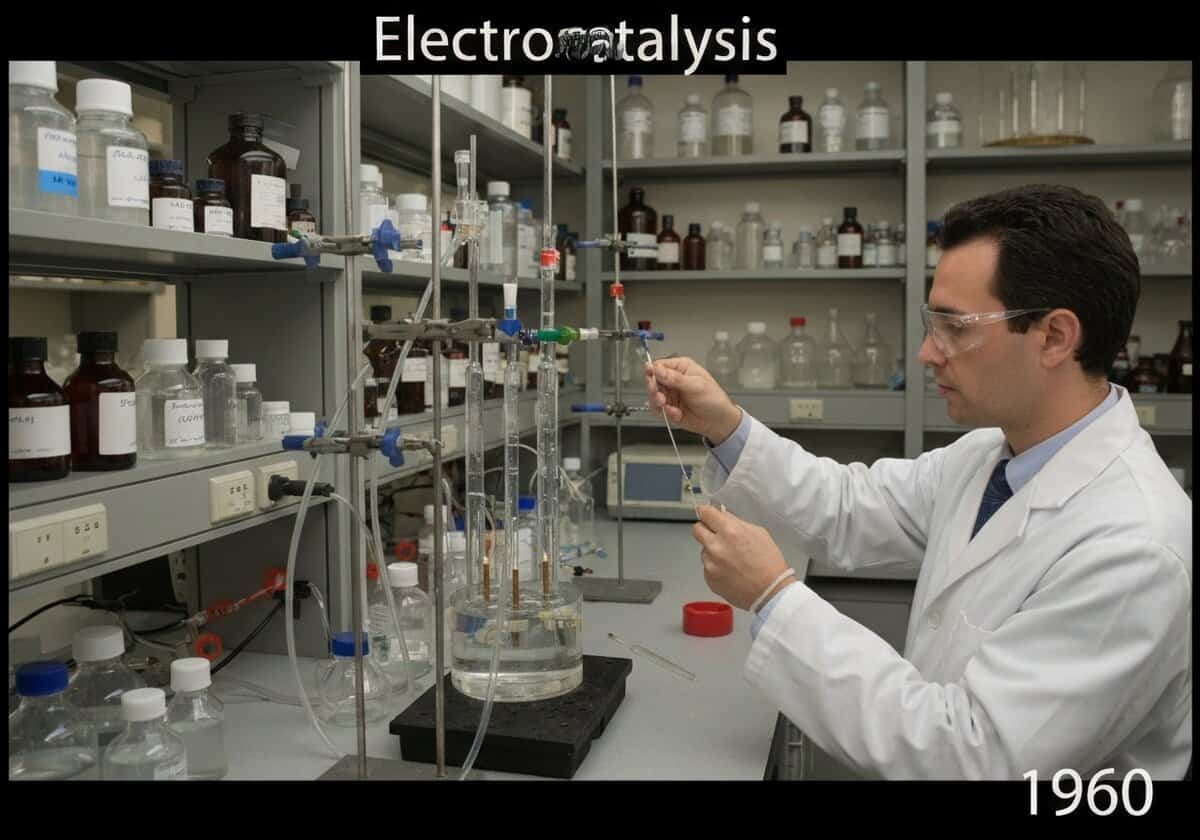
1960
Electrocatalysis research in a laboratory with electrochemical cell setup.

(画像はイメージです)

Electrocatalysis is a specific form of catalysis that accelerates the rate of electrochemical reactions occurring at an electrode surface. It is a subfield of both catalysis and electrochemistry. Electrocatalysts are crucial for increasing the efficiency and lowering the overpotential (the extra voltage required to drive a reaction at a reasonable rate) for key energy conversion reactions.
Electrocatalysis is fundamentally linked to heterogeneous catalysis but with the added dimension of an applied electrical potential controlling the reaction’s driving force. The catalyst is the electrode material itself or a substance coated onto it. Its function is to lower the activation energy for electron transfer steps. A key performance metric for an electrocatalyst is the overpotential ([latex]\eta[/latex]), defined as the difference between the thermodynamic potential and the actual potential required to achieve a certain current density. An efficient electrocatalyst minimizes [latex]\eta[/latex].

The performance is often analyzed using a Tafel plot, which shows a linear relationship between the logarithm of the current density ([latex]log(j)[/latex]) and the overpotential ([latex]eta[/latex]). The slope of this plot, the Tafel slope, provides insight into the reaction mechanism. For example, the oxygen evolution reaction (OER) and oxygen reduction reaction (ORR) are notoriously sluggish, requiring large overpotentials. Developing cheap, abundant, and efficient electrocatalysts (e.g., alternatives to platinum) for these reactions is a major goal in renewable energy research, as they are critical for technologies like water electrolyzers, fuel cells, and metal-air batteries. The Sabatier principle also applies here, stating that the ideal catalyst binds intermediates neither too strongly nor too weakly.

UNESCO Nomenclature: 2202
物理化学

タイプ

化学プロセス

混乱

実質的な

使用法

広く普及している

前駆物質

  • Michael Faraday’s laws of electrolysis
  • Walther Nernst’s work on the thermodynamics of electrochemical cells
  • Julius Tafel’s discovery of the relationship between current and overpotential
  • development of the potentiostat for electrochemical measurements

アプリケーション

  • fuel cells (e.g., hydrogen oxidation and oxygen reduction reactions)
  • water electrolyzers for hydrogen production
  • electrosynthesis of chemicals
  • corrosion prevention
  • electrochemical sensors

特許:

NA

潜在的なイノベーションのアイデア

ボットによるトラフィック(現在1日あたり4万件以上)を排除するため、このコンテンツはコミュニティメンバー限定となっています。
> ログイン < または > 登録 < (100%無料)でこれにアクセスできます。他のすべての制限付きコンテンツとツールも同様です。

Related to: electrocatalysis, electrochemistry, overpotential, fuel cell, water splitting, electrode, Tafel plot, oxygen evolution reaction, electron transfer, current density.

歴史的背景

電極触媒作用

1960
1960
1960
1960
1960
1960-05-16
1962
1960
1960
1960
1960
1960
1960
1961
1962

(日付が不明または関連性がない場合、例えば「流体力学」などでは、その注目すべき出現時期の概算値が提示されます。)

関連する発明、革新、および技術原理

フルサイズの画像とダウンロードは、登録会員のみが100%無料で利用できます。