Product Design, Manufacturing & Innovation Resources
» アース・オーバーシュート・デー(EOD)

アース・オーバーシュート・デー(EOD)

2006
  • Andrew Simms
Environmental awareness campaign highlighting Earth Overshoot Day in human ecology.

(画像はイメージです)

Earth Overshoot Day (EOD) is the calculated illustrative calendar date on which humanity’s demand for ecological resources and services in a given year exceeds what Earth can regenerate in that year. It marks the point where human consumption shifts from using the planet’s annual ecological interest to depleting its principal natural capital, effectively living on credit.

The concept of Earth Overshoot Day was conceived by Andrew Simms of the New Economics Foundation, a UK-based think tank. The primary goal was to create a simple, powerful, and easily understandable communication tool to highlight the scale of global resource unsustainability. While the underlying data and calculations are complex, framing the result as a specific calendar date makes the abstract notion of ecological deficit tangible and relatable to the general public. Each year, the Global Footprint Network, which partnered with Simms’ organization in 2006 to launch the first global EOD campaign, calculates the date. The campaign uses this date to raise awareness and encourage action from individuals, organizations, and governments. The narrative is compelling: the earlier the date falls in the year, the greater the ecological deficit. For instance, in 1971, the date was in late December, indicating a near balance. By the 2020s, it has consistently fallen in July or August, visually demonstrating that humanity is using approximately 1.7 Earths’ worth of resources annually. This framing helps to catalyze discussions on topics like circular economy, renewable energy, sustainable agriculture, and population growth, making it a cornerstone of modern environmental advocacy.

計算

The date for Earth Overshoot Day is determined by a rather simple formula that compares the planet’s ecological supply with human demand. The calculation is: [latex]\frac{\text{World Biocapacity}}{\text{World Ecological Footprint}} \times 365[/latex]. The result is the number of days in the year that Earth’s regeneration is sufficient to provide for humanity’s consumption, with the following day being Earth Overshoot Day.

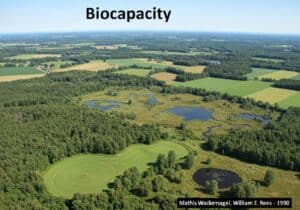
The formula’s two core components are the Ecological Footprint and Biocapacity, both developed by Mathis Wackernagel and William Rees. The Ecological Footprint represents the demand side, quantifying the biologically productive land and sea area required to produce all the resources a population consumes and to absorb its waste, particularly carbon emissions. The Biocapacity represents the supply side, measuring the productivity of a region’s ecological assets, such as forests, croplands, and fishing grounds. Both metrics are measured in a standardized unit called a ‘global hectare’ to allow for aggregation and comparison. The Global Footprint Network calculates these values for the entire world and for individual nations using data from sources like the United Nations Food and Agriculture Organization (FAO) and the International Energy Agency (IEA). The calculation is performed annually using the most recent available data, which typically has a lag of a few years. The result of the fraction (Biocapacity / Footprint) represents the portion of the year that humanity lives within the planet’s means. For example, if the ratio is 0.75, it means humanity’s demand is met for 75% of the year, or approximately 274 days, making the 275th day Earth Overshoot Day.

UNESCO Nomenclature: 2506
生態学

タイプ

抽象システム

混乱

実質的な

使用法

広く普及している

前駆物質

  • concept of carrying capacity in ecology
  • the limits to growth report (1972)
  • development of ecological footprint accounting
  • development of biocapacity accounting
  • thermoeconomics and energy accounting principles

アプリケーション

  • environmental awareness campaigns by ngos like wwf
  • framework for corporate sustainability reporting
  • educational tool in schools and universities for teaching resource management
  • basis for national and municipal environmental policy discussions
  • visual communication tool for media outlets reporting on climate change and resource depletion

特許:

NA

潜在的なイノベーションのアイデア

ボットによるトラフィック(現在1日あたり4万件以上)を排除するため、このコンテンツはコミュニティメンバー限定となっています。
> ログイン < または > 登録 < (100%無料)でこれにアクセスできます。他のすべての制限付きコンテンツとツールも同様です。

Related to: earth overshoot day, sustainability, ecological deficit, resource depletion, environmental awareness, new economics foundation, Andrew Simms, global footprint network, natural capital, consumption.

歴史的背景

アース・オーバーシュート・デー(EOD)

1990
1990
2000
2006
1990
1990
1993
2001-09-01

(日付が不明または関連性がない場合、例えば「流体力学」などでは、その注目すべき出現時期の概算値が提示されます。)

関連する発明、革新、および技術原理

フルサイズの画像とダウンロードは、登録会員のみが100%無料で利用できます。