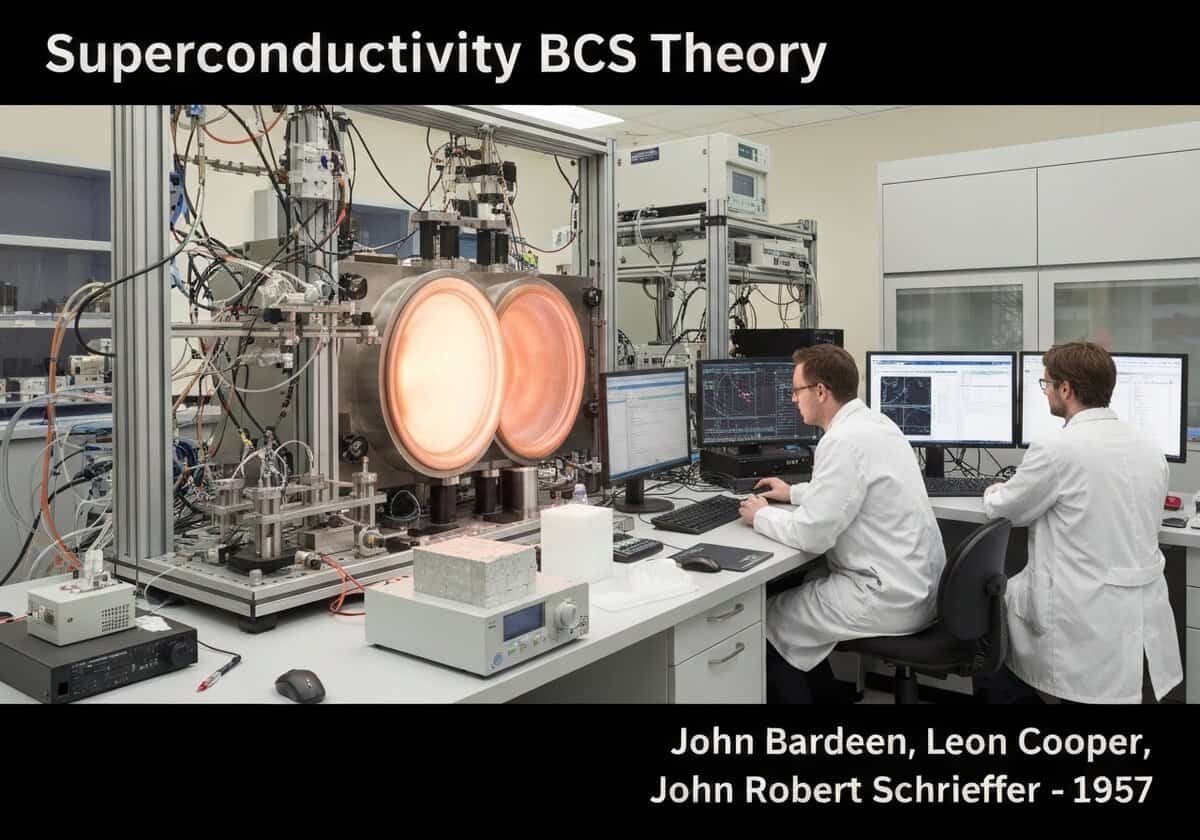
1957年にジョン・バーディーン、レオン・クーパー、ロバート・シュリーファーによって開発されたBCS理論は、従来の超伝導現象を微視的に説明する理論である。この理論によれば、臨界温度(T_c)以下では、電子は静電反発力を克服し、結晶格子(フォノン)との相互作用によってクーパー対と呼ばれる束縛対を形成することができる。これらの対はボソンのように振る舞い、単一の巨視的な量子状態に凝縮することができる。
(画像はイメージです)
1957年にジョン・バーディーン、レオン・クーパー、ロバート・シュリーファーによって開発されたBCS理論は、従来の超伝導現象を微視的に説明する理論である。この理論によれば、臨界温度(T_c)以下では、電子は静電反発力を克服し、結晶格子(フォノン)との相互作用によってクーパー対と呼ばれる束縛対を形成することができる。これらの対はボソンのように振る舞い、単一の巨視的な量子状態に凝縮することができる。
The BCS theory was a monumental achievement that solved a 46-year-old puzzle in physics. Its central concept is the Cooper pair. In a normal metal, electrons move independently and scatter off impurities and lattice vibrations (phonons), which causes electrical resistance. In the BCS model, an electron moving through the crystal lattice attracts the positive ions, creating a slight distortion or ripple in the lattice. This region of increased positive charge can then attract a second electron. This indirect, phonon-mediated attraction can overcome the direct Coulomb repulsion between the two electrons, binding them into a Cooper pair. These pairs have an integer spin (0 or 1), making them bosons, unlike individual electrons which are fermions. According to quantum statistics, bosons are not subject to the Pauli exclusion principle and can all occupy the same lowest-energy quantum state. Below [latex]T_c[/latex], a significant fraction of Cooper pairs condenses into this single macroscopic ground state, described by a single wave function. This condensate of pairs can move through the lattice without scattering, as scattering a single pair would require enough energy to break it apart and excite both electrons, an energy given by the superconducting energy gap, [latex]\Delta[/latex]. At low temperatures, this energy is not available, leading to zero resistance. The theory successfully predicted the isotope effect, where [latex]T_c \propto M^{-1/2}[/latex] (M is the isotopic mass), and provided a formula for the critical temperature: [latex]k_B T_c \approx 1.13 \hbar \omega_D \exp(-1/N(0)V)[/latex], linking [latex]T_c[/latex] to the Debye frequency [latex]\omega_D[/latex], the density of states [latex]N(0)[/latex], and the electron-phonon interaction potential [latex]V[/latex].
ボットによるトラフィック(現在1日あたり4万件以上)を排除するため、このコンテンツはコミュニティメンバー限定となっています。
> ログイン < または > 登録 < (100%無料)でこれにアクセスできます。他のすべての制限付きコンテンツとツールも同様です。
超伝導BCS理論
(日付が不明または関連性がない場合、例えば「流体力学」などでは、その注目すべき出現時期の概算値が提示されます。)

フルサイズの画像とダウンロードは、登録会員のみが100%無料で利用できます。
> ログイン <