Strings Comparison Algorithms compared with Diffchecker, Beyond Compare and Python difflib| Strings Comparison Algorithms | Diffchecker | Beyond Compare | Python difflib |
|---|
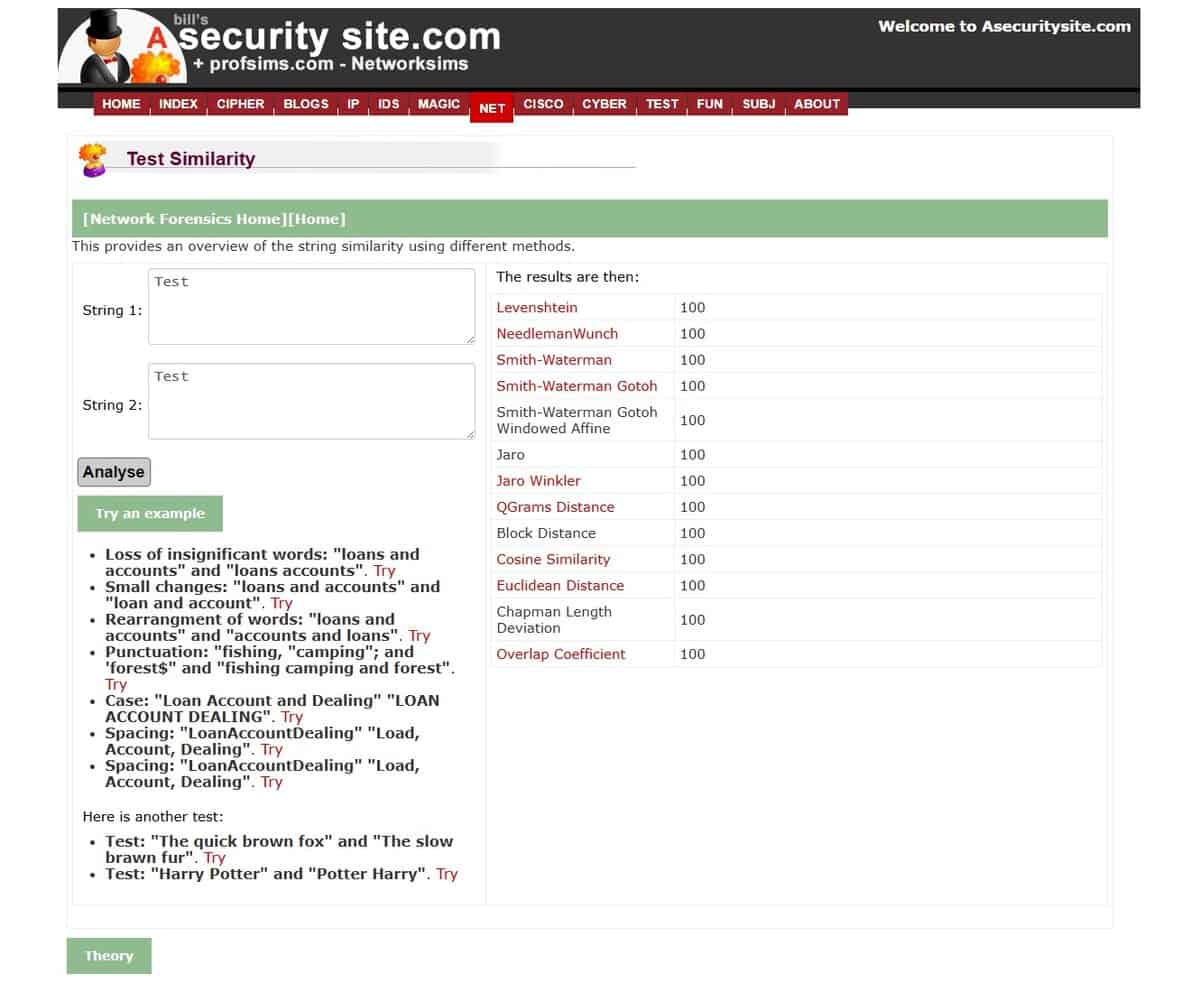
| What it measures: The page takes two sample strings and runs 13 algorithms at once, returning a similarity percentage for each. You can then pick the algorithm and the threshold that fit your data. | What it measures: The vendor describes core side-by-side comparison of two texts or files, plus Redline and folder or batch comparison on paid plans. The pricing page does not mention selectable similarity metrics. | What it measures: The vendor describes comparison of folders, text files, images and tables, with syntax highlighting and comparison rules for documents and source code. | What it measures: SequenceMatcher.ratio() returns a float between 0 and 1 computed as 2.0*M/T, where M is the number of matches and T the total number of elements in both sequences. |
| Algorithm basis: The list includes Levenshtein, Needleman-Wunsch, Smith-Waterman (with Gotoh variants), Jaro, Jaro-Winkler, q-grams, block distance, cosine similarity, Euclidean distance, Chapman length deviation and overlap coefficient. Edit-distance and alignment methods sit side by side. | | | Algorithm basis: The matching method is described as a little fancier than the Ratcliff-Obershelp gestalt algorithm. The documentation does not mention Levenshtein distance. |
| Use in code: Some of the listed algorithms ship with common languages, while others need external libraries or your own implementation. | Use in code: Separate API plans allow the comparison engine to be embedded in other applications. | Use in code: A scripting language is offered to automate syncs. | Use in code: It belongs to the Python standard library. get_close_matches(word, possibilities, n=3, cutoff=0.6) returns the best candidates. Worst-case time is quadratic, and strings of 200 or more items trigger an automatic junk heuristic that can be disabled with autojunk=False. |
| Licence, cost and platform: The page runs in the browser and sits behind a bot-blocking wall. A price or licence is not stated in the material available. | Licence, cost and platform: The Basic plan is free with no file size limit, but many Pro features are capped at about 5 to 10 uses monthly. Pro with desktop app is a paid per-seat plan, and the desktop app runs on Windows, Mac and Linux. | Licence, cost and platform: A per-user licence in Standard and Pro editions is a one-time purchase with no annual renewal fees. It runs on Windows, macOS and Linux and can be evaluated for free. | Licence, cost and platform: No separate cost, since it ships with Python. The documentation is under the Python Software Foundation License Version 2. |