Teoria atomica moderna
1808
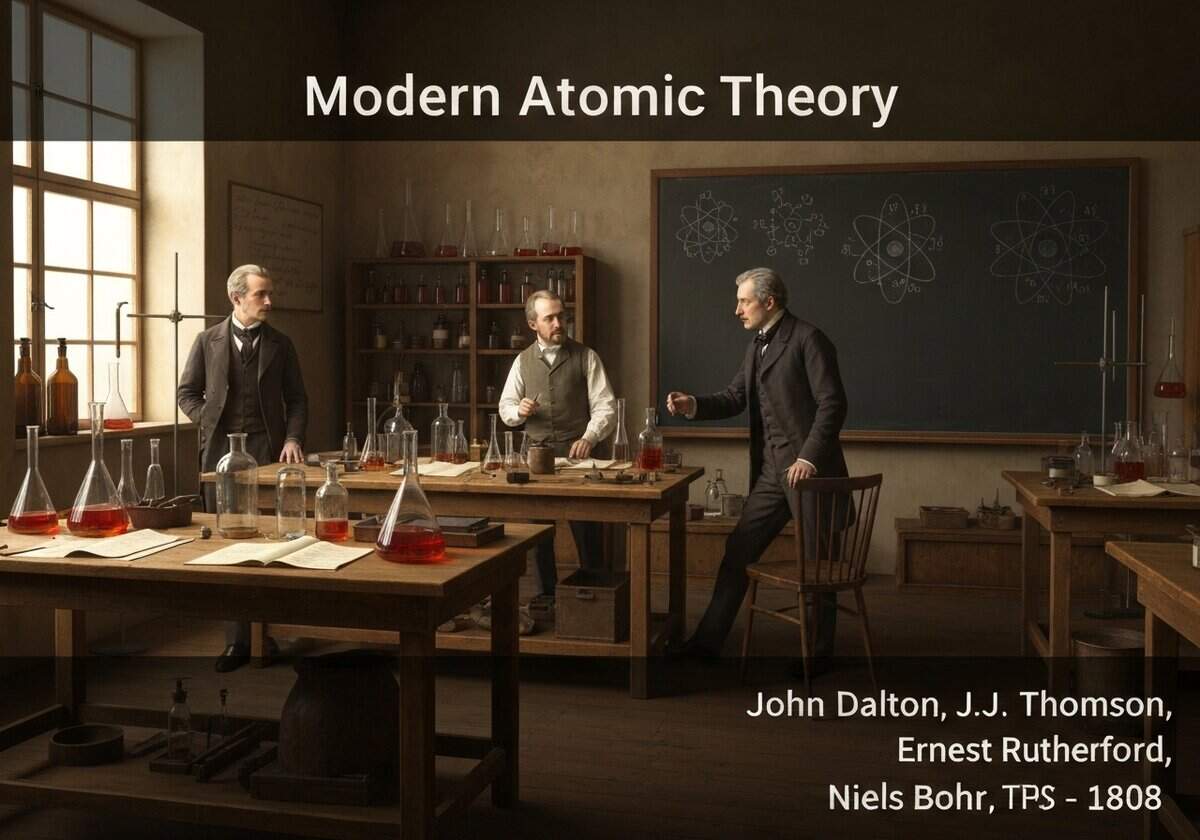
- John Dalton
- J.J. Thomson
- Ernest Rutherford
- Niels Bohr
La teoria atomica postula che tutta la materia sia composta da unità discrete chiamate atomi. Un elemento è costituito da atomi con un numero specifico di protoni nel nucleo. Sebbene un tempo fossero considerati indivisibili, ora si sa che gli atomi sono composti da particelle subatomiche: protoni, neutroni ed elettroni. Le reazioni chimiche comportano la riorganizzazione di questi atomi, che si conservano durante il processo.
The modern understanding of the atom is the result of a series of revolutionary discoveries that refined initial concepts. John Dalton’s early 19th-century theory provided the first scientific framework, postulating that elements were made of identical, indivisible atoms and that compounds were combinations of these atoms in fixed ratios. This explained the laws of mass conservation and definite proportions. However, the discovery of the electron by J.J. Thomson in 1897 proved that atoms were divisible. He proposed the ‘plum pudding’ model, with electrons embedded in a sphere of positive charge.
This model was overturned by Ernest Rutherford’s gold foil experiment in 1909. By firing alpha particles at a thin gold foil, he observed that while most passed through, a few were deflected at large angles. This implied a small, dense, positively charged nucleus, leading to his planetary model of the atom with electrons orbiting the nucleus. Niels Bohr refined this in 1913 by incorporating quantum ideas, proposing that electrons exist in specific, quantized energy levels or orbits. This model successfully explained the emission spectra of hydrogen. The final major evolution was the development of quantum mechanics in the 1920s by Schrödinger, Heisenberg, and others. In the current quantum mechanical model, electrons do not have fixed orbits but exist in probability distributions called orbitals, described by wavefunctions. This sophisticated model is the foundation for understanding chemical bonding, reactivity, and the properties of all matter.
UNESCO Nomenclature: 2201
- Fisica atomica e molecolare
Interruzione
Rivoluzionario
Precursori
- concetto greco di ‘atomos’ (Democrito, Leucippo)
- legge di conservazione della massa (Lavoisier)
- legge delle proporzioni definite (Joseph Proust)
- legge delle proporzioni multiple (John Dalton)
Applicazioni
- sviluppo della tavola periodica
- comprendere il legame chimico e la struttura molecolare
- energia nucleare e armi
- nanotecnologia
- tecnologia dei semiconduttori ed elettronica
- spettroscopia per l'analisi dei materiali
Idee e potenziali innovazioni
A causa dell'eliminazione del traffico generato dai bot, che attualmente supera i 40.000 al giorno, questo contenuto è riservato ai membri della community.
> Accedi O > Registrati L'accesso a questo contenuto, così come a tutti gli altri contenuti e strumenti riservati, è (100% gratuito).
Correlato a: atomo, teoria atomica, John Dalton, nucleo, protone, neutrone, elettrone, meccanica quantistica, particelle subatomiche, elemento chimico.