Teoría atómica moderna
1808
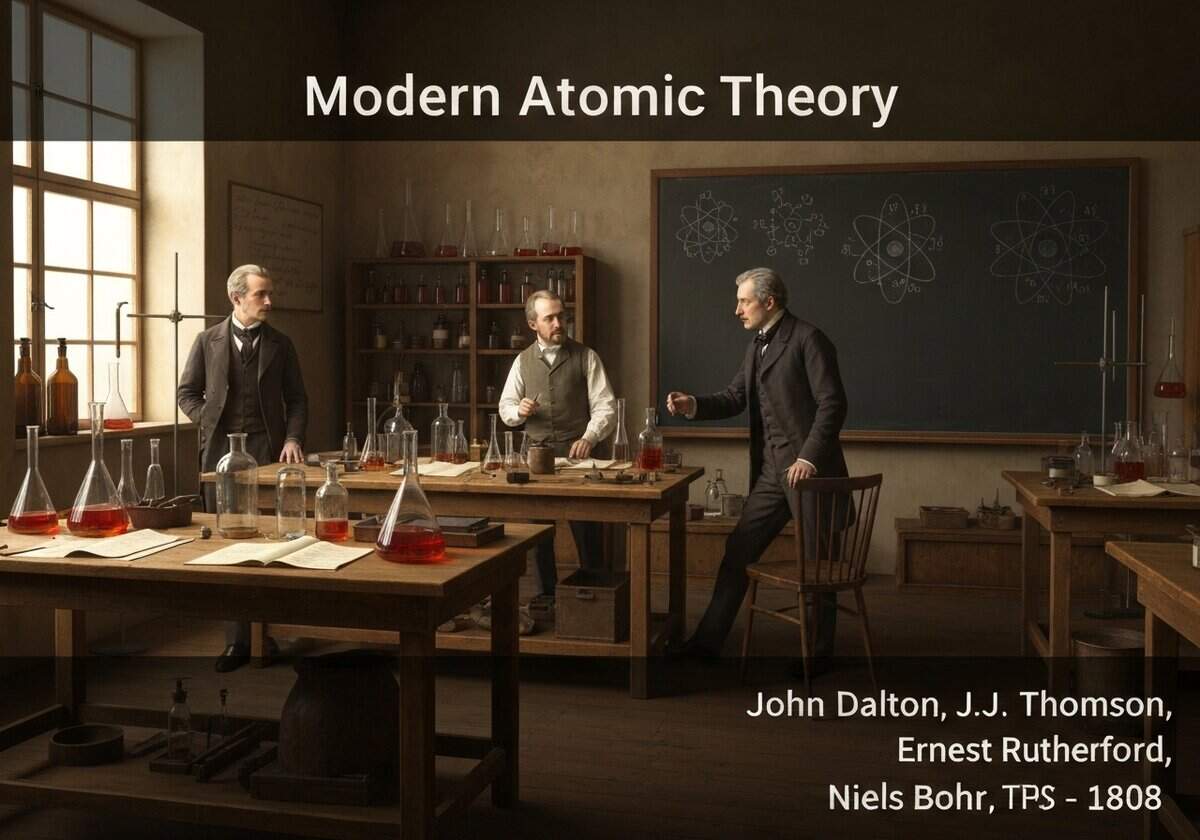
- John Dalton
- J.J. Thomson
- Ernest Rutherford
- Niels Bohr
La teoría atómica postula que toda la materia está compuesta de unidades discretas llamadas átomos. Un elemento está formado por átomos con un número específico de protones en su núcleo. Si bien antes se consideraban indivisibles, ahora se sabe que los átomos están compuestos por partículas subatómicas: protones, neutrones y electrones. Las reacciones químicas implican la reorganización de estos átomos, que se conservan durante el proceso.
The modern understanding of the atom is the result of a series of revolutionary discoveries that refined initial concepts. John Dalton’s early 19th-century theory provided the first scientific framework, postulating that elements were made of identical, indivisible atoms and that compounds were combinations of these atoms in fixed ratios. This explained the laws of mass conservation and definite proportions. However, the discovery of the electron by J.J. Thomson in 1897 proved that atoms were divisible. He proposed the ‘plum pudding’ model, with electrons embedded in a sphere of positive charge.
This model was overturned by Ernest Rutherford’s gold foil experiment in 1909. By firing alpha particles at a thin gold foil, he observed that while most passed through, a few were deflected at large angles. This implied a small, dense, positively charged nucleus, leading to his planetary model of the atom with electrons orbiting the nucleus. Niels Bohr refined this in 1913 by incorporating quantum ideas, proposing that electrons exist in specific, quantized energy levels or orbits. This model successfully explained the emission spectra of hydrogen. The final major evolution was the development of quantum mechanics in the 1920s by Schrödinger, Heisenberg, and others. In the current quantum mechanical model, electrons do not have fixed orbits but exist in probability distributions called orbitals, described by wavefunctions. This sophisticated model is the foundation for understanding chemical bonding, reactivity, and the properties of all matter.
UNESCO Nomenclature: 2201
- Física atómica y molecular
Precursores
- concepto griego antiguo de ‘átomos’ (Demócrito, Leucipo)
- ley de conservación de la masa (Lavoisier)
- ley de proporciones definidas (Joseph Proust)
- ley de proporciones múltiples (John Dalton)
Aplicaciones
- desarrollo de la tabla periódica
- Comprender el enlace químico y la estructura molecular
- energía nuclear y armas
- nanotecnología
- tecnología de semiconductores y electrónica
- espectroscopia para análisis de materiales
Ideas para posibles innovaciones
Debido al bloqueo del tráfico generado por bots, que actualmente supera los 40.000 al día, este contenido está reservado para los miembros de la comunidad.
> Iniciar sesión < o > Registrarse < (100% gratis) para acceder a esto, al igual que a todo el demás contenido y herramientas restringidos.
Relacionado con: átomo, teoría atómica, John Dalton, núcleo, protón, neutrón, electrón, mecánica cuántica, partículas subatómicas, elemento químico.