Product Design, Manufacturing & Innovation Resources
घर » Exothermic Welding

Exothermic Welding

1899-01-01
  • Hans Goldschmidt
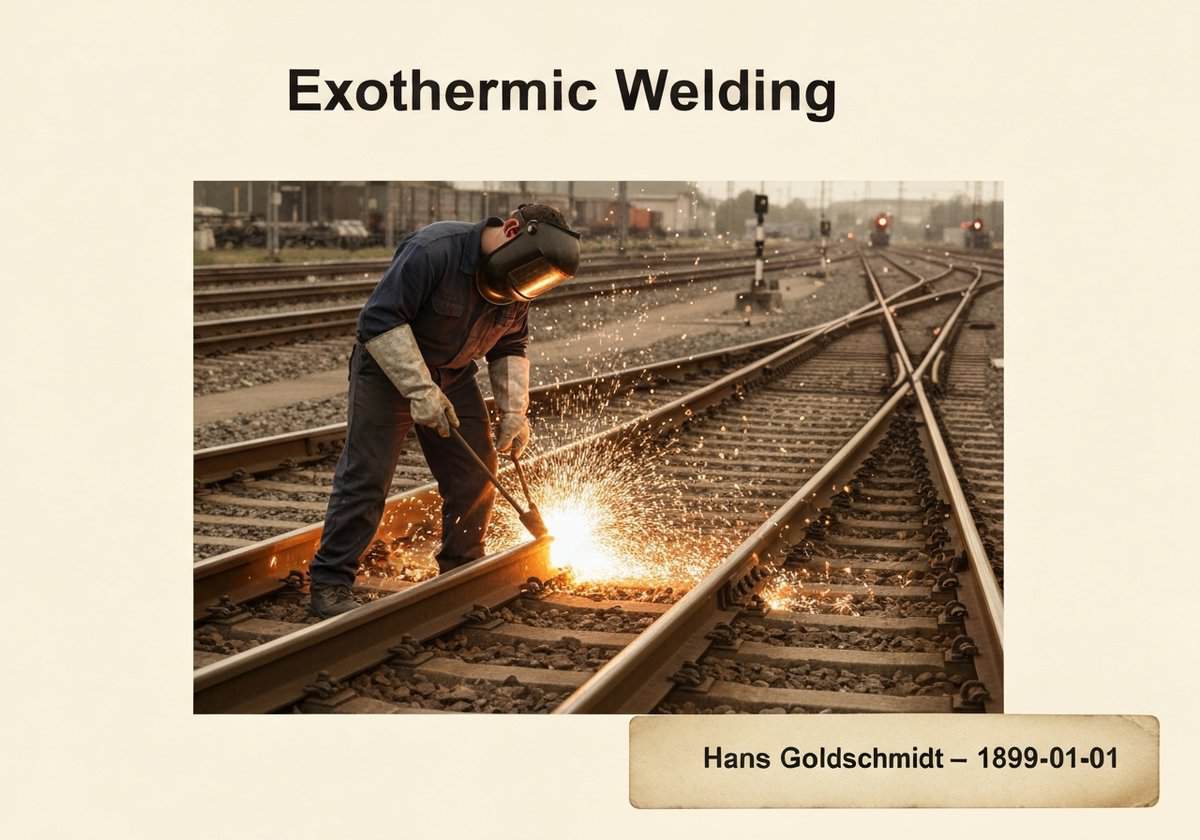
पटरियों पर एक्सोथर्मिक वेल्डिंग करने वाला तकनीशियन, अनुप्रयुक्त यांत्रिकी, वेल्डिंग प्रौद्योगिकी।.

(यह छवि केवल उदाहरण के लिए बनाई गई है)

Exothermic welding, also known as thermite welding, is a technique that uses the superheated molten metal from an aluminothermic reaction to create a strong, permanent molecular bond between metal components. The process is self-contained, requiring no external power source. It is most famously used to join sections of railway track into continuous welded rail, creating a smoother and more durable track.

The process of exothermic welding begins with the precise alignment of the two metal pieces to be joined, leaving a specific gap between them. A refractory mold, designed to match the cross-section of the parts, is clamped around the joint. The metal ends are often preheated with a torch to remove moisture and ensure a good fusion. A crucible containing the thermite charge is placed over the mold. After the thermite is ignited, the exothermic reaction proceeds inside the crucible, producing molten metal (e.g., steel) and a lighter slag of aluminum oxide. Once the reaction is complete, a tapping mechanism at the bottom of the crucible is opened, allowing the heavier molten metal to flow down into the mold cavity. The superheated liquid metal fills the gap, melting the surfaces of the parent metal pieces and fusing with them. The lighter aluminum oxide slag flows in last, filling the top of the mold and forming a protective layer over the molten steel, shielding it from atmospheric contamination as it cools.

After a prescribed cooling and solidification period, the mold is removed, and any excess metal and slag are trimmed away, typically by grinding, to produce a smooth, continuous joint. The resulting weld is not just a filler but a cast steel fusion that has a microstructure similar to the parent metal, resulting in excellent mechanical and electrical properties. Its primary advantage is its portability and independence from electricity, making it the ideal method for creating strong, reliable welds on large components in remote field locations.

UNESCO Nomenclature: 3301
– Applied mechanics

Type

औद्योगिक प्रक्रिया

व्यवधान

संतोषजनक

उपयोग

व्यापक उपयोग

शगुन

  • the invention of the goldschmidt process itself
  • advances in metallurgy and the understanding of steel and iron properties
  • development of refractory materials (ceramics) capable of containing molten metal
  • the expansion of railway networks, which created a demand for more durable rail joints than mechanical fishplates

आवेदन

  • welding railway rails into continuous welded rail (cwr)
  • joining large copper conductors for electrical grounding grids (e.g., at substations)
  • repairing heavy steel castings or forgings that are too large for conventional welding
  • attaching cathodic protection anodes to steel pipelines
  • creating permanent electrical connections in lightning protection systems

पेटेंट:

    संभावित नवाचार विचार

    बॉट ट्रैफिक को कम करने के कारण, जो वर्तमान में प्रति दिन 40,000 से अधिक है, यह सामग्री केवल समुदाय के सदस्यों के लिए आरक्षित है।
    > लॉगिन < या > रजिस्टर < इस सामग्री और अन्य सभी प्रतिबंधित सामग्रियों और उपकरणों तक पहुंच (100% निःशुल्क) है।

    Related to: exothermic welding, thermite welding, railway, rail, continuous welded rail, crucible, molten metal, joining, metallurgy, grounding.

    ऐतिहासिक संदर्भ

    Exothermic Welding

    1884
    1890
    1890
    1899-01-01
    1900
    1903
    1906
    1882-01-01
    1886-04-23
    1890
    1897
    1900
    1900
    1903-05-10
    1910

    (यदि तिथि अज्ञात है या प्रासंगिक नहीं है, उदाहरण के लिए "द्रव यांत्रिकी", तो इसके उल्लेखनीय उद्भव का एक अनुमानित आंकड़ा प्रदान किया गया है)

    संबंधित आविष्कार, नवाचार और तकनीकी सिद्धांत

    पंजीकृत सदस्यों के लिए पूर्ण आकार की छवियाँ और डाउनलोड 100% निःशुल्क उपलब्ध हैं।