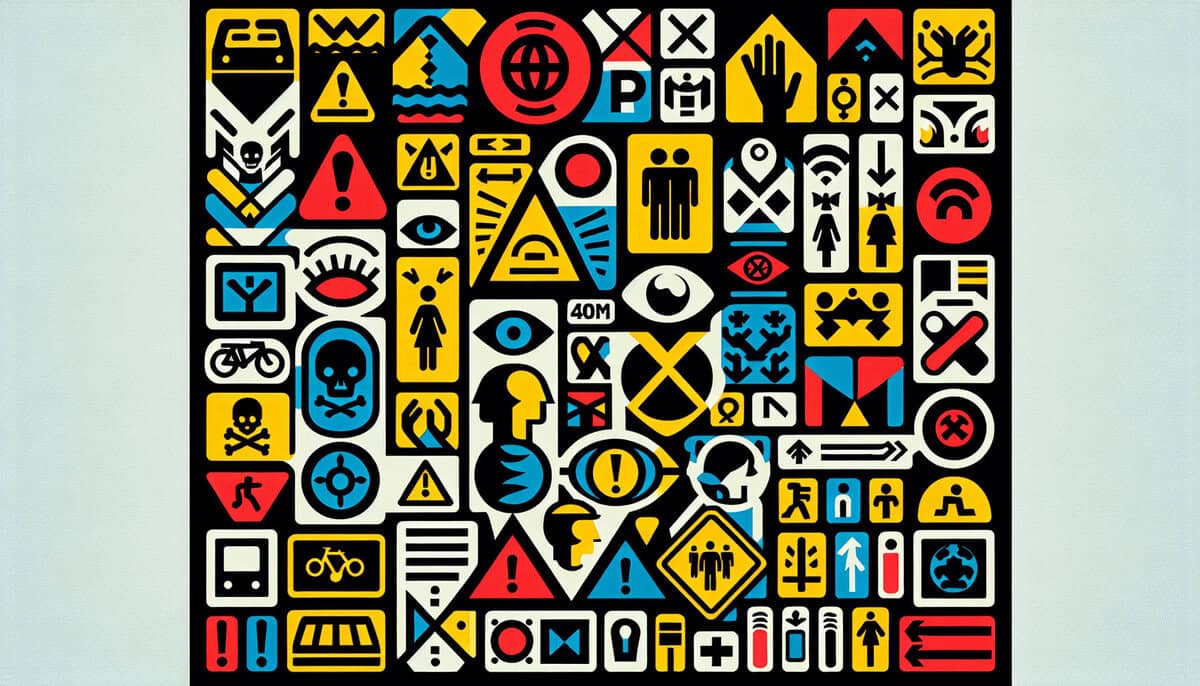
Los colores y los símbolos gráficos se utilizan a menudo para transmitir tipos específicos de información en diversos contextos, de forma rápida y eficaz, sin necesidad de traducción. Los colores suelen combinarse con símbolos para enfatizar el mismo mensaje y la misma importancia.
- Red: indicates urgency, danger, or importance. It’s commonly used in warning signs, emergency alerts, and to denote critical information
- Yellow: represents caution or a need for attention. It’s frequently used in traffic signals, hazard warnings, and to highlight advisory information.
- Green: signifies safety, permission, or positive status. It’s often seen in indicators for safe conditions, approval statuses, and to convey reassuring information.
- Blue: usually denotes informational content, trustworthiness, or neutrality. It’s widely used in informational signage, corporate branding, and to present general information without urgency.
- Black: associated with authority, formality, or severity. It’s commonly used in legal documents, formal communications, and to convey serious or critical information.
- Road symbols: stop sign, speed limit sign, pedestrian crossing sign, no parking sign …
- Indoors: exit sign, restroom symbols, elevator and staircase symbols, information desk Icon, no smoking sign …
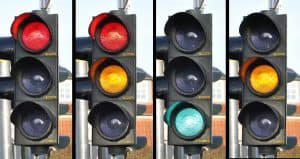
These color associations and signs can vary based on cultural contexts and specific applications, but they generally follow conventions or standards to facilitate effective comunicación. Find below an extensive list of applicable color coding and symbols standards, labelling and packaging requirements for most industrial sectors.
(haga clic en cualquier nodo intermedio para ampliar el árbol. Pase el ratón por encima del nombre de la norma para ver su título completo. Pulse sobre ella para visitar a uno de los proveedores)
Nota: este árbol se genera parcialmente de forma automática y está pensado para una primera aproximación global. Compruebe dos veces los requisitos y la integridad (ejemplo de error: enumerar la norma sobre metales de tierras raras para una resonancia magnética no es apropiado. Una resonancia magnética no tiene imán real).
Consulte los organismos oficiales de normalización que figuran en nuestra directorio de herramientas.