Product Design, Manufacturing & Innovation Resources
Hogar » Regenerador y economizador de motor Stirling

Regenerador y economizador de motor Stirling

1816-11-16
  • Robert Stirling
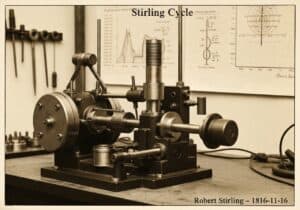
Matriz regeneradora de un motor Stirling que demuestra el almacenamiento de energía térmica en termodinámica.

(Imagen generada únicamente con fines ilustrativos)

El regenerador, o «economizador», es la contribución más importante de Robert Stirling y la clave de la alta eficiencia del motor. Se trata de un intercambiador de calor interno que almacena y libera energía térmica temporalmente durante el ciclo. A medida que el gas caliente se desplaza hacia el lado frío, deposita calor en la matriz del regenerador, que luego es absorbido por el gas frío en su viaje de regreso al lado caliente.
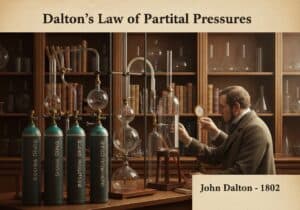
The regenerator’s function is to pre-cool the working gas before it enters the main cooler and pre-heat it before it enters the main heater. This dramatically reduces the amount of heat that must be added from the external source and rejected to the external sink during the isochoric (constant volume) phases of the cycle. In an ideal regenerator, the heat transferred from the gas to the matrix during the isochoric cooling process is exactly equal to the heat transferred back to the gas during the isochoric heating process. This internal heat recycling is what allows the ideal Stirling cycle’s efficiency to match the Carnot efficiency.

Designing an effective regenerator involves a careful balance of competing factors. It must have a high heat capacity to store sufficient energy, a large internal surface area for rapid heat transfer, and high thermal conductivity perpendicular to the gas flow to facilitate this transfer. However, it must also have low thermal conductivity parallel to the gas flow to prevent heat from simply bypassing the cycle and conducting from the hot to the cold end. Furthermore, it must have low aerodynamic resistance to minimize the work needed to pump the gas through it, and it must contain a minimal volume of gas (dead volume) to maximize the engine’s compression ratio. Common materials include stacks of fine metal wire mesh, metal foams, or ceramic matrices.

UNESCO Nomenclature: 2212
- Termodinámica

Tipo

Dispositivo físico

Ruptura

Revolucionario

Uso

Uso generalizado

Precursores

  • Principios básicos de la transferencia de calor (conducción, convección)
  • Comprensión de la capacidad térmica de los materiales.
  • Primeros diseños de intercambiadores de calor y recuperadores en hornos industriales

Aplicaciones

  • Motores Stirling de alta eficiencia para energía solar y cogeneración
  • Enfriadores criogénicos y refrigeradores de tubos de pulso donde la regeneración es fundamental para alcanzar temperaturas criogénicas.
  • motores y refrigeradores termoacústicos
  • procesos de separación de gases
  • refrigeradores criogénicos giromill
  • ciertos tipos de bombas de calor de ciclo de gas

Patentes:

  • GB 4081 of 1816

Ideas para posibles innovaciones

Debido al bloqueo del tráfico generado por bots, que actualmente supera los 40.000 al día, este contenido está reservado para los miembros de la comunidad.
> Iniciar sesión < o > Registrarse < (100% gratis) para acceder a esto, al igual que a todo el demás contenido y herramientas restringidos.

Related to: regenerator, heat exchanger, thermal efficiency, stirling engine, isochoric process, heat storage, working fluid, Carnot efficiency, pumping loss, dead volume.

Contexto histórico

Regenerador y economizador de motor Stirling

1802
1810
1816
1816-11-16
1820
1820
1822
1802
1808
1811
1816-11-16
1820
1820
1821
1822

(Si la fecha es desconocida o no es relevante, por ejemplo "mecánica de fluidos", se proporciona una estimación redondeada de su aparición notable)

Las imágenes a tamaño completo y las descargas sólo están disponibles, 100% gratis, para los miembros registrados.

> Acceso <