Optical Resonator
1958
- Charles H. Townes
- Arthur L. Schawlow
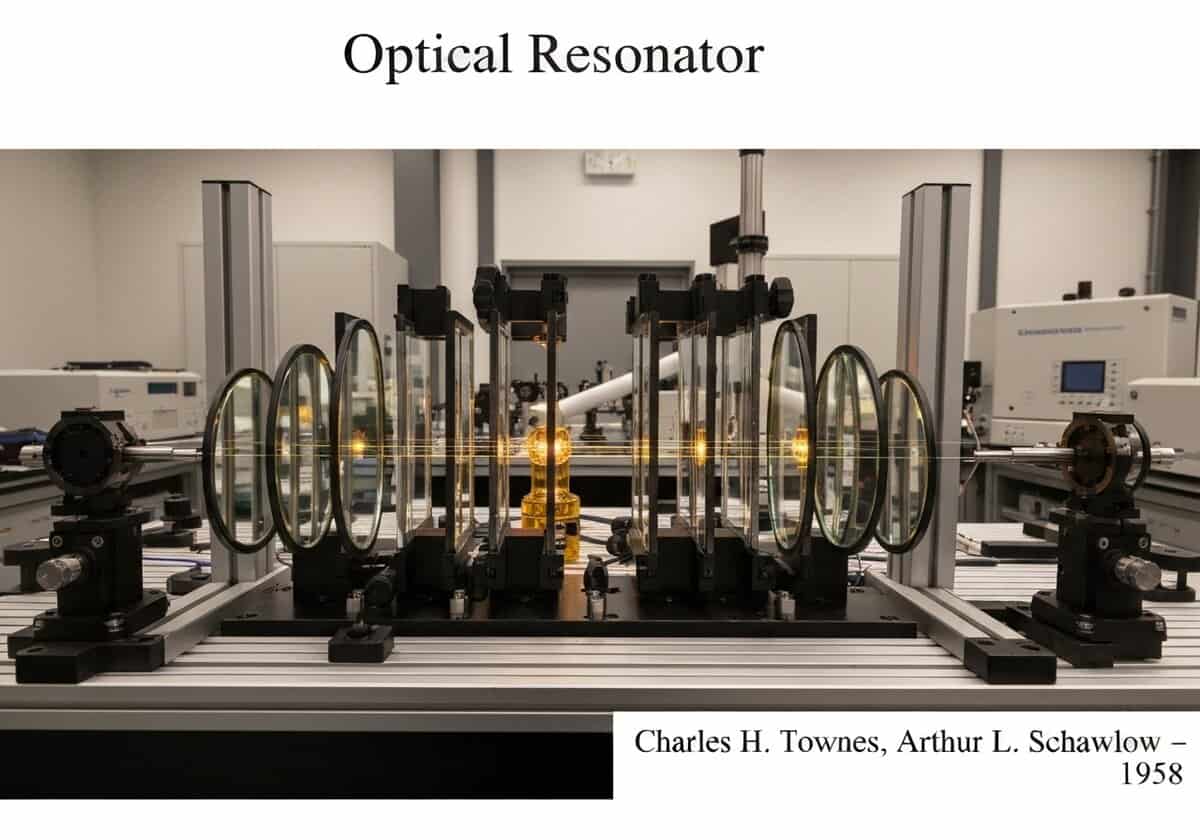
An optical resonator, or optical cavity, is an arrangement of mirrors that forms a standing wave cavity for light waves. In a laser, it surrounds the gain medium, providing positive feedback. Light from stimulated emission reflects back and forth, passing through the gain medium multiple times, leading to significant amplification and the formation of a coherent output beam.
The optical resonator is a critical component of most lasers, responsible for building up the light intensity and defining the properties of the output beam. The simplest and most common type is the Fabry-Pérot resonator, consisting of two parallel mirrors placed on either side of the gain medium. One mirror is a high reflector (nearly 100% reflectivity), while the other, the output coupler, is partially reflective (e.g., 99% reflectivity), allowing a portion of the light to escape as the laser beam.
As photons are generated by stimulated emission, they travel within the cavity. Those traveling along the axis between the mirrors are reflected back into the gain medium, stimulating further emission and amplifying the light. Photons not aligned with the axis are lost from the cavity. This process not only amplifies the light but also acts as a filter. Only light waves of specific frequencies, those that form a standing wave within the cavity (i.e., where the cavity length is an integer multiple of half the wavelength), are sustained. This resonant condition is what determines the longitudinal modes of the laser. The geometry of the mirrors (e.g., flat, concave) determines the stability of the resonator and the spatial profile (transverse modes) of the output beam, such as the fundamental Gaussian mode (TEM00).
UNESCO Nomenclature: 2210
- Óptica
Precursores
- fabry-pérot interferometer
- microwave cavity resonators used in masers
- principles of optical reflection and interference
Aplicaciones
- laser construction
- optical parametric oscillators
- optical interferometers (e.g., Fabry-Pérot)
- gravitational wave detectors like ligo
- high-precision optical frequency standards
Ideas para posibles innovaciones
Debido al bloqueo del tráfico generado por bots, que actualmente supera los 40.000 al día, este contenido está reservado para los miembros de la comunidad.
> Iniciar sesión < o > Registrarse < (100% gratis) para acceder a esto, al igual que a todo el demás contenido y herramientas restringidos.
Relacionado con: resonador óptico, cavidad óptica, láser, Fabry-Pérot, espejos, retroalimentación, amplificación, onda estacionaria, modos láser, calidad del haz.