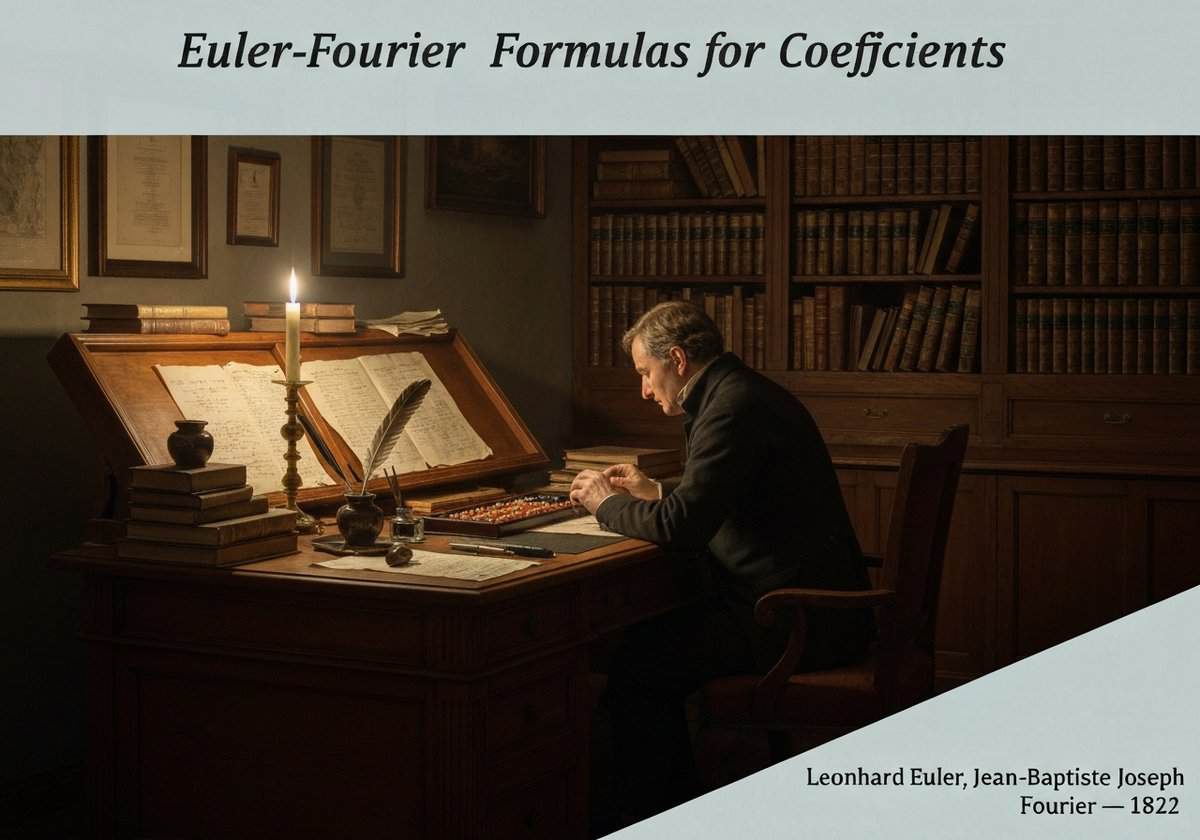
Fórmulas de Euler-Fourier para coeficientes
1822
- Leonhard Euler
- Jean-Baptiste Joseph Fourier
The coefficients for the Fourier series of a function [latex]s(x)[/latex] with period [latex]P[/latex] are calculated using integral formulas. The DC component is [latex]a_0 = \frac{2}{P} \int_{P} s(x) , dx[/latex]. The cosine coefficients are [latex]a_n = \frac{2}{P} int_{P} s(x) \cos\left(\frac{2pi n x}{P}\right) , dx[/latex], and the sine coefficients are [latex]b_n = \frac{2}{P} \int_{P} s(x) \sin\left(\frac{2\pi n x}{P}\right) , dx[/latex] for [latex]n ge 1[/latex].
These formulas, often called the Euler-Fourier formulas, are the mechanism for determining the contribution of each harmonic to the overall periodic function. They are derived by exploiting the orthogonality property of the trigonometric functions. Specifically, the integral of the product of two different sine or cosine functions (or a sine and a cosine) over a full period is zero. For example, [latex]int_{0}^{P} sin(frac{2pi n x}{P}) cos(frac{2pi m x}{P}) , dx = 0[/latex] for all integers [latex]n, m[/latex].
To find a specific coefficient, say [latex]a_k[/latex], one multiplies the entire Fourier series expansion of [latex]s(x)[/latex] by [latex]cos(frac{2pi k x}{P})[/latex] and then integrates over the period [latex]P[/latex]. Due to orthogonality, all terms in the infinite sum become zero except for the term involving [latex]a_k[/latex]. This isolates [latex]a_k[/latex], allowing it to be solved for. The same process is applied with [latex]sin(frac{2pi k x}{P})[/latex] to find [latex]b_k[/latex]. This analytical method provides the exact amplitudes needed to reconstruct the original function from its sinusoidal components, effectively transforming the function from the time domain to the frequency domain.
UNESCO Nomenclature: 1201
- Álgebra
Precursores
- Leonhard Euler’s work on trigonometric series
- principios de ortogonalidad de funciones
- cálculo integral desarrollado por Newton y Leibniz
- Daniel Bernoulli’s solution to the wave equation
Aplicaciones
- procesamiento de señales digitales (DSP)
- compresión de imagen (jpeg)
- síntesis de audio
- resolver ecuaciones diferenciales
- análisis espectral
Ideas para posibles innovaciones
Debido al bloqueo del tráfico generado por bots, que actualmente supera los 40.000 al día, este contenido está reservado para los miembros de la comunidad.
> Iniciar sesión < o > Registrarse < (100% gratis) para acceder a esto, al igual que a todo el demás contenido y herramientas restringidos.
Related to: Fourier coefficients, Euler-Fourier formulas, orthogonality, integral, harmonic analysis, spectral components, DC component, sine, cosine, frequency domain.