Product Design, Manufacturing & Innovation Resources
Hogar » Golpeteo del motor

Golpeteo del motor

1920
  • Harry Ricardo
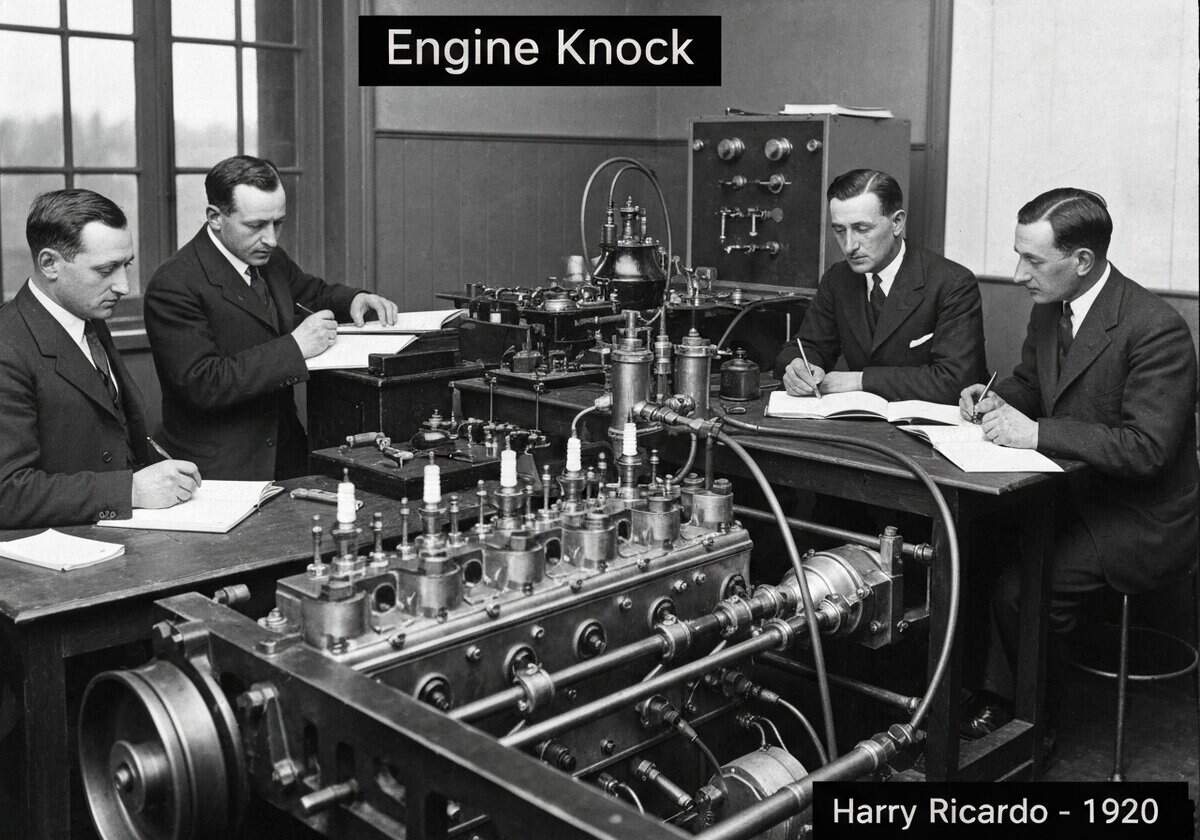
Análisis del motor de ciclo Otto en un laboratorio de automoción de los años 20, centrado en la eficiencia de la combustión.

(Imagen generada únicamente con fines ilustrativos)

Engine knock, or detonation, is a major constraint on the thermal efficiency of an Otto cycle engine. While higher compression ratios increase efficiency, they also raise the temperature and presión of the air-fuel mixture during compression. This can cause the mixture to auto-ignite prematurely, creating a shockwave that produces a ‘knocking’ sound and can damage the engine.

Engine knock occurs when a portion of the unburned air-fuel mixture (the end gas) ahead of the propagating flame front from the spark plug spontaneously ignites. This auto-ignition is caused by the end gas being compressed and heated beyond its auto-ignition temperature by both the piston’s compression stroke and the advancing flame front. The resulting combustion is extremely rapid and uncontrolled, creating a pressure wave that travels through the cylinder at supersonic speeds. This shockwave collides with the cylinder walls and piston crown, causing the characteristic metallic pinging or knocking sound.

The consequences of severe or prolonged engine knock are significant. The intense pressure spikes can lead to mechanical failure, including cracked pistons, broken piston rings, and damaged cylinder heads. The extreme temperatures can also cause pitting and erosion of metal surfaces. To prevent knock, several strategies are employed. The most fundamental is limiting the engine’s compression ratio to a level suitable for the available fuel. Fuel quality, measured by its octane rating, indicates its resistance to auto-ignition. Higher octane fuels allow for higher compression ratios. Modern engines use sophisticated electronic control systems with knock sensors (essentially microphones tuned to the frequency of knock) that detect the onset of detonation and instruct the engine control unit (ECU) to retard ignition timing, which reduces cylinder pressure and stops the knock.

UNESCO Nomenclature: 3305
- Ingeniería química

Tipo

Fenómeno físico

Ruptura

Incremental

Uso

Uso generalizado

Precursores

  • desarrollo de motores de ciclo Otto de alta compresión
  • observación de modos de falla del motor
  • Conocimientos básicos de cinética química y temperaturas de autoignición
  • Instrumentación capaz de medir la presión dentro del cilindro

Aplicaciones

  • desarrollo de combustibles de alto octanaje
  • uso de agentes antidetonantes como el tetraetilo de plomo (anteriormente) y el etanol (actualmente)
  • Unidades de control del motor (ECU) con sensores de detonación
  • Diseño de la forma de la cámara de combustión para evitar puntos calientes
  • sobrealimentación con turbocompresor y supercargador con intercooler

Patentes:

NA

Ideas para posibles innovaciones

Debido al bloqueo del tráfico generado por bots, que actualmente supera los 40.000 al día, este contenido está reservado para los miembros de la comunidad.
> Iniciar sesión < o > Registrarse < (100% gratis) para acceder a esto, al igual que a todo el demás contenido y herramientas restringidos.

Related to: engine knock, detonation, compression ratio, octane rating, auto-ignition, spark-ignition engine, pre-ignition, harry ricardo, anti-knock agent, engine damage.

Contexto histórico

Golpeteo del motor

1910
1920
1920
1920
1922
1924
1927
1910
1910
1920
1920
1920
1922
1925-01-01
1930

(Si la fecha es desconocida o no es relevante, por ejemplo "mecánica de fluidos", se proporciona una estimación redondeada de su aparición notable)

Invención, innovación y principios técnicos relacionados.

Las imágenes a tamaño completo y las descargas sólo están disponibles, 100% gratis, para los miembros registrados.

> Acceso <