Product Design, Manufacturing & Innovation Resources
Hogar » El enlace carbono-flúor: la fuente de la estabilidad de los PFAS

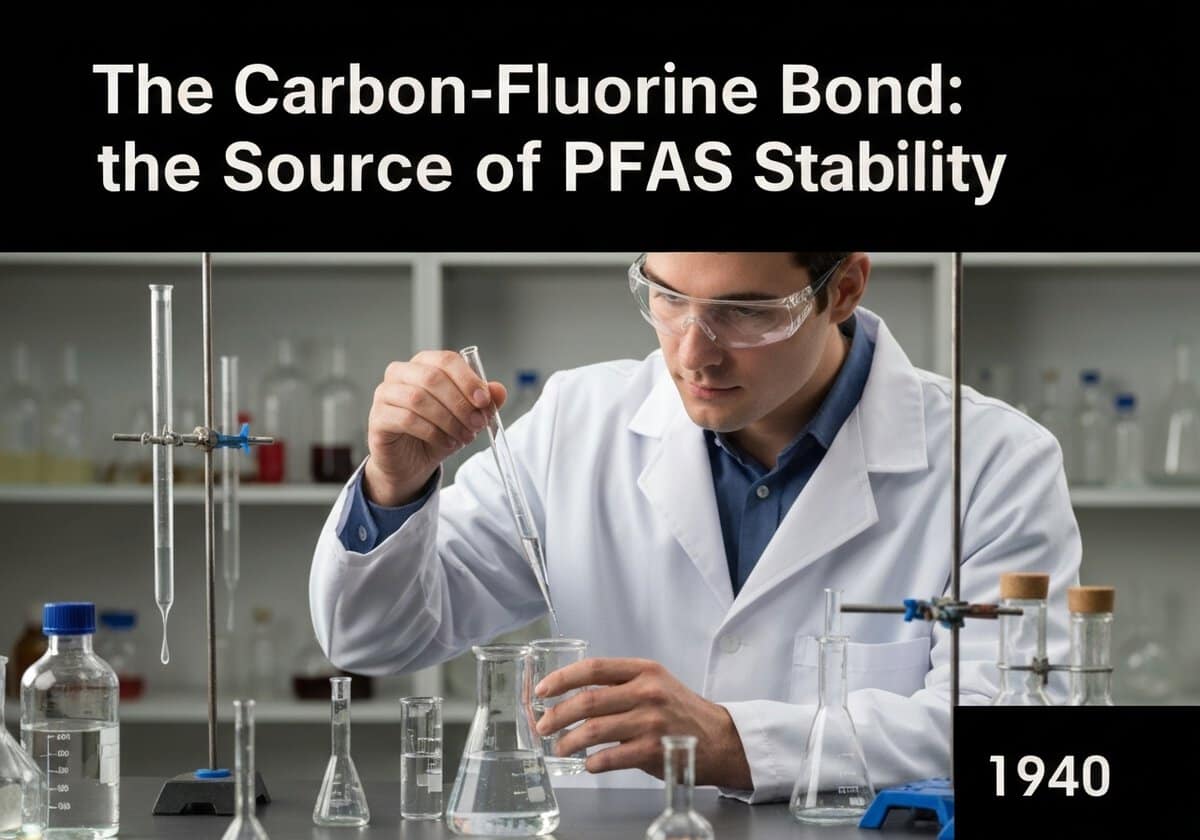
El enlace carbono-flúor: la fuente de la estabilidad de los PFAS

1940
Químico realizando un experimento sobre PFAS en el laboratorio de química orgánica.

(Imagen generada únicamente con fines ilustrativos)

Per- and polyfluoroalkyl substances (PFAS) are characterized by a chain of carbon atoms bonded to fluorine atoms. The carbon-fluorine (C-F) bond is one of the strongest single bonds in organic chemistry, with a bond dissociation energy around 485 kJ/mol. This extreme strength makes PFAS highly resistant to chemical, thermal, and biological degradation, leading to their environmental persistence.

The exceptional stability of per- and polyfluoroalkyl substances (PFAS) is fundamentally rooted in the properties of the carbon-fluorine (C-F) bond. Fluorine is the most electronegative element, creating a highly polarized bond with carbon. This results in a short bond length (around 1.35 Å) and a very high bond dissociation energy, making it extremely difficult to break. In perfluoroalkyl substances, where all non-terminal carbons are fully saturated with fluorine atoms, this effect is amplified. The fluorine atoms create a helical sheath around the carbon backbone, sterically protecting it from chemical attack. This ‘fluorine shield’ also repels both water (hydrophobicity) and oils (oleophobicity), a rare combination that makes PFAS effective surfactants. The cumulative inductive effect of multiple fluorine atoms also strengthens adjacent C-C bonds within the chain, further contributing to the molecule’s overall inertness. This chemical robustness is why PFAS are dubbed “forever chemicals”; they do not readily break down under natural environmental conditions, leading to their widespread accumulation.

UNESCO Nomenclature: 2506
- Química orgánica

Tipo

Propiedad química

Ruptura

Fundacional

Uso

Uso generalizado

Precursores

  • Descubrimiento del flúor por Henri Moissan en 1886
  • development of quantum mechanics to explain chemical bonding (e.g., linus pauling’s work on electronegativity)
  • Síntesis temprana de compuestos organofluorados simples a finales del siglo XIX y principios del XX

Aplicaciones

  • recubrimientos antiadherentes (teflón)
  • tejidos resistentes a las manchas (scotchgard)
  • espumas contra incendios (AFFF)
  • ropa repelente al agua
  • envases de alimentos

Patentes:

NA

Ideas para posibles innovaciones

Debido al bloqueo del tráfico generado por bots, que actualmente supera los 40.000 al día, este contenido está reservado para los miembros de la comunidad.
> Iniciar sesión < o > Registrarse < (100% gratis) para acceder a esto, al igual que a todo el demás contenido y herramientas restringidos.

Related to: carbon-fluorine bond, pfas, perfluoroalkyl, stability, bond energy, organic chemistry, forever chemicals, electronegativity, persistence, organofluorine.

Contexto histórico

El enlace carbono-flúor: la fuente de la estabilidad de los PFAS

1838
1872
1910
1940
1940
1946
1950
1800
1852
1900
1912
1940
1940
1950
1950

(Si la fecha es desconocida o no es relevante, por ejemplo "mecánica de fluidos", se proporciona una estimación redondeada de su aparición notable)

Invención, innovación y principios técnicos relacionados.

Las imágenes a tamaño completo y las descargas sólo están disponibles, 100% gratis, para los miembros registrados.

> Acceso <