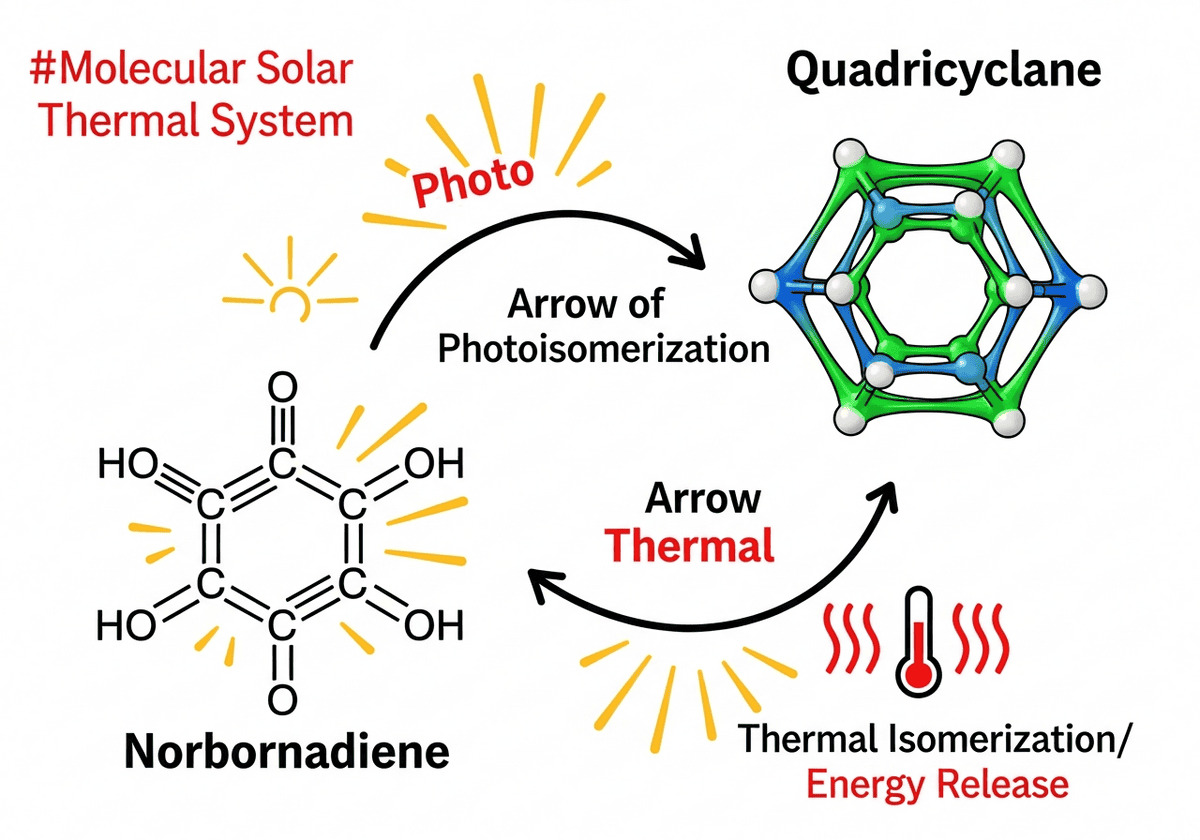

تخزن أنظمة الطاقة الشمسية الحرارية الجزيئية (MOST) الطاقة الشمسية مباشرةً داخل الروابط الكيميائية للجزيئات القابلة للتحويل الضوئي، وأبرزها زوج نوربورنادين-كوادريسيكلان، من خلال عملية تحويل ضوئي عكسية. تدفع الفوتونات الساقطة الجزيء من حالة أرضية مستقرة إلى حالة متوترة. طاقة عالية المتماثل التكافؤي، الذي يحتفظ بالطاقة المخزنة - ربما لأشهر - حتى يبدأ عامل محفز التفاعل العكسي، مما يؤدي إلى إطلاق الحرارة عند الطلب.
يعتمد أداء النظام على مردود الكم، ومعامل الامتصاص المولي المطابق للطيف الشمسي، وكثافة الطاقة لكل جزيء، وحاجز طاقة التنشيط لعملية التماثل العكسي، ومقاومة الإجهاد على المدى الطويل عبر دورات متكررة. وتُحدد الوظائف الجزيئية من خلال ضبط البدائل والروابط المترافقة، والمفاعلات الضوئية ذات التدفق المستمر، والتصميم الموجه بنظرية الكثافة الوظيفية، آفاق البحث الحالية.
تجمع هذه الصفحة أحدث المنشورات التي خضعت لمراجعة الأقران وبراءات الاختراع الممنوحة في مجالات المواد والحفز وتكامل الأنظمة:
هذه أحدث مجموعة مختارة لدينا من المنشورات وبراءات الاختراع العالمية باللغة الإنجليزية حول نظام الطاقة الشمسية الحرارية الجزيئية (MOST)، من بين العديد من المجلات العلمية على الإنترنت، مصنفة ومركزة على نوربورنادين-كوادريسيكلان، والتماثل الضوئي، والتماثل العكسي، وجزيء تخزين الطاقة، والوقود الشمسي، وتخزين الطاقة الكيميائية الضوئية، ومتماثل التكافؤ، ونظام الحلقة المتوترة، وحاجز طاقة التنشيط، والتفاعل العكسي التحفيزي، والمحفز المتجانس، والمحفز غير المتجانس، والعائد الكمي، ومطابقة الامتصاص، ومعامل الانقراض المولي، وكثافة الطاقة لكل جزيء، وتفاعل الإضافة الحلقية، والإطلاق التحفيزي الضوئي، والتفاعل العكسي الحراري، ووظائف الجزيء، وضبط البدائل، والرابط المترافق، وتخزين الجزيئات بالأغشية الرقيقة، ونظام تخزين الطور السائل، والمفاعل الضوئي ذو التدفق المستمر، ومطابقة الطيف الشمسي، والتحسيس الثلاثي، والنمذجة الجزيئية باستخدام نظرية الكثافة الوظيفية، ودورة مقاومة الإجهاد، وتخزين الطاقة في الدائرة المفتوحة، ونظام الطاقة الشمسية الحرارية الجزيئية.
Method for making methylene dianiline and polymethylene polyanilines using sapo-18 molecular sieve
Patent published on the 2026-06-18 in WO under Ref WO2026128799 by DOW GLOBAL TECH LLC [US] (Steelman David Keith [us], Barton David G [us], Wang Hongyi [us], Chojecki Adam [nl])
Abstract: Mixtures of methylene dianiline isomers and polymethylene polyanilines are made with controllable methylene dianiline isomer ratios. Aniline and formaldehyde are reacted to produce N,N -diphenylmethylene diamine (aminal), which is then partially rearranged to a mixture of aminobenzyl aniline isomers and methylene dianiline isomers in the presence of a SAPO-18 molecular sieve. Further rearrangement may be performed in the presence of a homogeneous catalyst to convert the remaining aminobenzyl ani[...]
Our summary: The method involves producing methylene dianiline and polymethylene polyanilines using a SAPO-18 molecular sieve. Methylene dianiline isomer ratios can be controlled through the reaction of aniline and formaldehyde. Further rearrangement with a homogeneous catalyst converts remaining isomers to the desired products.
methylene dianiline, polymethylene polyanilines, SAPO-18, molecular sieve
Patent
Carbon hydrogenation to ethanol versatile unit (chevu)
Patent published on the 2026-05-14 in AU under Ref AU2024227673 by BURKE JOHN (Burke John)
Abstract: The invention is a Domestic low power Carbon Hydrogenation to Ethanol versatile unit (CHEVU) and Heterogeneous Catalyst Testing unit can be used in conjunction with a point-source co2 capture system The invention is a Domestic low power Carbon Hydrogenation to Ethanol versatile unit (CHEVU) and Heterogeneous Catalyst Testing unit can be used in conjunction with a point-source co2 capture system ct c t[...]
Our summary: The CHEVU is a domestic low power unit for carbon hydrogenation to ethanol. It operates alongside a heterogeneous catalyst testing unit. This system can integrate with point-source CO2 capture technologies.
Carbon Hydrogenation, Ethanol Production, Heterogeneous Catalysis, CO2 Capture
Patent
A process for salt separation
Patent published on the 2026-04-09 in WO under Ref WO2026073900 by BASF SE [DE] (Pfeiffer Daniel [de], Delgado Nirvana [de], Schwarz Jonas Luca [de], Lejkowski Michael Ludwig [de])
Abstract: The present invention relates to a process for salt separation, and in particular to an alcohol conversion process employing a homogeneous catalyst and a base, wherein the separation of salts as a byproduct of said alcohol conversion process is carried out by crystallization.[...]
Our summary: This invention describes a process for separating salts during alcohol conversion. It utilizes a homogeneous catalyst and a base. The byproduct salts are separated through crystallization.
salt separation, alcohol conversion, homogeneous catalyst, crystallization
Patent
Synthesis, Properties and Application of Novel 2-Substituted Benzothiazole-Based Oxime Esters
Published on 2026-01-30 by Monika Dzwonkowska-Zarzycka, Alicja Balcerak-Wo?niak, Janina Kabatc-Borcz @MDPI
Abstract: The paper focuses on the synthesis and characterization of the spectroscopic and electrochemical properties of novel oxime esters. Six benzothiazole-based compounds were synthesized using a simple three-step procedure. The chemical structure of novel oxime esters was confirmed by Nuclear Magnetic Resonance spectroscopy (1H and 13C NMR), as well as FT-IR spectroscopy and elemental analysis. The melting point of these compounds was also determined. The spectroscopic properties were studied in 10 s[...]
Our summary: The paper presents the synthesis and characterization of novel benzothiazole-based oxime esters. Spectroscopic and electrochemical properties were analyzed, confirming their potential as Type I photoinitiators. Preliminary studies indicate their effectiveness in initiating light-induced polymerization.
Benzothiazole, Oxime Esters, Spectroscopy, Photoinitiators
Publication
Next-Generation Carbon-Based Quantum Dots for Healthcare and Beauty Applications
Published on 2026-01-29 by Muhammad Noor Nordin, Nur Farhana Shahrul Azhar, Nurhakimah Norhashim, Ili Farhana Mohamad Ali Nasri, Noor Hafidzah Jabarullah @MDPI
Abstract: Carbon quantum dots (CQDs) have attracted intense research interest due to their unique physicochemical properties and broad application potential. CQDs are a new class of ultrasmall fluorescent carbon nanoparticles (<10 nm) that exhibit bright photoluminescence, broad excitation spectra, high quantum yields (QYs), and excellent photostability. Structurally, they consist of graphitic sp2/sp3-hybridized carbon with amorphous or nanocrystalline cores. Unlike conventional semiconductor q[...]
Our summary: Carbon quantum dots (CQDs) are ultrasmall fluorescent nanoparticles with unique physicochemical properties. They offer a safer alternative to traditional semiconductor quantum dots for biomedical and cosmetic uses. This review highlights recent advancements in CQD synthesis and their potential applications in wound healing and beauty formulations.
Carbon Quantum Dots, Healthcare Applications, Photoluminescence, Green Chemistry
Publication
The Integration of a Metal Active Site and Photosensitive Unit
Published on 2026-01-19 by Haoyue Sun, Yu Yang, Yanchang Liu, Dongxue Yang, Yichang Liu, Zaicheng Sun @MDPI
Abstract: Metallaphotoredox catalysis merges the powerful bond-forming abilities of transition metal catalysis with unique electron or energy transfer pathways accessible in photoexcited states, injecting new vitality into organic synthesis. However, most transition metal catalysts cannot be excited by visible light. Thus, prevalent metallaphotoredox catalytic systems require dual catalysts: a transition metal catalyst and a separate photosensitizer. This leads to inefficient electron transfer between the[...]
Our summary: This content discusses the integration of metal active sites and photosensitive units in metallaphotoredox catalysis. It highlights the inefficiencies of dual catalyst systems and proposes single-atom site catalysts as a solution. The review emphasizes the benefits of this integration for enhancing photocatalytic efficiency and ease of catalyst reuse.
metallaphotoredox, single-atom catalysts, photocatalysis, electron transfer
Publication
Optimization of Biodiesel Production from Waste Cooking Oil Using a Construction Industry Waste Cement as a Heterogeneous and Reusable Catalyst
Published on 2026-01-14 by Jing Sun, Hongwei Chen, Hongjian Shen, Xiang Luo, Zezhou Lin, Honglei Zhang @MDPI
Abstract: Biodiesel, which is a blend of fatty acid methyl esters (FAME), has garnered significant attention as a promising alternative to petroleum-based diesel fuel. Nevertheless, the commercial production of biodiesel faces challenges due to the high costs associated with feedstock and the non-recyclable homogeneous catalyst system. To address these issues, a solid catalyst derived from construction industry waste cement was synthesized and utilized for biodiesel production from waste cooking oil (WCO)[...]
Our summary: This study explores the use of construction industry waste cement as a heterogeneous catalyst for biodiesel production from waste cooking oil. A maximum yield of 98.1% biodiesel was achieved under optimized conditions, demonstrating the catalyst s effectiveness and reusability. The research highlights a sustainable approach to biodiesel production, enhancing economic viability and environmental benefits.
Biodiesel, Waste Cooking Oil, Heterogeneous Catalyst, Transesterification
Publication
A Green Nanostructure for Marine Biosensing Applications
Published on 2025-08-01 by Ahmed Dawood, Mohsen Ghali, Laura Micheli, Medhat H. Hashem, Clara Piccirillo @MDPI
Abstract: Aquatic biomass—ranging from fish scales and crustacean shells to various algae species—offers an abundant, renewable source for carbon dot (CD) synthesis, aligning with circular economy principles. This review highlights recent studies for valorizing aquatic biomass into high-performance carbon-based nanomaterials—specifically aquatic biomass-based carbon dots (AB-CDs)—briefly summarizing green synthesis approaches (e.g., hydrothermal carb[...]
Our summary: This review discusses the synthesis of carbon dots from aquatic biomass for marine biosensing applications. It highlights green synthesis methods that reduce environmental impact and the unique properties of these carbon dots. The potential applications include detecting marine biotoxins, environmental monitoring, and drug delivery systems.
carbon dots, aquatic biomass, biosensing, green synthesis
Publication