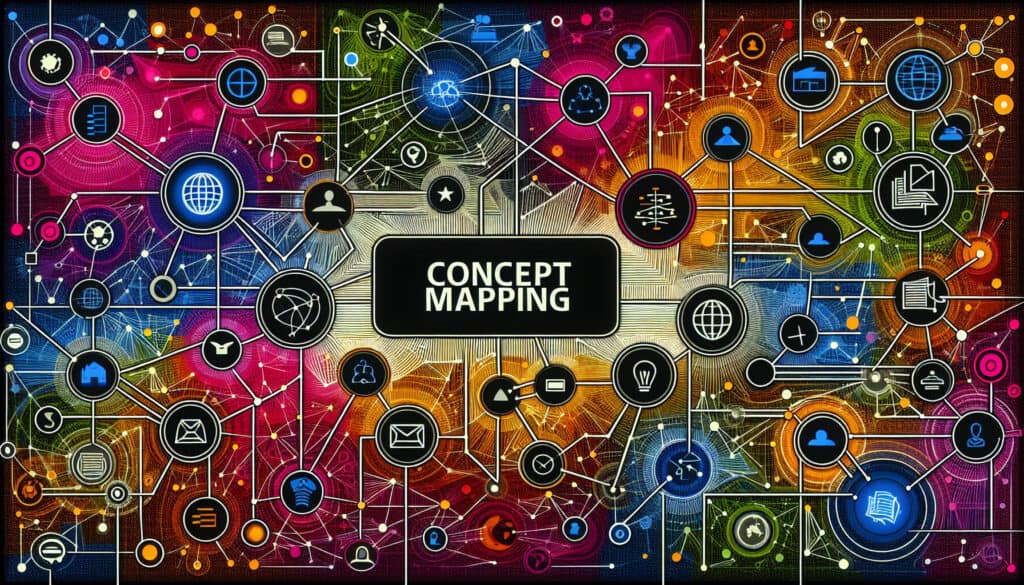
It involves creating a visual map where nodes represent concepts and links represent the relationships between them. It is used for brainstorming, knowledge organization, and problem-solving.
优点
有助于理解复杂的关系并组织思路,促进创造性思维和问题解决能力,并可作为有效的沟通和学习工具。
缺点
如果概念太多,就会变得杂乱无章,难以阅读;这个过程可能很耗时;而且表达方式可能带有主观性。
类别
构思, 问题解决, 产品设计
最适合:
以视觉方式组织和呈现概念及其关系,以促进理解和产生想法。
Concept Mapping proves valuable across various stages of product development and design, enabling teams to explore interconnected ideas and refine their focus. For instance, during the ideation phase, cross-functional teams can visually represent their thoughts around a new product or solution, enhancing collaborative efforts and preventing information silos. In sectors like healthcare, education, and software development, concept mapping facilitates the identification of user needs, system requirements, and design specifications. Participating in this process typically involves designers, engineers, product managers, and stakeholders who contribute diverse perspectives, enriching the map’s effectiveness. The methodology proves beneficial in workshops and brainstorming sessions, where participants can dynamically adapt the map as new ideas arise, ensuring that no significant concepts are overlooked. By using color coding and various shapes, teams can prioritize elements and elucidate relationships between aspects, making discussions more productive and focused. This visual representation serves not just as a tool for problem-solving but also as a foundation for creating documentation, training materials, and roadmaps, ensuring that all participants maintain a unified vision throughout the project’s lifecycle.