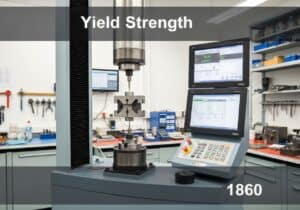
The fundamental idea behind a proof test, also known as proof loading, is to apply a controlled stress that simulates a worst-case or overload scenario in a safe environment. This stress, the ‘proof load’, is carefully calculated to be a specific percentage above the maximum expected working load. For instance, a crane hook rated for 10 tons might be proof tested to 12.5 or 15 tons. The key is that this proof load must remain below the material’s nominal yield strength. If the component withstands this load without any permanent deformation (plastic deformation), it passes the test. This provides a high degree of confidence that the component is free from significant hidden flaws, such as cracks, voids, improper heat treatment, or incorrect material composition, which could lead to failure under normal operating conditions. It is a practical method to verify both the design and the manufacturing process for every single unit, rather than relying solely on statistical sampling or theoretical calculations.
Historically, the need for such tests became apparent during the Industrial Revolution with the widespread use of steam boilers and iron bridges. Catastrophic failures, often resulting in significant loss of life, highlighted the unreliability of materials and manufacturing techniques of the era. Proof testing was instituted as a mandatory safety measure to ensure that each critical component could handle its intended loads. While modern non-destructive testing (NDT) methods like ultrasonic or X-ray inspection can detect flaws, the proof test remains a definitive ‘go/no-go’ assessment of a component’s actual strength and integrity under load, integrating the effects of all variables in the final product.