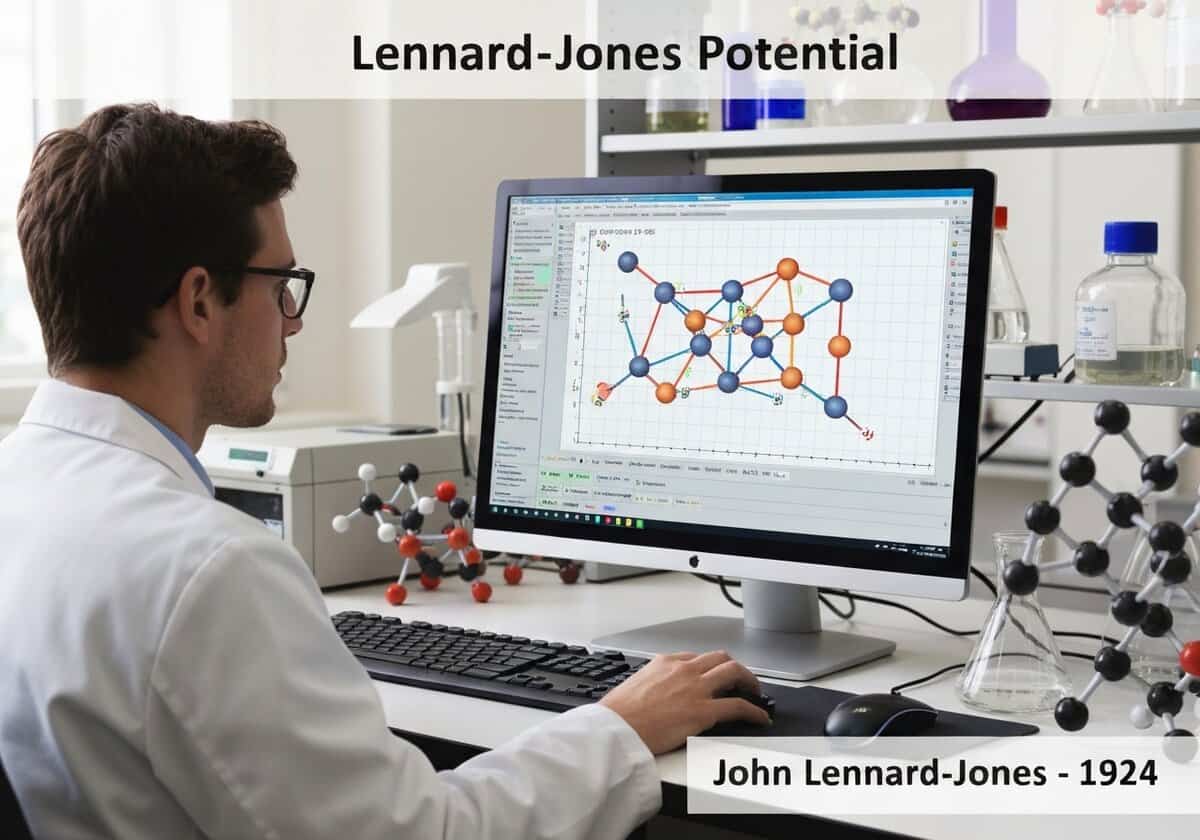
一种简单而广泛使用的数学模型,用于近似计算两个中性原子或分子之间相互作用的势能。它结合了一个长程吸引力项([latex]\propto r^{-6}[/latex]),代表了 范德瓦耳斯 力与一个陡峭的短程斥力项([latex]\propto r^{-12}[/latex])代表保利斥力。计算公式为 [latex]V_{LJ}(r) = 4epsilon [(\frac\{sigma}{r})^{12} - (\frac\{sigma}{r})^6][/latex].


(图片仅供参考)
一种简单而广泛使用的数学模型,用于近似计算两个中性原子或分子之间相互作用的势能。它结合了一个长程吸引力项([latex]\propto r^{-6}[/latex]),代表了 范德瓦耳斯 力与一个陡峭的短程斥力项([latex]\propto r^{-12}[/latex])代表保利斥力。计算公式为 [latex]V_{LJ}(r) = 4epsilon [(\frac\{sigma}{r})^{12} - (\frac\{sigma}{r})^6][/latex].

The Lennard-Jones potential is a cornerstone of computational physics and chemistry due to its simplicity and effectiveness in capturing the essential physics of atomic interactions. The potential describes two main features. The attractive part, [latex]-(\frac{\sigma}{r})^6[/latex], models the London dispersion force, which dominates at medium to long ranges. The [latex]r^{-6}[/latex] dependence is theoretically justified for the interaction between two induced dipoles. The repulsive part, [latex]+(\frac{\sigma}{r})^{12}[/latex], models the strong repulsion that occurs when two atoms get very close and their electron clouds begin to overlap. This repulsion is a consequence of the Pauli exclusion principle. The [latex]r^{-12}[/latex] form was chosen primarily for computational convenience (as the square of the [latex]r^{-6}[/latex] term), though it provides a reasonable approximation of the steep repulsive wall.
模型中的两个参数具有明确的物理含义:[latex]\epsilon[/latex] (epsilon) 是势阱的深度,代表吸引力的强度;[latex]\sigma[/latex] (sigma) 是势能为零的距离,代表原子的有效直径。尽管伦纳德-琼斯势能是一种近似值,但它在预测简单的非极性物质的性质方面却非常成功,是用于模拟蛋白质、聚合物和其他材料的更复杂力场的基本构件。.
伦纳德-琼斯潜力
(如果日期未知或不相关,例如“流体力学”,则提供其显著出现的近似估计)
只有注册会员才能免费获得 100% 的全尺寸图片和下载。.
> 登录 <