Product Design, Manufacturing & Innovation Resources
Lar » Síntese cutânea de vitamina D

Síntese cutânea de vitamina D

1930
  • Adolf Windaus
  • Kurt Huldschinsky
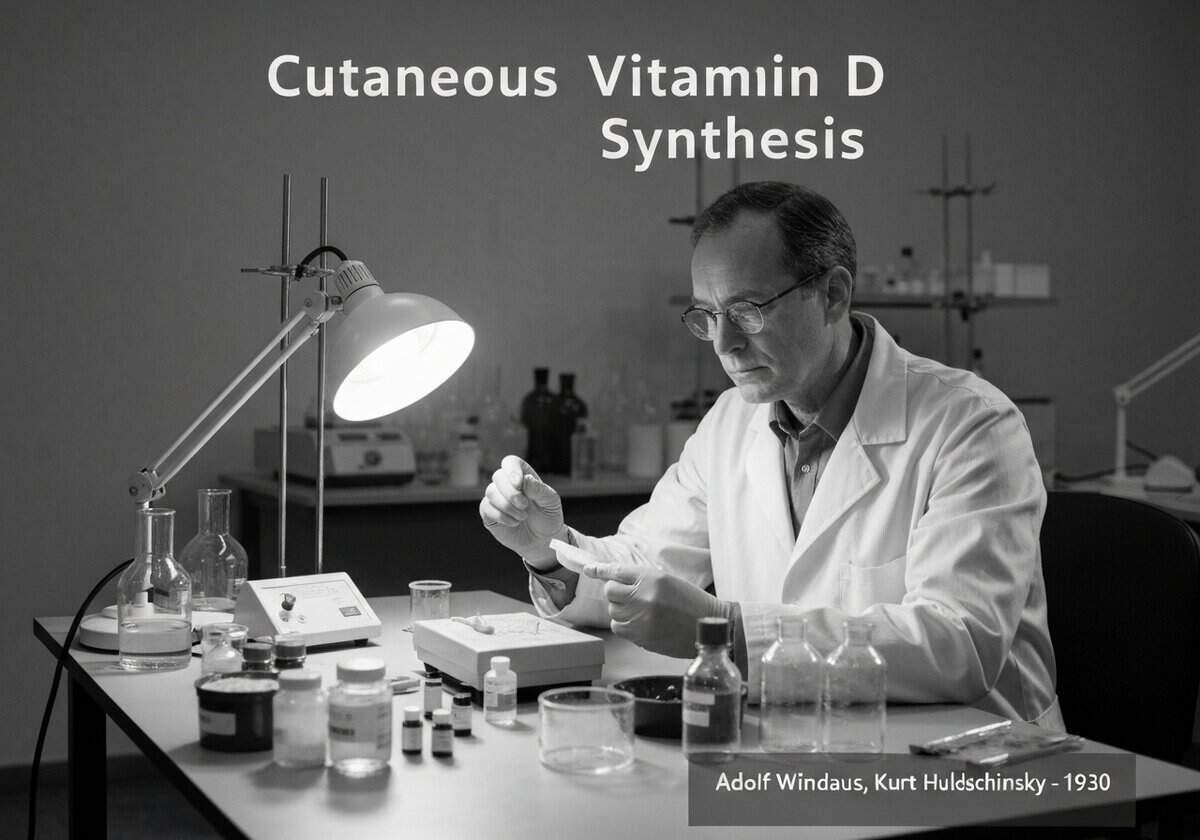
Cena de laboratório retratando a pesquisa de síntese de vitamina D cutânea em bioquímica.

(Imagem gerada apenas para fins ilustrativos)

Sunlight, specifically ultravioleta B (UVB) radiation with wavelengths between 290-315 nm, triggers the synthesis of vitamin D in the skin. When UVB photons strike the skin, they cause the photochemical conversion of 7-dehydrocholesterol into previtamin D3, which is then isomerized into vitamin D3 (cholecalciferol). This process is the primary natural source of vitamin D for humans.
The synthesis of vitamin D is a multi-step process essential for human health. It begins in the epidermis when UVB radiation breaks a chemical bond in 7-dehydrocholesterol, a derivative of cholesterol. The resulting compound, previtamin D3, is thermally unstable and rapidly rearranges itself into vitamin D3 (cholecalciferol). This vitamin D3 is then transported via the bloodstream to the liver, where it undergoes hydroxylation to become calcifediol (25-hydroxyvitamin D). Calcifediol is the main circulating form of vitamin D and is what is typically measured in blood tests. For its final activation, calcifediol travels to the kidneys (and other tissues), where it is converted into calcitriol (1,25-dihydroxyvitamin D), the biologically active form of the vitamin. Calcitriol functions as a hormone, primarily regulating calcium and phosphate levels in the blood, which is critical for bone mineralization. Several factors influence the efficiency of this process, including latitude, season, time of day, skin pigmentation (melanin acts as a natural sunblock), and the use of sunscreen, all of which can modulate the amount of UVB radiation reaching the skin’s precursor molecules.

UNESCO Nomenclature: 2401
Bioquímica

Tipo

Processo Bioquímico

Interrupção

Substancial

Uso

Uso generalizado

Precursores

  • discovery of rickets as a disease
  • identification of ‘fat-soluble factor a’ (later split into vitamins a and d) by elmer mccollum
  • theodor scherfig’s observation of sunlight’s benefits for children’s health
  • advances in organic chemistry allowing for the isolation and structural analysis of sterols

Aplicações

  • treatment of rickets and osteomalacia
  • public health recommendations for sun exposure
  • fortification of foods like milk and cereal with vitamin d
  • development of vitamin d supplements
  • uvb phototherapy for skin conditions like psoriasis
  • understanding of calcium metabolism and bone health

Patentes:

NA

Ideias de Inovação Potencial

Devido ao tráfego de bots de coleta de dados, atualmente superior a 40 mil por dia, este conteúdo é reservado aos membros da comunidade.
> Login < ou > Registrar < (100% gratuito) para acessar isso, assim como todo o restante do conteúdo e das ferramentas restritas.

Related to: vitamin D, UVb radiation, sunlight, skin, 7-dehydrocholesterol, cholecalciferol, rickets, bone health, calcium metabolism, photochemistry.

Contexto histórico

Síntese cutânea de vitamina D

1900
1910
1921
1930
1930
1940
1950
1880
1902
1920
1928
1930
1940
1950
1950

(Caso a data seja desconhecida ou irrelevante, por exemplo, "mecânica dos fluidos", é fornecida uma estimativa aproximada de seu surgimento notável)

Princípios relacionados à invenção, inovação e tecnologia

Imagens em tamanho real e downloads estão disponíveis apenas, 100% gratuitos, para membros registrados.